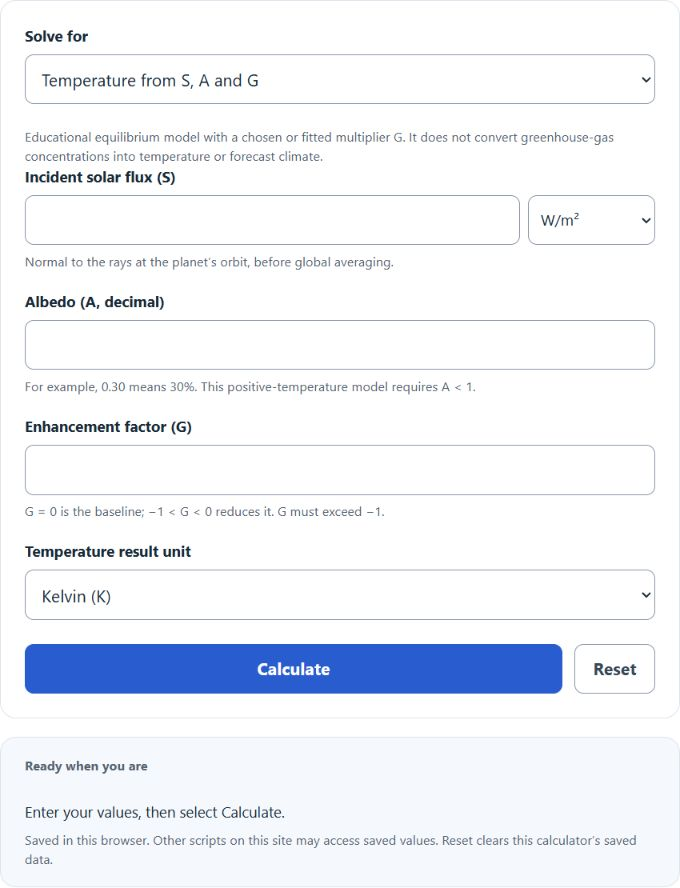
Calculate greenhouse effect variables by finding surface temperature, solar radiation, albedo, or enhancement factor from any three inputs.
Greenhouse Effect Formula (Simplified Model)
This calculator estimates a planet’s equilibrium surface temperature from three key inputs: incoming solar radiation, planetary albedo, and a simplified greenhouse enhancement factor. It is useful for fast comparisons, sensitivity checks, and educational energy-balance calculations.
In this model:
- T = surface temperature in Kelvin
- S = incident solar flux normal to the rays at the planet’s orbit, before global averaging, in W/m²
- A = planetary albedo as a decimal from 0 up to, but below, 1 for this positive-temperature model
- G = chosen or fitted enhancement multiplier, where G = 0 is the baseline and -1 < G < 0 represents reduction below it; this is not a greenhouse-gas concentration
- σ = Stefan-Boltzmann constant, approximately 5.670374419 × 10⁻⁸ W·m-2·K-4
At steady equilibrium, the outgoing flux to space equals the globally averaged absorbed solar flux, (1-A)S/4. This educational model separately defines surface blackbody emission as the following multiplier relation; it is not an atmospheric radiative-transfer calculation.
What Each Input Means
| Input | What to Enter | How It Affects Temperature |
|---|---|---|
| Solar Radiation (S) | Incident solar flux normal to the rays at the planet’s orbit, before dividing by 4 for global averaging | Higher values increase temperature |
| Albedo (A) | The fraction of sunlight reflected away; enter it as a decimal such as 0.30, not 30 | Higher values decrease temperature |
| Greenhouse Factor (G) | A chosen or fitted dimensionless multiplier; negative values above -1 reduce the baseline | Higher values increase temperature |
| Surface Temperature (T) | The calculated equilibrium temperature | Returned in K, °C, or °F depending on the selected output unit |
No-Greenhouse Baseline
If the greenhouse factor is set to zero, the formula reduces to the familiar planetary effective-temperature equation. This gives a useful baseline for comparing how much additional warming the greenhouse term introduces.
The division by 4 is important. A planet intercepts sunlight over a disk but emits thermal radiation over its full surface area, so the average absorbed solar energy is lower than the top-of-atmosphere solar flux.
Rearranged Forms
Because the calculator can solve for any one missing variable when the other three are known, these rearranged forms are often useful:
To solve for solar radiation:
To solve for albedo:
To solve for greenhouse enhancement factor:
Temperature Conversions
If you are entering or checking temperatures manually, convert to Kelvin before applying the radiative formula.
How to Use the Calculator
- Enter the shown incident solar flux in W/m² or BTU(IT)/(h·ft²), before global averaging; do not use ground-level irradiance or an already averaged solar flux.
- Enter the shown albedo as a decimal from 0 up to, but below, 1.
- Enter the greenhouse enhancement factor. Values must be greater than -1.
- Select the quantity to solve for, enter the three shown inputs and select Calculate.
- Interpret the result as a global-average equilibrium estimate, not a local weather temperature or seasonal average.
Example
Using:
- S = 1361 W/m²
- A = 0.30
- G = 0.40
The model gives:
That is approximately 3.77°C or 38.78°F. With the same solar radiation and albedo but G = 0, the estimated temperature would be about 254.58 K, so the greenhouse term adds roughly 22.34 K of warming in this simplified case.
How to Interpret Results
- Higher S means more incoming energy, so temperature rises.
- Higher A means more reflected sunlight, so temperature falls.
- Higher G means stronger greenhouse warming, so temperature rises.
- Because temperature depends on the fourth root of energy input, changes in S, A, or G do not translate into one-to-one temperature changes.
Common Input Mistakes
- Entering 30 for albedo instead of 0.30
- Using ground-level solar irradiance instead of top-of-atmosphere solar radiation
- Entering Celsius or Fahrenheit directly into a formula that requires Kelvin
- Interpreting the result as a forecast rather than a simplified equilibrium estimate
- Using extreme values of G and expecting the model to capture real atmospheric physics in detail
Model Limits
This greenhouse effect calculator assumes steady equilibrium, a uniform blackbody surface with unit emissivity, and negligible internal heating. It is intentionally simple; it cannot infer climate change from greenhouse-gas concentrations. It does not explicitly model clouds, atmospheric layers, pressure, humidity, wavelength-dependent absorption, day-night differences, seasons, or heat transport. Its main purpose is to show how solar input, reflectivity, and greenhouse strength interact in a compact radiative-balance framework.