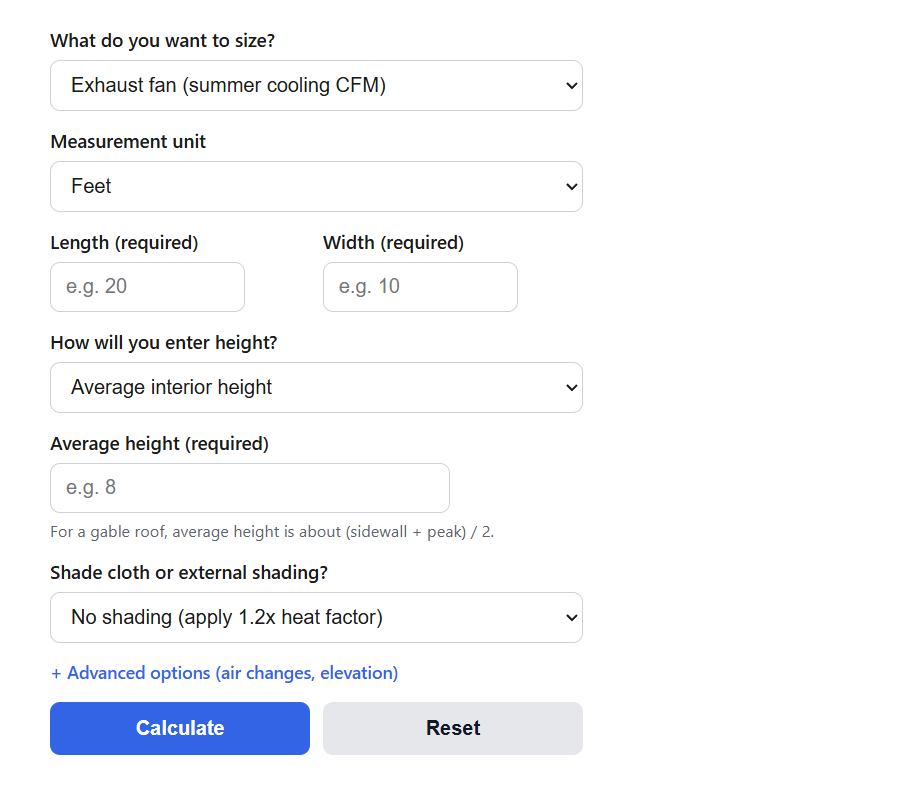
Calculate the exhaust fan CFM your greenhouse needs from its dimensions, plus winter airflow, intake vent area, and HAF circulation fan sizing.
Greenhouse Fan Sizing Formula
CFM = L * W * H * ACM * SF * EF
- CFM is the minimum rated airflow of the exhaust fan (cubic feet per minute)
- L is the interior length of the greenhouse (ft)
- W is the interior width of the greenhouse (ft)
- H is the average interior height (ft); for a gable roof use (sidewall + peak) / 2
- ACM is the air changes per minute (1 is the standard; 1.5 to 2 for dense crops or grow lights)
- SF is the shade factor (1.2 with no shade cloth, 1.0 with shading)
- EF is the elevation factor, EF = 1 + 0.04 * (elevation in ft / 1000)
The exhaust fan mode multiplies the interior volume of the greenhouse by the air exchange rate, then applies a 1.2 heat factor when there is no shade cloth and an elevation correction for thinner air at altitude. It also reports a winter minimum ventilation rate of 2 CFM per square foot of floor area and the intake vent free area your fan needs, sized at 150 CFM per square foot.
HAF CFM = 2 * L * W
The circulation fan mode sizes horizontal air flow (HAF) fans at 2 CFM per square foot of floor area. These fans do not exhaust air; they keep it moving in a loop inside the greenhouse to even out temperature and humidity.
Intake Area = CFM / 150
The intake vent mode works backward from a fan you already own. It returns the free intake area in square feet, then converts it to a gross louver size assuming shutters are about 65 percent free area when open.
Typical Fan Sizes and Elevation Adjustments
The table below shows the minimum exhaust fan size for common hobby and small commercial greenhouse footprints at one air change per minute, with and without shade cloth.
| Greenhouse (L x W x H ft) | Volume (ft³) | CFM with shade | CFM no shade (x1.2) |
|---|---|---|---|
| 8 x 6 x 6 | 288 | 288 | 346 |
| 10 x 8 x 7 | 560 | 560 | 672 |
| 12 x 10 x 8 | 960 | 960 | 1,152 |
| 20 x 12 x 8 | 1,920 | 1,920 | 2,304 |
| 30 x 16 x 10 | 4,800 | 4,800 | 5,760 |
| 96 x 30 x 12 | 34,560 | 34,560 | 41,472 |
Fan ratings are published at sea-level air density. Air gets thinner at altitude, so a fan must move more of it to remove the same heat. Most greenhouse fan charts skip this correction, but at mountain elevations it changes the answer by a full fan size. Multiply your base CFM by the factor below for your site elevation.
| Site elevation | Elevation factor | Example: 2,000 CFM base becomes |
|---|---|---|
| Sea level to 1,000 ft | 1.00 - 1.04 | 2,000 - 2,080 CFM |
| 2,000 ft | 1.08 | 2,160 CFM |
| 4,000 ft | 1.16 | 2,320 CFM |
| 6,000 ft | 1.24 | 2,480 CFM |
| 8,000 ft | 1.32 | 2,640 CFM |
Example Problems
Example 1. A 12 ft by 8 ft hobby greenhouse has an average interior height of 7 ft, no shade cloth, and sits near sea level. Volume = 12 * 8 * 7 = 672 ft³. At one air change per minute the base requirement is 672 CFM. With no shade cloth, apply the 1.2 heat factor: 672 * 1.2 = 806 CFM. You would look for a wall-mount exhaust fan rated around 850 to 900 CFM to cover screen and louver losses.
Example 2. A 30 ft by 20 ft greenhouse has a 6 ft sidewall and a 10 ft peak, uses shade cloth, and sits at 5,000 ft elevation. Average height = (6 + 10) / 2 = 8 ft, so volume = 30 * 20 * 8 = 4,800 ft³. The shade factor is 1.0 and the elevation factor is 1 + 0.04 * 5 = 1.20, giving 4,800 * 1.20 = 5,760 CFM. Winter minimum ventilation is 2 * 600 ft² = 1,200 CFM, and the fan needs about 5,760 / 150 = 38 ft² of free intake area on the opposite end wall.
Frequently Asked Questions
Why is one air change per minute the standard?
Solar gain through glazing heats greenhouse air fast enough that interior temperature can climb several degrees in under a minute. Replacing the full interior volume every 60 seconds holds the inside within roughly 5 to 10 degrees F of outdoor air on a sunny day. Slower rates let heat accumulate faster than the fan removes it, which is why per-hour exchange rates used in building HVAC do not apply here.
Do I still need an exhaust fan if I have roof vents?
Passive roof and side vents work well in mild weather when there is a breeze and the vent area is at least 15 to 20 percent of the floor area. On hot, still days natural ventilation stalls, and that is exactly when the greenhouse overheats. Most growers in warm climates use both: passive vents for spring and fall, and a thermostat-controlled exhaust fan sized with this calculator for summer peaks.
What is the difference between exhaust fans and HAF circulation fans?
An exhaust fan pushes inside air out and pulls fresh air through intake vents, controlling temperature and humidity. HAF (horizontal air flow) fans hang inside the greenhouse and move air in a horizontal loop without exchanging it. They eliminate hot and cold pockets, keep humidity off leaf surfaces, and strengthen stems. Size exhaust capacity at one volume per minute and HAF capacity at about 2 CFM per square foot of floor, and run the HAF fans whenever the exhaust fan is off.