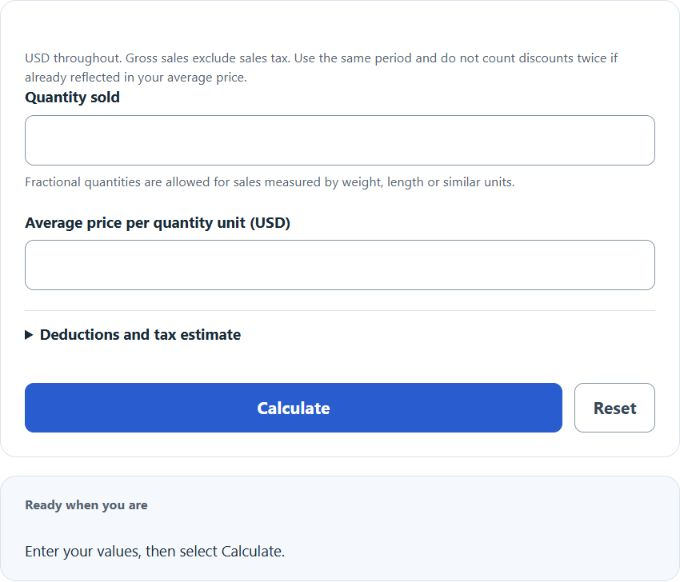
Calculate gross sales from quantity sold and average price, then apply optional returns, allowances and discounts. An optional entered tax rate gives a separate collection estimate.
Gross Sales Formula
The gross sales calculator uses the units sold and average sale price to find gross sales. It then subtracts returns, allowances, and discounts to estimate net sales, sales tax, and total collected.
- GS = gross sales
- U = units sold
- P = average sale price per unit
- TD = total deductions
- R = returns
- A = allowances
- D = discounts
- NS = net sales
- TR = sales tax rate as a percent
- Tax = estimated sales tax
- TC = total collected
Gross Sales is calculated before subtracting returns, allowances, or discounts. Total Deductions combines those reductions. Net Sales is gross sales minus deductions, which may be negative if deductions exceed this period’s gross sales. Estimated Sales Tax is calculated only when a rate is entered and net sales are nonnegative, assuming all such sales are taxable at that one rate. Estimated Net Sales Plus Tax adds the rounded estimate; it is not a record of actual cash received. Blank deductions mean zero; a blank tax rate omits tax and collection estimates.
Common Gross Sales Adjustments
| Item | What it means | Effect on result |
|---|---|---|
| Returns | Money refunded to customers for returned products | Reduces net sales |
| Allowances | Price reductions given after a sale, often for defects or service issues | Reduces net sales |
| Discounts | Promotional, volume, or early-payment reductions | Reduces net sales |
| Sales tax | Tax charged on taxable sales | Adds to total collected, but is not usually treated as sales revenue |
| Result | Use this number for |
|---|---|
| Gross Sales | Measuring total sales activity before reductions |
| Total Deductions | Seeing how much revenue was reduced by returns, allowances, and discounts |
| Net Sales | Estimating sales after customer credits and reductions |
| Total Collected | Estimating customer payment including sales tax |
Example Gross Sales Calculations
Example 1
You sold 500 units at an average sale price of $25. Returns were $300, allowances were $100, discounts were $250, and the sales tax rate was 6.625%.
- Gross sales = 500 × $25 = $12,500.00
- Total deductions = $300 + $100 + $250 = $650.00
- Net sales = $12,500.00 - $650.00 = $11,850.00
- Estimated sales tax = $11,850.00 × 6.625% = $785.06
- Total collected = $11,850.00 + $785.06 = $12,635.06
Example 2
You sold 120 units at an average sale price of $40. Returns were $500, allowances were $0, discounts were $300, and the sales tax rate was 8%.
- Gross sales = 120 × $40 = $4,800.00
- Total deductions = $500 + $0 + $300 = $800.00
- Net sales = $4,800.00 - $800.00 = $4,000.00
- Estimated sales tax = $4,000.00 × 8% = $320.00
- Total collected = $4,000.00 + $320.00 = $4,320.00
Gross Sales Calculator FAQ
Are gross sales the same as net sales?
No. Gross sales are the total sales before subtracting returns, allowances, and discounts. Net sales are what remains after those deductions are subtracted. If you need a cleaner measure of actual sales revenue, net sales is usually more useful than gross sales.
Should sales tax be included in gross sales?
Sales tax is usually not included in gross sales because it is collected from the customer and later paid to the tax authority. When a rate is entered and net sales are nonnegative, this calculator estimates tax separately and adds it to net sales. It assumes one rate applies to all of those net sales; actual taxability and refunds are not determined.
What happens if deductions are greater than gross sales?
Negative net sales remain visible when returns, allowances and discounts exceed gross sales. The calculator does not infer tax refunds or cash collected from that negative amount; use actual records and applicable tax rules.