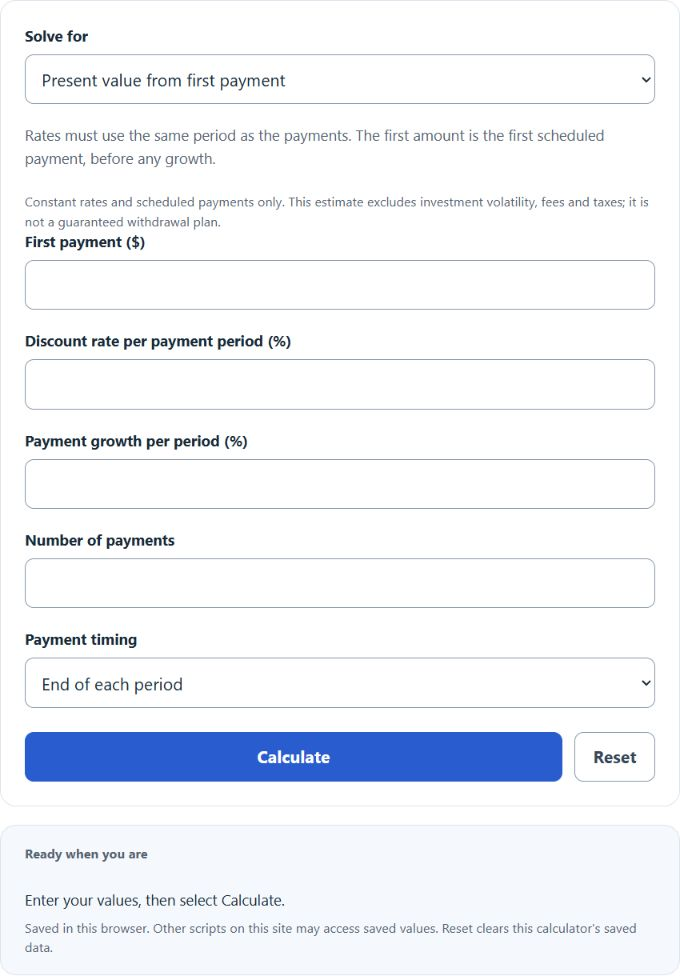
Calculate the present value of a growing annuity from the first payment, discount rate, growth rate, and number of periods, or solve for the first payment needed to reach a target present value.
Growing Annuity Present Value Formula
PV = P / (r - g) * [1 - ((1+g)/(1+r))^n]
- PV is the present value of the growing annuity ($)
- P is the first payment, made at the end of period 1 ($)
- r is the discount rate per period (decimal)
- g is the growth rate of the payments per period (decimal)
- n is the total number of payments
When the discount rate and the growth rate are equal, the denominator becomes zero and the standard formula cannot be used. In that case the present value simplifies to:
PV = P * n / (1 + r)
If payments arrive at the beginning of each period instead of the end (an annuity due), multiply the result by one plus the discount rate:
PV(due) = PV * (1 + r)
The calculator works in two directions. In the first mode you enter the first payment, discount rate, growth rate, and number of periods, and it returns the present value along with the final payment, the total of all payments, and the future value of the stream. In the second mode you enter a target present value and it solves the formula in reverse for the first payment, which is useful when you know how much money is available today and need to size the payments. Both modes support end-of-period and beginning-of-period timing. The calculator also reports the present value of the same stream with no growth and the growth premium, which is the extra present value created purely by the growth rate.
Present Value Factors and Rate Relationships
The table below shows the present value per $1 of first payment for a 20-period growing annuity with end-of-period payments. Multiply the factor by your first payment to estimate the present value.
| Growth rate (g) | r = 4% | r = 6% | r = 8% | r = 10% |
|---|---|---|---|---|
| 0% | 13.59 | 11.47 | 9.82 | 8.51 |
| 2% | 16.09 | 13.42 | 11.35 | 9.74 |
| 4% | 19.23 | 15.84 | 13.25 | 11.24 |
| 6% | 23.18 | 18.87 | 15.60 | 13.08 |
How the discount rate compares to the growth rate determines how each successive payment contributes to present value:
| Relationship | What it means |
|---|---|
| r > g | Discounting outpaces growth, so each later payment adds less present value than the one before it. This is the typical case. |
| r = g | Growth exactly offsets discounting. Every payment contributes the same present value, P / (1 + r), so PV is just that amount times n. |
| r < g | Payments grow faster than they are discounted, so each later payment adds more present value. PV rises quickly as n increases, and a perpetuity version would be infinite. |
Example Problems
Example 1. You expect to receive $10,000 at the end of the first year, growing 3% per year for 20 years, and you discount at 8%. The factor is [1 – (1.03/1.08)^20] / (0.08 – 0.03) ≈ 12.2500, so PV is approximately $122,500.41 using the unrounded factor. The same stream with no growth would be worth $98,181.47, so the 3% growth adds a premium of $24,318.94 of present value.
Example 2. You have $250,000 today and want it to fund 25 annual end-of-year withdrawals that grow 2% per year, assuming a 6% return. The factor is [1 – (1.02/1.06)^25] / (0.06 – 0.02) ≈ 15.4435, so the first withdrawal is approximately $16,188.01 using the unrounded factor. By year 25 the withdrawal has grown to $26,037.40.
Frequently Asked Questions
What if the growth rate is higher than the discount rate?
The formula still works for a finite number of periods. Both the numerator and the denominator become negative, so the result stays positive. Each later payment is worth more in present value terms than the one before it, so the present value climbs quickly as you add periods. Only the perpetuity version breaks down when g is greater than or equal to r, because the sum never converges.
How is a growing annuity different from a growing perpetuity?
A growing annuity has a fixed number of payments, while a growing perpetuity continues forever. The perpetuity formula, PV = P / (r – g), is the limit of the annuity formula as n goes to infinity, and it is only valid when r is greater than g. For positive payments and r greater than g, a finite annuity is worth less than the matching convergent perpetuity.
Can I use this for inflation-adjusted retirement withdrawals?
You can model an illustrative inflation-adjusted payment stream by using expected inflation as the payment growth rate, a matching per-period discount rate, and the target present value mode. This assumes constant rates, no fees or taxes, and every scheduled payment. It does not account for investment volatility or sequence-of-returns risk and does not establish a safe or guaranteed retirement withdrawal amount.