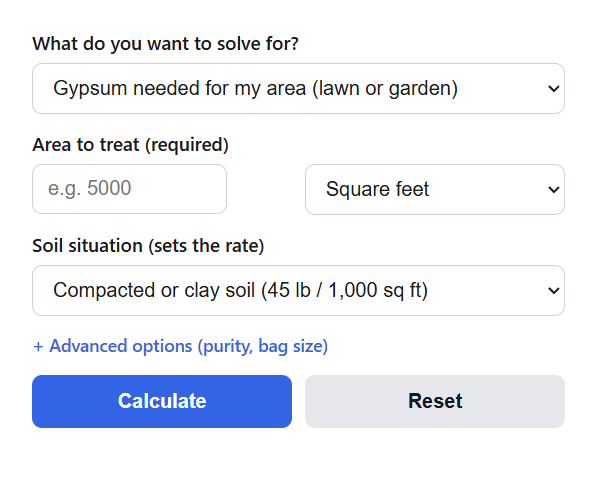
Calculate how much gypsum to apply to your lawn, garden, or field, with rates in lb per 1,000 sq ft, tons per acre from soil test values, and bags needed.
Gypsum Application Rate Formula
G = (A / 1000) * R * (100 / P)
- G is the total gypsum needed (lb)
- A is the area to treat (sq ft)
- R is the application rate (lb per 1,000 sq ft)
- P is the product purity (%)
For sodic soil reclamation based on a lab soil test, the calculator uses the gypsum requirement formula:
GR = 1.72 * CEC * ((ESPi - ESPf) / 100) * (D / 12) * F
- GR is the gypsum requirement (tons per acre)
- CEC is the cation exchange capacity (meq/100 g)
- ESPi is the current exchangeable sodium percentage (%)
- ESPf is the target exchangeable sodium percentage (%)
- D is the soil depth to reclaim (inches)
- F is the exchange efficiency factor (typically 1.2 to 1.5)
The area mode multiplies your lawn or garden area by a rate matched to your soil situation, corrects for product purity, and converts the total into bags. The soil test mode uses the constant 1.72, which is the tons of pure gypsum per acre-foot of soil needed to replace 1 meq of exchangeable sodium per 100 g of soil, scaled to your chosen depth and adjusted by the efficiency factor because calcium-sodium exchange is never complete. The bag coverage mode divides the bag weight by your rate to show how many square feet one bag treats.
Typical Rates and Soil Test Requirements
Use the first table when you do not have a soil test and are matching a rate to a visible soil problem. Rates at the high end should be split into two applications.
| Situation | Rate (lb / 1,000 sq ft) | Per acre equivalent |
|---|---|---|
| Established lawn, maintenance | 5 – 10 | 220 – 440 lb |
| General soil improvement | 20 – 30 | 870 – 1,300 lb |
| Compacted or clay soil | 40 – 50 | 1,750 – 2,200 lb |
| New lawn on heavy clay | 100+ (split doses) | 4,350+ lb |
| Agricultural field amendment | 45 – 90 | 1 – 2 tons |
The second table shows the calculated gypsum requirement in tons per acre for reclaiming the top 6 inches of a sodic soil, using an efficiency factor of 1.25. Find your soil’s CEC column and the row for how many percentage points of ESP you need to remove. Sandy soils have low CEC (5 – 15), loams are mid range (10 – 25), and clays are high (20 – 40), which is why the same ESP problem takes far more gypsum on clay.
| ESP reduction needed | CEC 10 | CEC 20 | CEC 30 |
|---|---|---|---|
| 5 points | 0.5 tons/acre | 1.1 tons/acre | 1.6 tons/acre |
| 10 points | 1.1 tons/acre | 2.2 tons/acre | 3.2 tons/acre |
| 15 points | 1.6 tons/acre | 3.2 tons/acre | 4.8 tons/acre |
| 20 points | 2.2 tons/acre | 4.3 tons/acre | 6.5 tons/acre |
Example Problems
Example 1: Compacted clay lawn. You have a 5,000 sq ft lawn on compacted clay and choose the 45 lb per 1,000 sq ft rate with 100% purity. G = (5,000 / 1000) * 45 * (100 / 100) = 225 lb of gypsum. In 40 lb bags, 225 / 40 = 5.6, so you need 6 bags. Since 45 lb per 1,000 sq ft is below the split threshold, you can apply it in one pass and water it in.
Example 2: Sodic soil from a lab test. A soil test reports ESP of 20% and CEC of 15 meq/100 g. You want to bring ESP down to 5% in the top 6 inches using an efficiency factor of 1.25. GR = 1.72 * 15 * ((20 – 5) / 100) * (6 / 12) * 1.25 = 2.42 tons per acre, which is about 4,840 lb per acre or 111 lb per 1,000 sq ft. A total this size is applied in one dose, but anything above roughly 5 tons per acre should be split across seasons.
FAQ
Does gypsum change soil pH like lime does? No. Gypsum is calcium sulfate, a neutral salt, so it supplies calcium and sulfur without meaningfully raising or lowering pH. Lime is calcium carbonate and neutralizes acidity. If your soil test shows low pH, you need lime; if it shows adequate pH but high sodium or poor structure, gypsum is the right amendment. The two can be applied together when a test calls for both.
Will gypsum loosen any clay soil? Only clay soils that are dispersive or sodium-affected respond structurally to gypsum. In those soils, calcium displaces sodium on the clay particles, allowing them to flocculate into stable aggregates that improve drainage and reduce crusting. On a well-aggregated, non-sodic clay, gypsum still supplies calcium and sulfur but will not dramatically change the texture. A soil test showing ESP or sodium levels tells you which case you have before you spend on high rates.
How often should gypsum be reapplied? Gypsum is moderately soluble and its effects typically last one to three years depending on rainfall and irrigation. For lawns, a light maintenance dose of 5 – 10 lb per 1,000 sq ft once or twice a year sustains the effect after an initial corrective application. For sodic soil reclamation, retest ESP after a full season of leaching before deciding on a second dose rather than reapplying on a schedule.