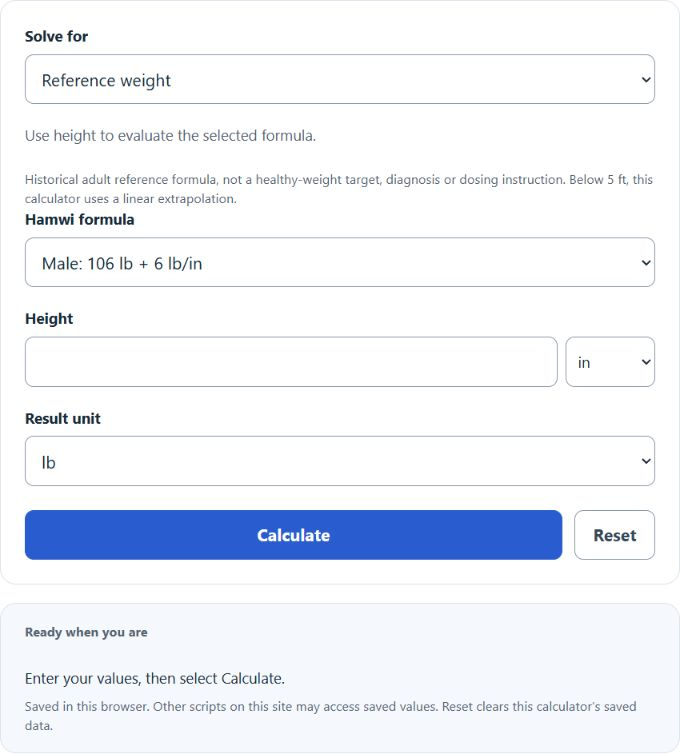
Calculate a historical Hamwi reference weight from height and the selected formula, or invert that equation in lb/kg and in/cm/m units. The inverse is a formula-equivalent height, not a prediction of actual height.
- All Health and Medical Calculators
- Adjusted Body Weight & Ideal Body Weight Calculator
- Ideal Waist Size Calculator
- Ideal Weight Calculator
Hamwi Equation Formula
The Hamwi equation estimates ideal body weight (IBW) from height using a different starting value for males and females. In practical terms, the formula starts at 5 feet tall and then adds a fixed amount for each inch above that height. If height is below 5 feet, the same formula subtracts weight instead of adding it.
Standard Hamwi formulas
For males:
For females:
Height conversion formulas used when your input is metric:
To convert the result from pounds to kilograms:
Variable definitions
- IBW = ideal body weight
- Hin = height in inches
- 60 = 5 feet expressed in inches
If your height is less than 60 inches, the term (Hin - 60) becomes negative, so the formula automatically subtracts the correct amount.
How to use the calculator
- Select the male or female option used by the calculator.
- Enter height in inches, centimeters, or meters.
- Click calculate to generate ideal body weight.
- Read the result in pounds or kilograms.
- Use the value as a reference estimate rather than a strict target.
Quick reference values
| Height | Male IBW | Female IBW |
|---|---|---|
| 5’0” (152.4 cm) | 106 lb (48.1 kg) | 100 lb (45.4 kg) |
| 5’4” (162.6 cm) | 130 lb (59.0 kg) | 120 lb (54.4 kg) |
| 5’8” (172.7 cm) | 154 lb (69.9 kg) | 140 lb (63.5 kg) |
| 6’0” (182.9 cm) | 178 lb (80.7 kg) | 160 lb (72.6 kg) |
| 6’4” (193.0 cm) | 202 lb (91.6 kg) | 180 lb (81.6 kg) |
Examples
Male, 70 inches tall
Female, 165 cm tall
How to interpret the result
The Hamwi result is best used as a screening or reference number. It gives a fast estimate based on height alone, which makes it useful for general comparison and for calculators that need an ideal body weight input. It does not directly measure body fat, muscle mass, frame size, hydration status, or where weight is carried on the body.
- Useful for: quick IBW estimates, nutrition planning inputs, and comparison with other weight-related formulas.
- Less useful for: athletes with high muscle mass, people with unusual body proportions, edema, pregnancy, or anyone needing a full clinical assessment.
- Not the same as: BMI, body fat percentage, lean body mass, or a personalized healthy weight recommendation.
When the Hamwi equation is most helpful
This calculator is especially convenient when you need a simple height-based estimate without entering age, activity level, or body composition data. Because the input requirements are minimal, it is often used as a starting point before comparing results with other tools such as BMI, adjusted body weight, or calorie-needs calculators.
Common questions
Does the formula work for heights under 5 feet?
This calculator extends the displayed linear equation below 5 feet, subtracting from its baseline. Below-baseline conventions differ across references; this extrapolation is not a validated healthy-weight estimate. Nonpositive formula results are rejected.
Why are there separate formulas for males and females?
The calculator applies different constants for the male and female selections, which changes both the starting point at 5 feet and the amount added per extra inch of height.
Can I use metric units?
Yes. Enter centimeters or meters directly in the calculator, or convert height to inches first using the formulas above. The final result can also be shown in kilograms.
Should the result be treated as an exact target weight?
No. It is an estimate designed to provide a useful reference point. A realistic healthy weight range can vary based on body composition, age, frame size, training history, and overall health context.