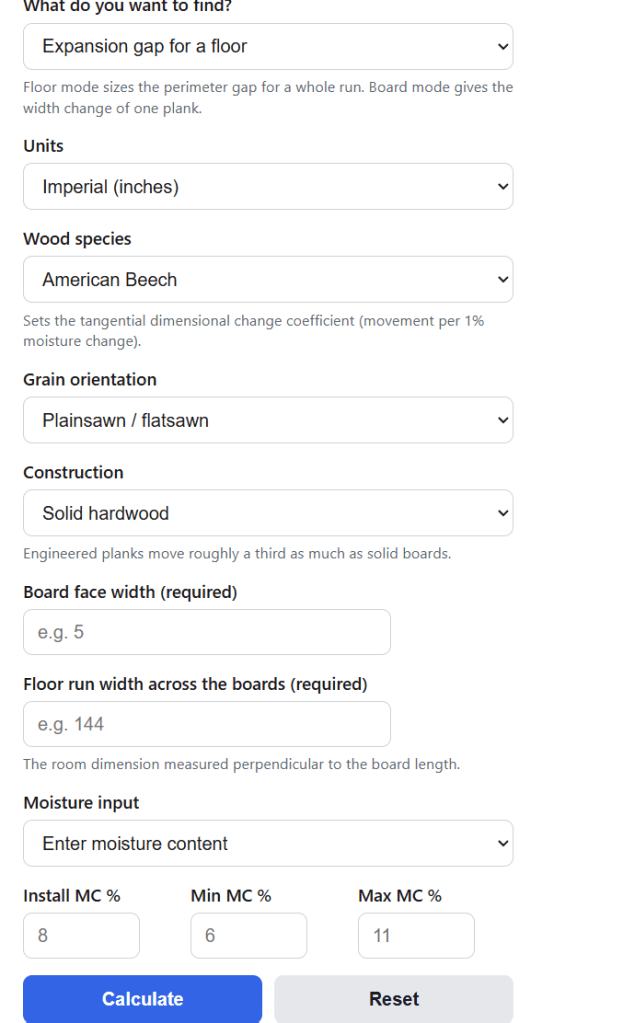
Calculate the hardwood floor expansion gap to leave at the perimeter and the seasonal movement per board, by species, board width, and moisture content.
Hardwood Floor Expansion Gap Formula
Wood moves across its width as its moisture content changes. The calculator estimates that movement and turns it into the gap you leave at the perimeter. To find the total seasonal swelling across a floor run, it uses:
M = R * C * dMC
To turn that movement into the gap to leave at each wall, it splits the movement between the two sides of the run and adds a safety margin:
Gap = (R * C * dMC) / 2 * 1.15
To find the width change of a single plank, it uses the board width in place of the run:
B = W * C * dMC
Variables:
- M is the total seasonal movement across the run, in the same unit as the run width
- R is the floor run width measured across the boards (the room dimension perpendicular to board length)
- W is the face width of one board
- C is the effective dimensional change coefficient: the species tangential coefficient multiplied by a grain factor and a construction factor
- dMC is the change in wood moisture content, in percentage points
- 1.15 is a 15 percent safety margin, and the division by 2 splits movement between the two perimeter sides
The species coefficient sets the base movement. The calculator multiplies it by 0.55 for quartersawn or riftsawn stock, which moves less than plainsawn, and by about 0.35 for engineered construction, which resists width movement because of its cross-layered core. You pick the solve-for mode at the top: floor mode sizes the perimeter gap for a whole run, and board mode returns the width change of a single plank. If you do not know your moisture content, the humidity option converts indoor relative humidity to an estimated moisture content before running the same formulas.
Movement Coefficients and Humidity Reference
The first table lists tangential dimensional change coefficients for common flooring species. A higher number means more width change for the same moisture swing. These are the values behind the species dropdown.
| Species | Tangential coefficient | Relative movement |
|---|---|---|
| American beech | 0.00431 | High |
| Hickory | 0.00411 | High |
| Red oak | 0.00369 | Moderate |
| White oak | 0.00365 | Moderate |
| Hard maple | 0.00353 | Moderate |
| Yellow birch | 0.00338 | Moderate |
| Brazilian cherry (jatoba) | 0.00300 | Moderate |
| Black walnut | 0.00274 | Low |
| Black cherry | 0.00248 | Low |
| Teak | 0.00186 | Low |
The second table is the piece most gap guides leave out: it maps indoor relative humidity to the moisture content wood settles at near 70 degrees Fahrenheit. Read your dry season and humid season humidity, take the two moisture values, and the difference is the dMC to enter. This is how the humidity option in the calculator works.
| Indoor relative humidity | Wood moisture content |
|---|---|
| 20% | 4.5% |
| 30% | 6.2% |
| 40% | 7.7% |
| 50% | 9.2% |
| 60% | 11.0% |
| 70% | 13.1% |
| 80% | 16.0% |
Most heated and cooled homes hold between 30 and 60 percent relative humidity through the year, which is a moisture content swing of roughly 5 percentage points. Homes with wide seasonal swings or no humidity control move more and need larger gaps.
Example Problems
Example 1: Perimeter gap for an oak floor.
You install red oak (coefficient 0.00369) as solid, plainsawn 5 inch boards across a room that is 144 inches wide. The wood goes in at 8 percent moisture content, and you expect a range of 6 percent in the dry season to 11 percent in the humid season. The swelling change is 11 minus 8, which is 3 points. The movement across the run is 144 times 0.00369 times 3, which is about 1.59 inches. Splitting that between the two sides and adding the 15 percent margin gives 1.59 divided by 2 times 1.15, or about 0.92 inch of gap at each wall.
Example 2: Movement of a single board.
Using the same red oak board at 5 inches wide, with a moisture content change of 3 points, the width change is 5 times 0.00369 times 3, which is about 0.055 inch. A quartersawn board of the same size moves about 0.030 inch, and an engineered board about 0.019 inch, because the calculator scales the coefficient by 0.55 and 0.35 for those cases.
Frequently Asked Questions
How big should the expansion gap around a hardwood floor be?
The common rule of thumb is about 3/4 inch for solid flooring and 5/16 to 1/2 inch for engineered, with up to 1 inch on solid runs over 20 feet. Those are safe defaults, but the real number depends on your species, board width, run length, and how much your indoor humidity swings. Enter those into the calculator to size the gap for your floor rather than relying on a single figure.
Why do I use moisture content and not relative humidity?
Wood responds to the moisture it actually holds, not to the humidity reading on a thermostat. The dimensional change coefficient is defined per percentage point of wood moisture content, so the movement formula needs moisture content as its input. The humidity table above and the humidity option in the calculator convert your relative humidity into an estimated moisture content so you can still get a gap if you only know the room humidity.
Should I ever fill the expansion gap?
Keep it open. The gap only does its job if the floor has somewhere to grow when it swells, so it is normally hidden under skirting, shoe molding, or a threshold rather than filled. If you want a sealed look at a doorway or hearth, use a flexible material that can compress and stretch, and never fix trim tightly to the floor across the gap.