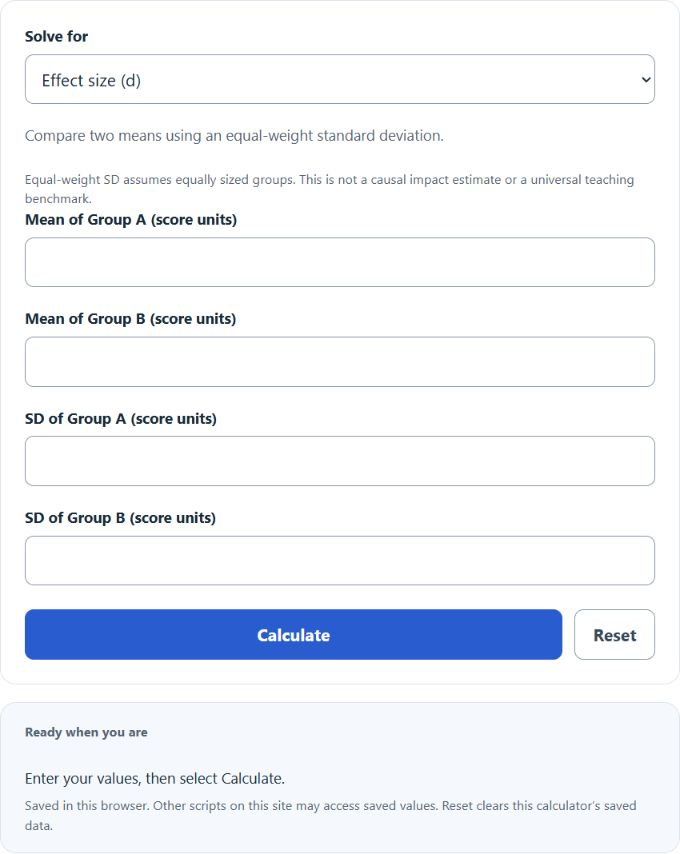
Calculate a signed standardized mean difference using an equal-weight SD, or choose a missing mean or SD to solve. The calculator also reads an influence from your own JSON dataset.
Related Calculators
- Kruskal Wallis Effect Size Calculator
- Interaction Effect Calculator
- HSD (Honestly Significant Difference) Calculator
- Welch’s T Test Calculator
- All Statistics Calculators
Hattie Effect Size Formula
This calculator uses the following equal-weight standardized mean difference (d):
Variables:
- M1 is the mean of Group A
- M2 is the mean of Group B
- SDpooled is the equal-weight SD, sqrt((SD1^2 + SD2^2) / 2); the usual pooled sample SD agrees when the groups have equal sample sizes
To calculate the Hattie effect size, subtract the mean of Group B from the mean of Group A and divide the result by the pooled standard deviation of the two groups.
What is Hattie Effect Size?
Here, effect size is the signed difference between two group means divided by an equal-weight SD. It describes a standardized difference, not evidence of causation. Hattie’s 0.40 hinge point is a descriptive research reference whose interpretation depends on context and study design. The conventional 0.2, 0.5 and 0.8 labels are associated with Cohen, rather than Hattie, and are not universal rules.
How to Calculate Hattie Effect Size?
The following steps outline how to calculate the Hattie Effect Size.
- First, determine the mean of Group A (M1).
- Next, determine the mean of Group B (M2).
- Then, calculate the standard deviation of Group A and Group B.
- Calculate the equal-weight standard deviation (SDpooled) using the formula: SDpooled = sqrt((SD1^2 + SD2^2) / 2).
- Finally, calculate the Hattie Effect Size (d) using the formula: d = (M1 - M2) / SDpooled.
- Select the value to solve, enter the relevant inputs and select Calculate. For this example, SDpooled ≈ 9.5131 and d ≈ 0.7358.
Example Problem :
Use the following variables as an example problem to test your knowledge.
Mean of Group A (M1) = 85
Mean of Group B (M2) = 78
Standard Deviation of Group A (SD1) = 9
Standard Deviation of Group B (SD2) = 10