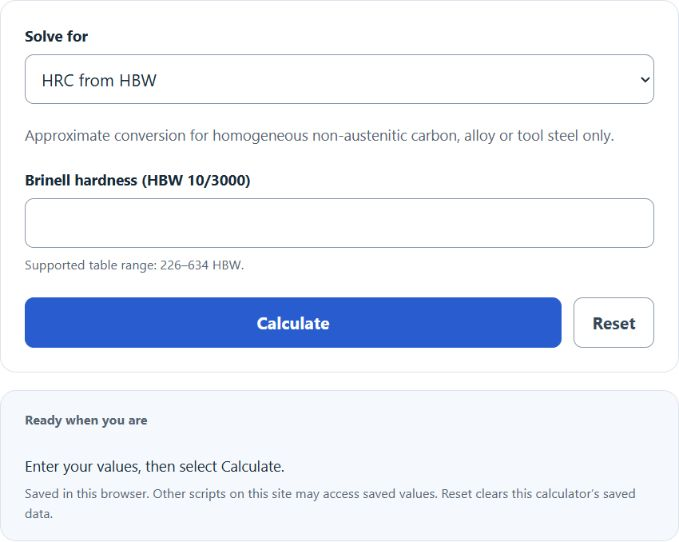
Estimate HBW Brinell hardness from HRC Rockwell C hardness or reverse the conversion using a non-austenitic steel table. The supported range is 226–634 HBW (HBW 10/3000) or 20–59 HRC. Conversions are approximate and material dependent. HRC to HBW converter.
| HBW to HRC | HRC to HBW |
|---|---|
| 226 HBW ≈ 20 HRC | 20 HRC ≈ 226 HBW |
| 253 HBW ≈ 25 HRC | 25 HRC ≈ 253 HBW |
| 286 HBW ≈ 30 HRC | 30 HRC ≈ 286 HBW |
| 301 HBW ≈ 32 HRC | 32 HRC ≈ 301 HBW |
| 327 HBW ≈ 35 HRC | 35 HRC ≈ 327 HBW |
| 353 HBW ≈ 38 HRC | 38 HRC ≈ 353 HBW |
| 371 HBW ≈ 40 HRC | 40 HRC ≈ 371 HBW |
| 421 HBW ≈ 45 HRC | 45 HRC ≈ 421 HBW |
| 481 HBW ≈ 50 HRC | 50 HRC ≈ 481 HBW |
| 560 HBW ≈ 55 HRC | 55 HRC ≈ 560 HBW |
| These are selected points from the Struers non-austenitic steel HBW30 table. The calculator interpolates linearly between consecutive integer-HRC points from 20–59 HRC / 226–634 HBW without extrapolation. Conversion does not replace a direct hardness test. | |
- All Unit Converters
- Materials Properties Unit Converters
- Brinell To Rockwell Calculator
- Brinell Hardness Number Calculator w/ Formula
- Surface Roughness Calculator
Watch the complete HBW-to-HRC explanation and transcript
Hbw To Hrc Formula
The calculator uses piecewise linear interpolation between adjacent points (B₀, R₀) and (B₁, R₁) in the non-austenitic steel table, rather than a universal hardness equation. Here B denotes HBW 10/3000 and R denotes HRC.
Variables:
- HRC is the Rockwell C Hardness
- HBW is the Brinell Hardness
For 300 HBW, the adjacent table points are 294 HBW at 31 HRC and 301 HBW at 32 HRC: HRC ≈ 31 + (300 − 294) / (301 − 294) = 31.86. Reverse conversion interpolates the same interval. Use only the stated range; displayed decimal places do not establish measurement accuracy.
What is a Hbw To Hrc?
HBW to HRC refers to the conversion from Hardness Brinell (HBW) to Hardness Rockwell C (HRC), which are both measurements of hardness in materials. The Brinell hardness test involves applying a known load to the surface of the material through a tungsten-carbide ball of known diameter, while the Rockwell hardness test uses a different method involving a small indentation. This calculator is limited to homogeneous non-austenitic carbon, alloy and tool steels in the stated table conditions. Alloy, heat treatment and microstructure affect the relationship; it is not a universal conversion for austenitic stainless steel or nonferrous materials. Use direct testing for acceptance decisions.