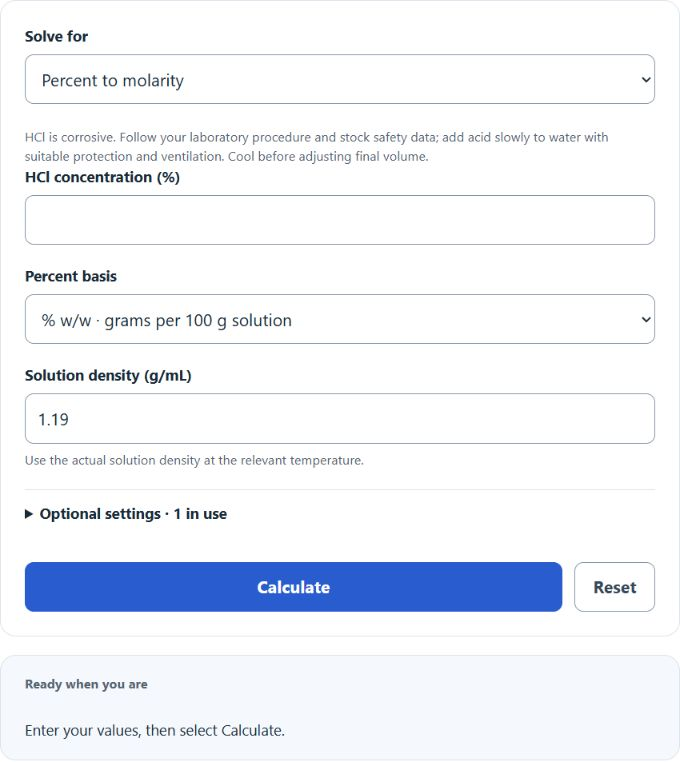
Convert HCl percent w/w or w/v to molarity, reverse molarity to percent, calculate from pure HCl mass and final volume, or plan a stock dilution. Results include mass concentration, acid–base normality and transparent calculation details.
Quick overview: HCl to molarity
To find the molarity of a hydrochloric acid solution, first convert the mass of pure HCl into moles using its molar mass of 36.46 g/mol. Then divide those moles by the final solution volume in liters.
- 36.46 g of HCl in 1.00 L = 1.00 mol/L
- 3.646 g of HCl in 1.00 L = 0.10 mol/L
- 18.23 g of HCl in 0.25 L = 2.00 mol/L
- Increasing mass at the same volume increases molarity
- Increasing volume at the same mass decreases molarity
- mg/m3 to ppm Converter
- mcg/dl to ng/ml Converter
- mg to ml Calculator
- ppb (Parts Per Billion) Calculator
- All Unit Converters
HCl to Molarity Formula
The following formula is used to calculate the molarity of an HCl solution from its mass and final solution volume.
Variables:
- M is the molarity of the HCl solution in mol/L
- m is the mass of pure HCl in grams
- 36.46 is the molar mass of HCl in g/mol
- V is the final solution volume in liters
To calculate the molarity, divide the mass of pure HCl by 36.46 to convert grams into moles, then divide by final solution volume in liters. Choose the mass mode above for this method. For mass percent, use M = 10 × percent × density / molar mass; for mass/volume percent, omit density. Density must apply to the actual solution and temperature; use the reagent assay and safety data.
What is HCl Molarity?
HCl molarity is the concentration of hydrochloric acid in a solution, expressed as moles of HCl per liter of solution. Because hydrochloric acid is a strong acid, it is commonly described by its molarity when preparing laboratory solutions, comparing concentrations, or performing stoichiometric calculations. A higher molarity means more HCl is dissolved in each liter of solution.
How to Calculate HCl Molarity?
The following steps outline how to calculate the molarity of an HCl solution.
- First, determine the mass of pure HCl in grams.
- Next, divide that mass by 36.46 g/mol to convert it into moles of HCl.
- Then, determine the final solution volume in liters.
- Finally, divide the moles of HCl by the solution volume to calculate molarity.
- After inserting the values and calculating the result, check your answer with the calculator above.
Example Problem:
Use the following variables as an example problem to test your knowledge.
Mass of HCl (m) = 36.46 g
Solution Volume (V) = 1.00 L
Molarity (M) = (36.46 / 36.46) / 1.00 = 1.00 mol/L
HCl to Molarity Examples Table
The table below lists several example combinations of mass of HCl and solution volume, with the resulting molarity computed using the formula above.
| Mass of HCl (g) | Solution Volume (L) | Resulting Molarity (mol/L) |
|---|---|---|
| 3.646 | 1.00 | 0.10 |
| 7.292 | 1.00 | 0.20 |
| 36.46 | 1.00 | 1.00 |
| 36.46 | 0.50 | 2.00 |
| 18.23 | 0.25 | 2.00 |
| 3.646 | 0.25 | 0.40 |
In practical chemistry work, you may start with a measured mass of HCl, a target molarity, or a planned final volume. Understanding the relationship between mass, moles, and solution volume makes it easy to prepare or verify hydrochloric acid solutions accurately.