Convert mg/m³ to ppm or ppm to mg/m³ for gases and custom compounds based on molecular weight, temperature, pressure, and ideal gas law.
- W/W To W/V Calculator
- molarity to volume Converter
- ug/ml to ppb Converter
- ppm To mol/L Calculator
- All Unit Converters
mg/m³ to ppm Formula
The following formula is used to convert a gas concentration from milligrams per cubic meter to parts per million at 25 °C and 1 atm.
The reverse formula can also be used when converting from ppm back to mg/m³.
Variables:
- ppm is the concentration in parts per million
- mg/m³ is the concentration in milligrams per cubic meter
- MW is the molecular weight of the gas in g/mol
- 24.45 is the molar volume of an ideal gas at 25 °C and 1 atm
To calculate ppm from mg/m³, multiply the concentration in mg/m³ by 24.45 and divide the result by the molecular weight of the gas or vapor.
What is mg/m³ to ppm Conversion?
mg/m³ and ppm are both used to describe airborne concentrations, but they measure different things. mg/m³ is a mass-based concentration that tells you how many milligrams of a substance are present in one cubic meter of air. ppm is a volumetric mixing ratio that expresses how many parts of a gas are present per million parts of air. Because ppm depends on gas volume, the conversion between mg/m³ and ppm changes based on the molecular weight of the substance and the assumed temperature and pressure.
Under standard reference conditions of 25 °C and 1 atm, one mole of an ideal gas occupies about 24.45 liters. This allows the conversion between mg/m³ and ppm to be made directly for gases and vapors using the molecular weight. Lighter gases produce larger ppm values for the same mg/m³ concentration, while heavier gases produce smaller ppm values.
How to Convert mg/m³ to ppm?
The following steps outline how to convert mg/m³ to ppm.
- First, determine the concentration in mg/m³.
- Next, determine the molecular weight (MW) of the gas or vapor.
- Then, apply the formula ppm = (mg/m³ × 24.45) / MW.
- Finally, compare your result with the calculator above to verify the conversion.
Example Problem :
Use the following values as an example problem to test your knowledge.
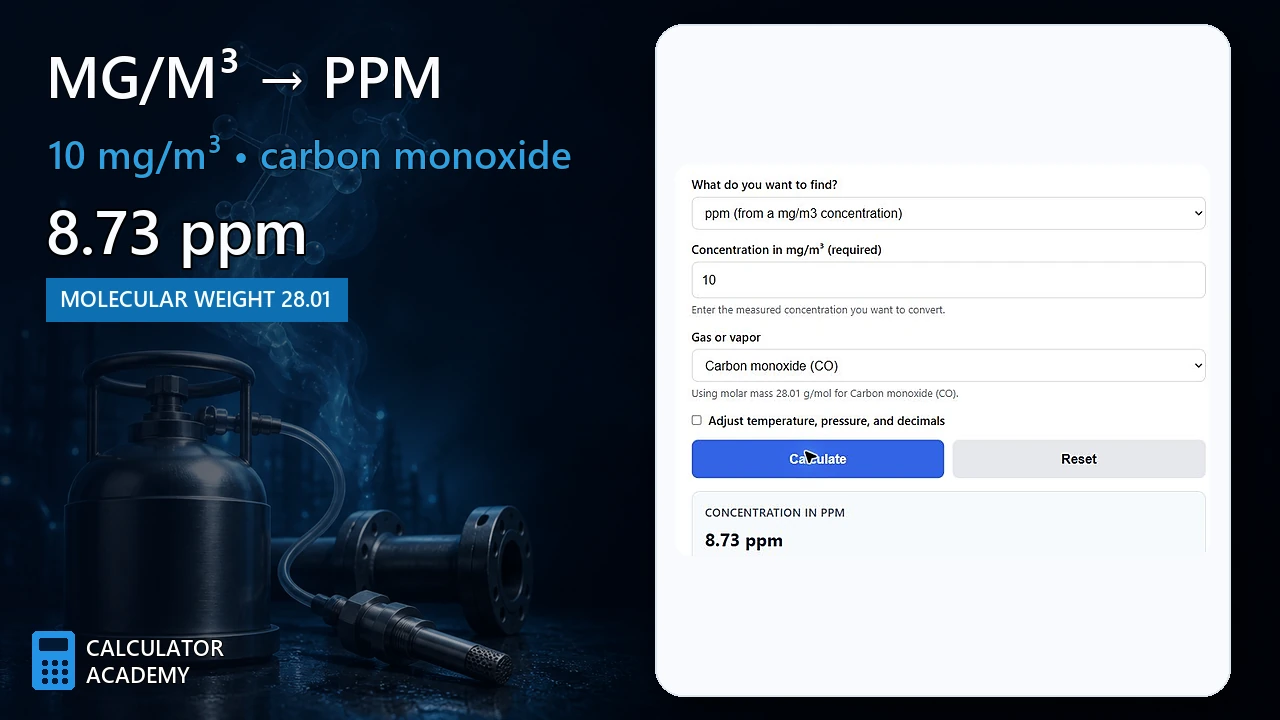
Concentration = 10 mg/m³
Gas = Carbon Monoxide (CO)
Molecular Weight = 28.01 g/mol
ppm = (10 × 24.45) / 28.01 = 8.73 ppm
mg/m³ to ppm Conversion Table
The table below lists approximate ppm values for a 10 mg/m³ concentration of several common gases and vapors at 25 °C and 1 atm.
| Gas / Vapor | Molecular Weight (g/mol) | 10 mg/m³ in ppm |
|---|---|---|
| Carbon Monoxide (CO) | 28.01 | 8.73 ppm |
| Carbon Dioxide (CO₂) | 44.01 | 5.56 ppm |
| Sulfur Dioxide (SO₂) | 64.07 | 3.82 ppm |
| Nitrogen Dioxide (NO₂) | 46.01 | 5.31 ppm |
| Ozone (O₃) | 48.00 | 5.09 ppm |
| Ammonia (NH₃) | 17.03 | 14.36 ppm |
| Benzene (C₆H₆) | 78.11 | 3.13 ppm |
In air quality, industrial hygiene, and exposure monitoring, concentration limits may be reported in either mg/m³ or ppm depending on the standard being used. Understanding the molecular-weight-based conversion helps compare measurements, safety thresholds, and instrument readings across different sources.