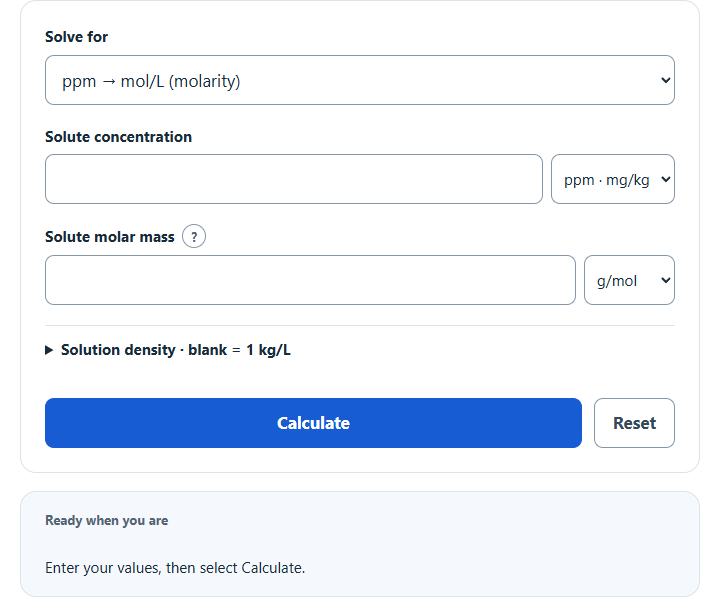
Convert ppm to mol/L (molarity) from the solute’s molar mass, with mg/L and µmol/L shown too. Density defaults to 1 kg/L for dilute water solutions.
ppm to mol/L Formula
The following formula is used to calculate the molarity (mol/L) from a given concentration in ppm and molar mass, assuming a dilute aqueous solution where 1 ppm ≈ 1 mg/L.
Variables:
- M is the molarity (mol/L)
- Cppm is the mass concentration in mg/kg of solution. Density ρ is in kg/L; the optional default is 1 kg/L, approximating dilute water.
- Mm is the molar mass (g/mol)
To calculate the molarity, multiply mass-basis ppm by solution density in kg/L to obtain mg/L, multiply by 10-3 to obtain g/L, and divide by molar mass. For an mg/L input, omit the density multiplier.
| Concentration (ppm, mg/L) | Molarity (mol/L) |
|---|---|
| 0.1 | 1.71116e-6 |
| 0.5 | 8.5558e-6 |
| 1 | 1.71116e-5 |
| 2 | 3.42232e-5 |
| 5 | 8.5558e-5 |
| 10 | 0.000171116 |
| 20 | 0.000342232 |
| 25 | 0.00042779 |
| 50 | 0.00085558 |
| 75 | 0.00128337 |
| 100 | 0.00171116 |
| 150 | 0.00256674 |
| 200 | 0.00342232 |
| 250 | 0.0042779 |
| 300 | 0.00513348 |
| 400 | 0.00684464 |
| 500 | 0.0085558 |
| 750 | 0.0128337 |
| 1000 | 0.0171116 |
| 2000 | 0.0342232 |
| Assumes NaCl (M = 58.44 g/mol) and solution density 1 kg/L, so mass ppm and mg/L are numerically equal. Formula: molarity (mol/L) = ppm (mg/L) ÷ [1000 × M (g/mol)]. In dilute aqueous solutions, 1 ppm ≈ 1 mg/L. | |
What is ppm to mol/L Conversion?
The conversion from ppm (parts per million) to mol/L (molarity) is a common calculation in chemistry, particularly in solution chemistry. Ppm is a unit of concentration that denotes the number of parts of a substance in a million parts of the solution. Molarity, on the other hand, is a measure of the concentration of a solute in a solution in terms of the amount of substance in a given volume. The conversion from mass-basis ppm also needs final-solution density. Use the same chemical entity for the concentration and molar mass; this gives analytical amount concentration and does not predict ion dissociation, activity or equilibrium.
How to Calculate ppm to mol/L?
The following steps outline how to calculate the conversion from ppm to mol/L.
- First, determine the concentration in ppm (Cppm).
- Next, determine the molar mass of the solute (Mm).
- Next, establish solution density ρ in kg/L and use M = (Cppm × ρ × 10-3) / Mm. The default ρ = 1 kg/L reproduces the dilute-water approximation.
- Finally, calculate the molarity (mol/L).
- After inserting the values and calculating the result, check your answer with the calculator above.
Example Problem :
Use the following variables as an example problem to test your knowledge.
Concentration in ppm (Cppm) = 500 ppm
Molar Mass (Mm) = 58.44 g/mol. At solution density 1 kg/L, 500 ppm gives 500/(1000 × 58.44) ≈ 0.00855578 mol/L.