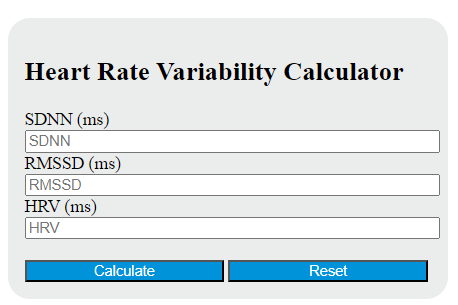
Calculate RMSSD, SDNN, pNN50, mean RR, and heart rate from RR intervals or beat-to-beat BPM, with unit conversion, filtering, and clear formulas.
SDNN/RMSSD Ratio Formula (HRV-derived)
The following formula is used to calculate the SDNN/RMSSD ratio (a dimensionless index derived from two common HRV time-domain metrics).
Variables:
- SDNN/RMSSD Ratio is unitless (dimensionless)
- SDNN is the standard deviation of normal-to-normal (NN) intervals (typically reported in ms)
- RMSSD is the root mean square of successive differences of NN intervals (typically reported in ms)
To calculate the SDNN/RMSSD ratio, divide SDNN by RMSSD. If both are in the same time unit (for example, ms), the units cancel and the result has no units.
What is Heart Rate Variability (HRV)?
Heart Rate Variability (HRV) refers to the variation in time between heartbeats (beat-to-beat variation), influenced by the autonomic nervous system. HRV is commonly summarized using different metrics (for example, SDNN and RMSSD). In general, HRV can be influenced by many factors (for example, sleep, illness, training load, stress, medications, alcohol, time of day, and measurement conditions), so interpretation is often most meaningful when comparing to your own baseline over time.
How to Calculate the SDNN/RMSSD Ratio?
The following steps outline how to calculate the SDNN/RMSSD ratio using the formula SDNN/RMSSD = SDNN / RMSSD.
- First, determine the value of SDNN (standard deviation of NN intervals) in a time unit (commonly milliseconds, ms).
- Next, determine the value of RMSSD (root mean square of successive differences of NN intervals) in the same time unit (commonly ms).
- Next, use the formula SDNN/RMSSD = SDNN / RMSSD to calculate the ratio (unitless).
- Finally, calculate the ratio value.
- After inserting the variables and calculating the result, check your answer with the calculator above.
Example Problem:
Use the following variables as an example problem to test your knowledge:
SDNN (standard deviation of NN intervals) = 50 ms
RMSSD (root mean square of successive differences of NN intervals) = 20 ms, so the SDNN/RMSSD ratio = 50 ÷ 20 = 2.5 (unitless).