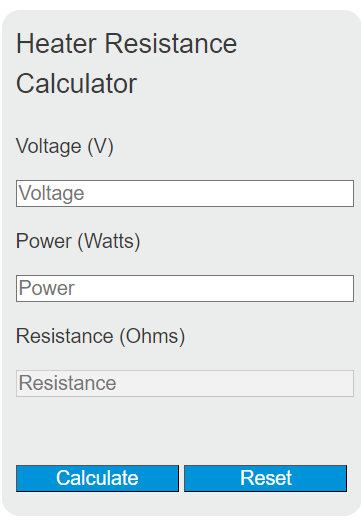
Calculate heater resistance and current from voltage and power, or solve Ohm’s law for any two values in heater circuits and check amp draw.
Related Calculators
- Ohms To Watts Calculator
- Amps Draw Calculator
- Inductive Load Calculator
- Energy Loss Calculator
- All Physics Calculators
Heater Resistance Formula
The calculator uses Ohm’s law and the DC power equations. In the “Find resistance” mode, it solves for resistance from voltage and power, then derives current.
In the “Ohm’s law” mode, it solves the full set of values from any two inputs using these relationships:
- R = heater resistance in ohms (Ω)
- V = supply voltage in volts (V)
- I = current draw in amps (A)
- P = heater power in watts (W)
Find resistance mode: Enter the supply voltage and the nameplate wattage. The calculator returns the cold-equivalent resistance using R = V² / P and the steady-state current using I = P / V.
Ohm’s law mode: Enter any two of voltage, current, resistance, or power. The calculator picks the matching formula pair, solves for the remaining two values, and shows the formula it used.
Typical Heater Values and Circuit Limits
Use these tables to sanity-check the resistance and current the calculator returns.
| Heater | Voltage | Power | Resistance | Current |
|---|---|---|---|---|
| Small space heater | 120 V | 750 W | 19.2 Ω | 6.25 A |
| Standard space heater | 120 V | 1500 W | 9.6 Ω | 12.5 A |
| Toaster element | 120 V | 1000 W | 14.4 Ω | 8.33 A |
| Water heater element | 240 V | 4500 W | 12.8 Ω | 18.75 A |
| Baseboard heater | 240 V | 2000 W | 28.8 Ω | 8.33 A |
| Electric clothes dryer | 240 V | 5000 W | 11.5 Ω | 20.83 A |
| Breaker | Continuous load limit (80%) | Max heater wattage at 120 V | Max heater wattage at 240 V |
|---|---|---|---|
| 15 A | 12 A | 1440 W | 2880 W |
| 20 A | 16 A | 1920 W | 3840 W |
| 30 A | 24 A | 2880 W | 5760 W |
| 40 A | 32 A | 3840 W | 7680 W |
Example Problems
Example 1: 1500 W space heater on 120 V. Resistance is R = 120² / 1500 = 14400 / 1500 = 9.6 Ω. Current is I = 1500 / 120 = 12.5 A. That sits just over the 12 A continuous limit on a 15 A circuit, so it belongs on a 20 A circuit if it runs for long periods.
Example 2: Unknown heater that pulls 8 A at 240 V. In Ohm’s law mode, enter V = 240 and I = 8. Resistance is R = 240 / 8 = 30 Ω and power is P = 240 × 8 = 1920 W.
FAQ
Does this give cold or hot resistance? The calculator returns the operating resistance, which is what V² / P implies at rated conditions. A heating element measured cold with a multimeter usually reads lower because metal resistance rises with temperature.
Why doesn’t my multimeter reading match the calculator? Nichrome and similar alloys have a small but real temperature coefficient. Expect the cold reading to be roughly 5 to 15 percent below the value from V² / P. A reading far outside that range suggests a damaged element.
Can I use this for a 240 V heater wired in North America? Yes. Enter 240 V as the voltage. The math is the same; only the numbers change.
What if I only know the resistance and want the wattage at a different voltage? Use the Ohm’s law tab. Enter the resistance and the new voltage. The calculator returns the current and the power at that voltage using P = V² / R.