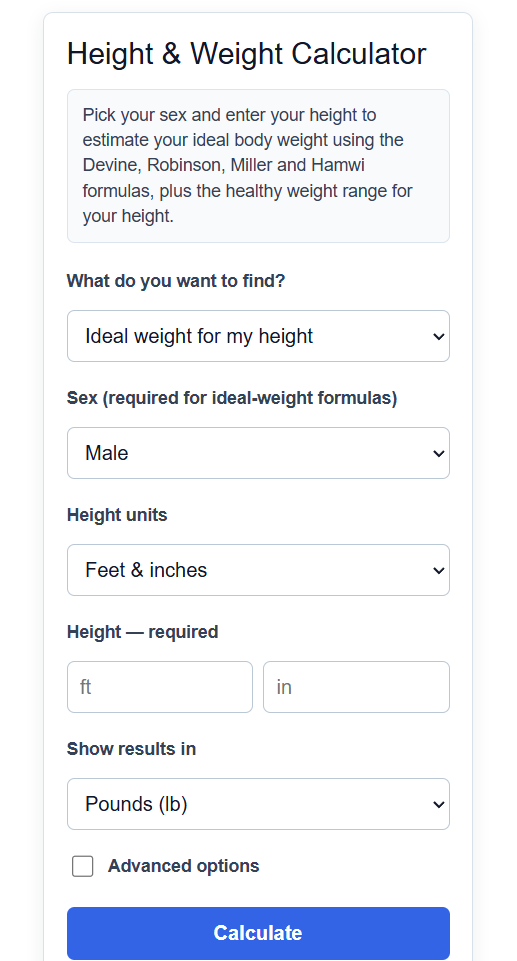
Calculate ideal body weight with Devine, Robinson, Miller, and Hamwi formulas, or check adult BMI and a healthy weight range in pounds or kilograms.
Height and Weight Formula
This calculator works in two modes. The ideal weight mode estimates a healthy target weight from your height and sex using four established formulas. The BMI mode checks your current weight against the healthy range for your height.
Ideal body weight (results are in kilograms, where H is height in inches):
Devine (male) = 50.0 + 2.3 * (H - 60)
 Devine (female) = 45.5 + 2.3 * (H - 60)
 Robinson (male) = 52 + 1.9 * (H - 60)
 Robinson (female) = 49 + 1.7 * (H - 60)
 Miller (male) = 56.2 + 1.41 * (H - 60)
 Miller (female) = 53.1 + 1.36 * (H - 60)
 Hamwi (male) = 48 + 2.7 * (H - 60)
 Hamwi (female) = 45.5 + 2.2 * (H - 60)
Body mass index and the healthy weight range (H in meters, W in kilograms):
BMI = W / (H * H)
 Healthy weight = 18.5 * H * H to 24.9 * H * H
- H: your height. The ideal weight formulas use height in inches above 5 feet (60 inches). BMI uses height in meters.
- W: your body weight in kilograms.
- BMI: body mass index, the ratio of weight to height squared.
- 18.5 and 24.9: the BMI cutoffs that mark the healthy weight band.
The ideal weight formulas all share the same shape: a base weight at 5 feet plus a fixed amount for every inch above that. They differ only in the base and the per-inch figure, which is why the calculator reports all four plus their average. Below 5 feet the formulas are extrapolated and become less reliable. The BMI mode does not need your sex because the BMI thresholds are the same for adult men and women.
Healthy Weight and BMI Reference Ranges
BMI sorts adults into four standard categories. These cutoffs are the same ones the calculator uses to label your result.
| BMI | Category |
|---|---|
| Below 18.5 | Underweight |
| 18.5 to 24.9 | Healthy weight |
| 25.0 to 29.9 | Overweight |
| 30.0 and above | Obese |
The healthy weight range below comes from the BMI band of 18.5 to 24.9 applied at each height. It is the same range the ideal weight mode reports alongside the formula estimates.
| Height | Healthy weight (lb) | Healthy weight (kg) |
|---|---|---|
| 5 ft 0 in (152 cm) | 95 to 128 | 43 to 58 |
| 5 ft 4 in (163 cm) | 108 to 145 | 49 to 66 |
| 5 ft 8 in (173 cm) | 122 to 164 | 55 to 74 |
| 6 ft 0 in (183 cm) | 137 to 184 | 62 to 84 |
| 6 ft 4 in (193 cm) | 153 to 205 | 69 to 93 |
Example Problems
Example 1: Ideal weight for a man who is 5 ft 10 in. A height of 5 ft 10 in is 70 inches, which is 10 inches above 60. The Devine estimate is 50.0 + 2.3 * 10 = 73.0 kg, or about 161 lb. The Robinson estimate is 52 + 1.9 * 10 = 71.0 kg, about 157 lb. Running all four formulas gives an average near 72 kg (159 lb), and the healthy BMI range for this height runs from about 129 lb to 174 lb.
Example 2: BMI for a woman who is 5 ft 4 in and weighs 150 lb. Convert weight to kilograms: 150 / 2.2046 = 68.0 kg. Convert height to meters: 64 inches * 0.0254 = 1.626 m. BMI = 68.0 / (1.626 * 1.626) = 25.7, which falls in the overweight category. The healthy range for this height is roughly 108 lb to 145 lb, so the target would be to reach the upper end of that band.
Frequently Asked Questions
Which ideal weight formula should I trust? No single formula is correct for everyone. They were built decades ago from population averages, mostly for medication dosing and insurance tables, so they ignore muscle mass and build. The calculator shows all four and their average so you can see the spread rather than rely on one number. Treat the healthy BMI range as the wider, more practical guide.
Why does the ideal weight mode ask for my sex but the BMI mode does not? The ideal weight formulas use different base weights for men and women, so sex changes the result. BMI uses the same thresholds for all adults, so it only needs your height and weight.
Is BMI accurate for athletes or older adults? Not always. BMI cannot tell muscle from fat, so a muscular person can read as overweight while having low body fat. It can also underestimate body fat in older adults who have lost muscle. Use BMI as a screening tool and talk to a healthcare professional before acting on the number.