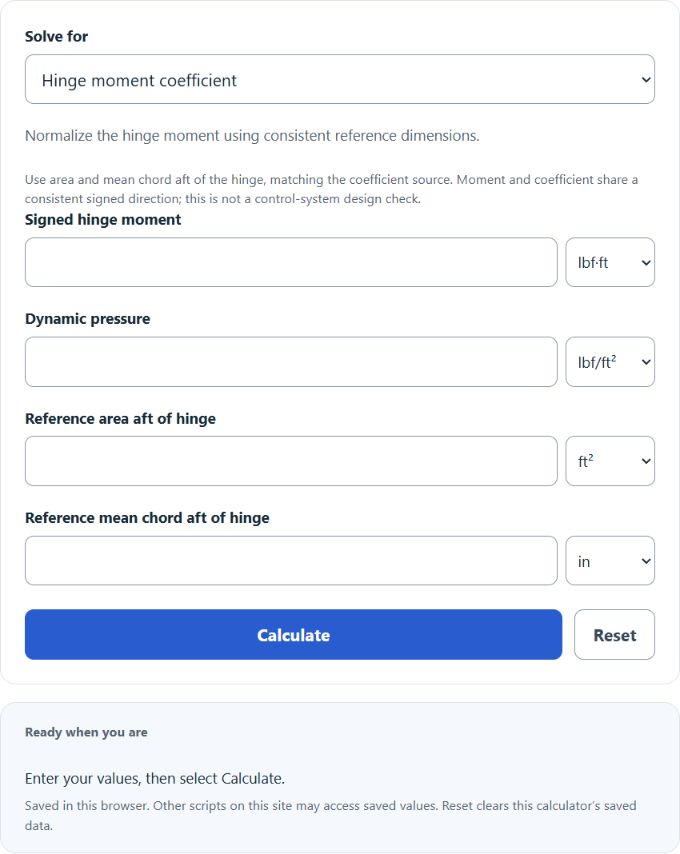
Calculate hinge moment coefficient, hinge moment, dynamic pressure, reference control-surface area, or reference mean chord from four inputs. Use reference dimensions and a sign convention matching the coefficient source.
Related Calculators
- Stagnation Pressure Calculator
- Wind Resistance Calculator
- Horizontal + Vertical Force Calculator
- Center of Mass Calculator (X,Y coordinates)
- All Physics Calculators
Hinge Moment Coefficient Formula
The hinge moment coefficient is calculated from signed hinge moment, dynamic pressure, reference control-surface area, and reference mean chord. Here S and c refer to the surface aft of the hinge; use the same normalization and positive-moment direction as the source coefficient data.
The calculator can also rearrange the same equation to solve for any one missing value:
- Ch = hinge moment coefficient, unitless
- H = hinge moment
- q = dynamic pressure
- S = reference control-surface area aft of the hinge
- c = reference mean aerodynamic chord aft of the hinge
Select the unknown and enter the other four values. The calculator converts hinge moment to N·m, pressure to Pa, area to m², and chord to m before applying the equation. The coefficient is dimensionless. Pressure, area and chord must be positive. Signed moment and coefficient may be zero when solving either of those quantities; solving pressure, area or chord requires nonzero moment and coefficient with matching signs.
Supported Units and Base Conversions
The table below shows the unit options used by the calculator and how they relate to the base units used internally.
| Quantity | Supported units | Base unit used |
|---|---|---|
| Hinge moment coefficient | Unitless | Unitless |
| Hinge moment | lb-ft, N-m | N·m |
| Dynamic pressure | lb/ft², psi, kPa, Pa | Pa |
| Control surface area | sq ft, sq m, sq in, sq yd | m² |
| Mean aerodynamic chord | in, ft, cm, m | m |
Common Dynamic Pressure Conversions
| Input unit | Equivalent in lb/ft² |
|---|---|
| 1 psi | 144 lb/ft² |
| 1 kPa | 20.885434 lb/ft² |
| 1 Pa | 0.020885434 lb/ft² |
| 1 lb/ft² | 1 lb/ft² |
Example Problems
Example 1: Calculate hinge moment coefficient
Given:
- Hinge moment = 120 lb-ft
- Dynamic pressure = 25 lb/ft²
- Control surface area = 8 ft²
- Mean aerodynamic chord = 12 in
The hinge moment coefficient is 0.6000.
Example 2: Calculate hinge moment
Given:
- Hinge moment coefficient = 0.040
- Dynamic pressure = 30 lb/ft²
- Control surface area = 10 ft²
- Mean aerodynamic chord = 15 in
The hinge moment is 15.0000 lbf·ft.
FAQ
What is a hinge moment coefficient?
The hinge moment coefficient is a unitless value that relates the aerodynamic hinge moment on a control surface to dynamic pressure, control surface area, and chord length. It is commonly used when analyzing control surfaces such as elevators, rudders, ailerons, tabs, and flaps.
Why is the hinge moment coefficient unitless?
It is treated as a coefficient because it normalizes hinge moment against the aerodynamic loading terms in the denominator. This lets you compare hinge moment behavior without using the raw moment alone. In practical calculations, you still need to keep the input units consistent with the formula or use the unit selectors in the calculator.
Why do I need four known values?
The equation has 5 variables. To solve for one unknown, the other 4 values must be known. If more than one value is missing, there is not enough information to find a single result. Select which value to solve for; the calculator displays only the inputs required for that mode.