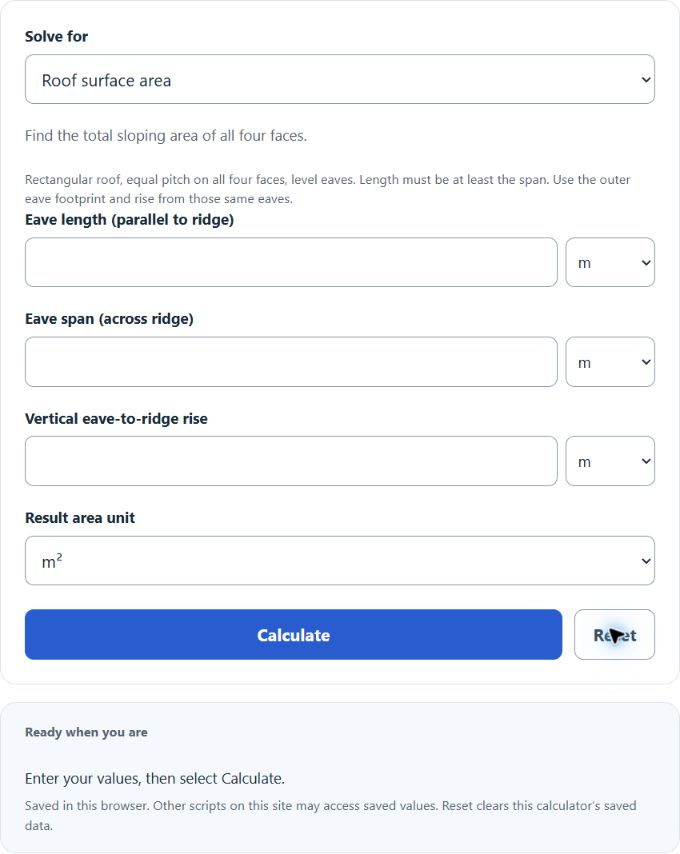
Calculate hip roof length, width, rise or roof surface area from any 3 inputs using meters, feet, inches, square meters, square feet, or square yards.
- All Construction Calculators
- Roof Waste Calculator
- Roof Drains Calculator
- Roof Tile Spacing Calculator
Hip Roof Formula
The calculator models a rectangular hip roof with level eaves and equal pitch on all four faces. Length is the longer horizontal eave-footprint dimension parallel to the ridge; span is the full perpendicular eave-to-eave width, and rise is measured from that same eave level. Length must be at least the span; equal dimensions give a square pyramidal roof. The result is geometric surface area, excluding waste, dormers, valleys and separate product allowances.
Rearranged formulas for solving each missing value:
- A = total roof surface area
- L = horizontal eave-footprint length, measured parallel to the ridge
- W = full horizontal eave-to-eave span across the ridge
- H = rise, the vertical height from the eave to the ridge
Select the quantity to solve for and enter the other three measurements. Length, span and rise are converted to meters, and area to square meters, before the final result is converted to your selected unit. Rise may be zero only for the flat mathematical limit, where area equals the footprint.
Common Roof Pitch and Rise Reference
Roof pitch is often written as rise over 12 inches of run. The rise used in the calculator is the full vertical height from the eave to the ridge, not the pitch number itself.
| Pitch | Angle, Approx. | General Description |
|---|---|---|
| 3:12 | 14.0° | Low slope |
| 4:12 | 18.4° | Common residential slope |
| 6:12 | 26.6° | Moderate slope |
| 8:12 | 33.7° | Steeper roof |
| 12:12 | 45.0° | Very steep roof |
Area Unit Conversions
| Unit | Equivalent | Useful For |
|---|---|---|
| 1 square meter | 10.7639 square feet | Metric plans and measurements |
| 1 square foot | 0.092903 square meters | Common U.S. roof area estimates |
| 1 square yard | 9 square feet | Some material and covering estimates |
Examples
Example 1: Calculate roof surface area
Suppose the eave-footprint length is 40 ft, the span is 24 ft, and the rise from those eaves is 6 ft.
The total roof surface area is about 1,073.31 square feet.
Example 2: Calculate rise
Suppose the roof area is 1,073.31 sq ft, the length is 40 ft, and the width is 24 ft.
The rise is about 6 feet.
FAQ
What does rise mean for a hip roof?
Rise is the vertical distance from the eave line to the ridge. It is not the sloped rafter length and it is not the roof pitch by itself. If you know the roof pitch and the horizontal run, you can find rise from pitch before using the calculator.
Does the calculated roof area include overhangs?
To include overhangs, use the outer eave footprint and the vertical rise from that same outer eave level. For example, a 40 ft by 24 ft wall footprint with a 6 ft wall-line rise and 1 ft horizontal overhangs on all sides becomes 42 ft by 26 ft with a 6.5 ft rise at the outer eaves, preserving the 6:12 pitch. If rise was already measured from the outer eaves, use that measurement without another adjustment.
Why does the calculator say there is no real solution?
An invalid combination can imply a nonpositive span, an area smaller than the flat footprint, or a length shorter than the span under the ridge convention. A pitched roof has more sloping area than its footprint. Check the units, use length at least as large as span, and measure all dimensions from the same eave footprint.