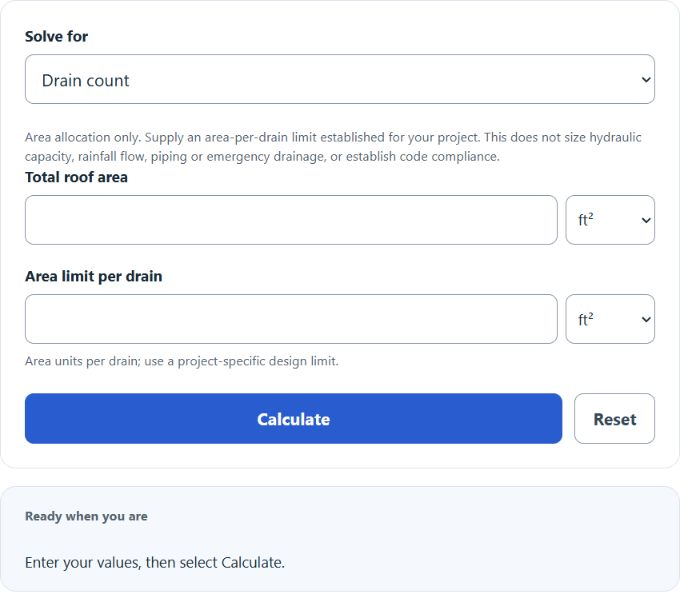
Calculate an area-allocation drain count, total area allocation or average area per drain in sq ft, sq m or sq yd. Supply a project-specific area-per-drain limit; this is not hydraulic sizing or a code-compliance check.
Related Calculators
- Drainage Fall Calculator
- 4/12 Pitch Roof Calculator
- Percent Slope Calculator
- Lot Coverage Calculator
- All Construction Calculators
Roof Drains Formula
The roof drains calculator uses the relationship between total roof area, the roof area served by each drain, and the number of drains.
- A = total roof area
- P = roof area per drain
- N = number of roof drains
- ceil = round up to the next whole number
Choose the quantity to calculate, then enter the other two values. For count mode, area per drain is a supplied maximum allocation; the other modes multiply or average areas and do not establish allowable hydraulic capacity.
- If you enter area per drain and number of drains, it calculates the total roof area.
- If you enter total roof area and number of drains, it calculates the area assigned to each drain.
- If you enter total roof area and area per drain, it calculates the number of drains and rounds up to a whole drain.
Area units are converted to square feet internally. You can enter total area or area per drain in square feet, square meters, or square yards.
Area Unit Conversions Used
The calculator converts all area values to square feet before applying the formulas.
| Unit | Equivalent in square feet | Use in calculator |
|---|---|---|
| 1 sq ft | 1 sq ft | Base unit |
| 1 sq m | approximately 10.7639104 sq ft | Metric roof area or area per drain |
| 1 sq yd | 9 sq ft | Area measured in square yards |
Example Calculations
Example 1: Calculate the number of roof drains
Suppose a project-specific design has established a 2,500 sq ft allocation limit per drain for a 12,000 sq ft roof. This example does not establish that limit for another project.
The arithmetic gives 5 drains at the supplied area limit. Actual catchments, capacity and drainage requirements still need design verification.
Example 2: Calculate square feet per drain
You have a 9,000 sq ft roof and 6 roof drains.
Each drain serves 1,500 sq ft per drain.
FAQ
Why does the calculator round the number of drains up?
You cannot install part of a drain. If the area calculation gives 4.2 drains, you need 5 drains to cover the full area based on the entered area-per-drain value.
Does this calculator size roof drains for rainfall intensity?
No. This calculator only uses roof area, area per drain, and number of drains. Actual roof drainage design can depend on rainfall intensity, drain diameter, pipe slope, roof slope, local code, overflow drainage, and drain manufacturer capacity data.
What should I enter for square feet per drain?
Enter the roof area that one drain is intended to serve. This value may come from a design standard, code table, manufacturer data, or a project-specific drainage plan.