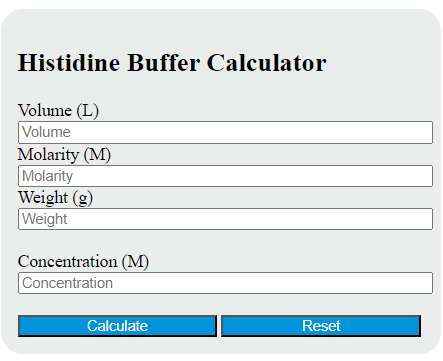
Use this Histidine Buffer Calculator to find acid/base composition, predict pH, weigh histidine reagents, or plan a stock dilution with full calculation steps.
- All Chemistry Calculators
- Buffer Capacity Calculator + Formula
- Molecular Polarity Calculator
- Bacterial Concentration Calculator
Histidine Buffer Formula
This calculator helps you solve for histidine concentration, required histidine mass, final solution volume, or molar mass when the other three values are known. It is most useful for preparing a histidine-containing solution to a target molarity. For L-histidine free base, a common default molar mass is 155.15 g/mol. If you are using a different form, such as a salt or hydrate, enter the molar mass for that exact reagent.
A convenient way to think about the calculation is to convert mass into moles first, then divide by the final volume.
Rearranged Forms
If you know the target concentration and want to solve for a different variable, these equivalent forms are useful.
Variable Definitions
| Symbol | Meaning | Typical Units |
|---|---|---|
| C | Histidine concentration of the final solution | M, mM, µM |
| W | Mass of histidine added | g, kg, oz, lb |
| MW | Molar mass of the histidine form being used | g/mol, kg/mol |
| V | Final solution volume after mixing and dilution | L, mL, US gal |
| n | Amount of substance | mol |
How to Use the Calculator Correctly
- Confirm which histidine reagent you are weighing and use its correct molar mass.
- Enter the final volume of the solution, not just the initial volume of water added to the flask or beaker.
- Enter any three known values and let the calculator solve for the missing one.
- Keep units consistent. Millimolar and milliliters are common sources of conversion mistakes.
- If you are preparing a true buffer at a target pH, adjust the pH separately after the histidine is dissolved.
Concentration vs. Buffer pH
This calculator determines how much histidine is present in the solution. It does not directly determine the final pH. In practice, buffer pH depends on the balance between protonated and unprotonated histidine, along with temperature, ionic strength, and any acid or base used during adjustment.
That means two solutions can have the same histidine molarity but different pH values if they were adjusted differently. For laboratory preparation, it is common to dissolve the histidine, partially adjust the pH, bring the solution to final volume, and then verify the pH again.
Example
Suppose you want to prepare 250 mL of a 50 mM histidine solution using L-histidine free base with a molar mass of 155.15 g/mol. Convert the target concentration to 0.050 M and the final volume to 0.250 L, then calculate the required mass.
You would weigh approximately 1.94 g of L-histidine free base, dissolve it, and then bring the total solution volume to 250 mL.
Quick Reference for 1 L of Solution
The table below shows the mass of L-histidine free base needed for several common target concentrations in a final volume of 1 liter.
| Target Concentration | Mass Required |
|---|---|
| 5 mM | 0.776 g |
| 10 mM | 1.552 g |
| 25 mM | 3.879 g |
| 50 mM | 7.758 g |
| 100 mM | 15.515 g |
Common Mistakes to Avoid
- Using the wrong molar mass: free base, hydrochloride salts, and hydrates do not share the same value.
- Using starting solvent volume instead of final volume: concentration is based on the final made-up volume.
- Forgetting unit conversions: 100 mL is 0.100 L, and 50 mM is 0.050 M.
- Assuming concentration determines pH: molarity tells you how much histidine is present, not the final acidity of the buffer.
- Ignoring volume changes during pH adjustment: when accuracy matters, adjust and then bring the solution to the final mark.
Practical Preparation Tips
- Dissolve the histidine in less than the final required volume first so there is room for pH adjustment.
- Mix thoroughly before checking pH or making final concentration decisions.
- For reproducible results, record the reagent form, molar mass used, target molarity, final volume, and final pH.
- If your application is sensitive, prepare fresh solution or store it under conditions appropriate for your protocol.