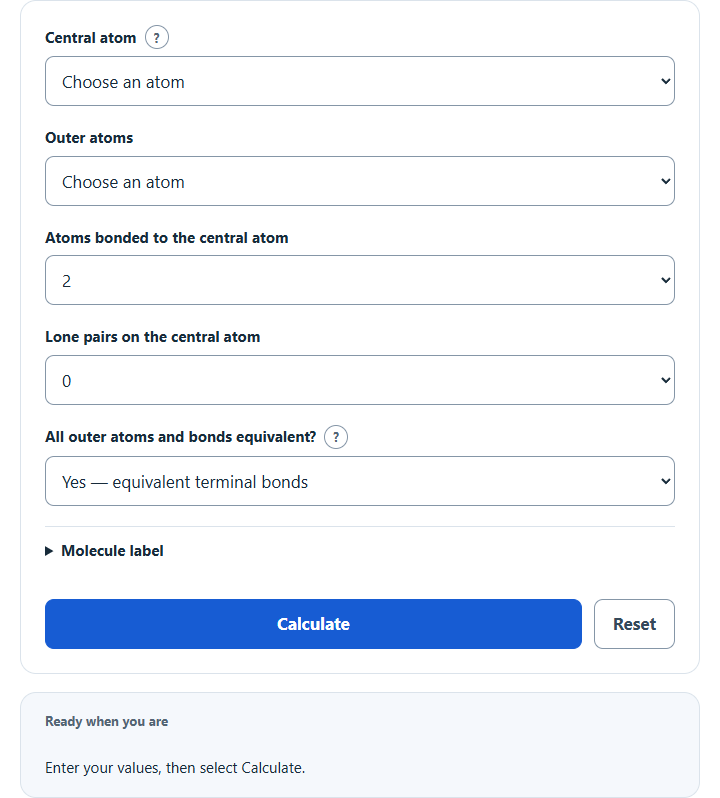
Check whether a molecule is polar or nonpolar: pick the central and outer atoms, bonded atoms and lone pairs to get bond polarity and VSEPR shape.
- All Chemistry Calculators
- Polarity Index Calculator
- Percent Ionic Character Calculator
- Polarization Calculator
Molecular Polarity Formula
Molecular “polarity” is commonly quantified by the molecular dipole moment, which is the vector sum of the individual bond dipoles. Electronegativity difference (ΔEN) is dimensionless and is only a qualitative bond indicator. It cannot, by itself or multiplied by a bond length, determine the molecular dipole moment.
Variables:
- μ is the net molecular dipole moment (debye, D)
- μbond is the dipole moment of one bond (D)
- ΔEN is the difference in Pauling electronegativity between the two bonded atoms (dimensionless)
- AXmEn describes m bonded atoms and n central lone pairs; a multiple bond counts as one electron domain
The bond-vector picture is a qualitative approximation to the full molecular charge distribution. This calculator reports ΔEN, a rough bond classification, common VSEPR shapes and a conditional cancellation result. It does not estimate partial charges, ionic percentage, bond length or a dipole in debye. Identical terminal atoms must also have equivalent bonds for ideal cancellation arguments to apply.
What is Molecular Polarity?
Molecular polarity refers to an uneven distribution of electron density in a molecule. This uneven distribution creates a dipole moment, meaning one region of the molecule is relatively electron-rich (partially negative) and another is relatively electron-poor (partially positive). Molecular polarity strongly influences physical properties such as solubility, boiling point, and intermolecular forces.
How to Calculate Molecular Polarity?
The following steps describe this calculator’s qualitative model. Start with a valid neutral, single-center Lewis structure; the optional molecule label is not parsed.
- Choose the central and outer atoms, which fill in their Pauling electronegativities, or choose Custom and enter your own. Their absolute difference is the reported ΔEN.
- Select bonded atoms and central lone pairs to obtain AXmEn, electron-domain geometry and a common molecular shape. Up to six electron domains are supported.
- Indicate whether all terminal atoms and bonds are equivalent. Mixed or unknown terminal bonds leave molecular polarity undetermined from one EN pair.
- For equivalent nonzero bond dipoles, test ideal geometric cancellation. Linear AX2, trigonal planar AX3, tetrahedral AX4, trigonal bipyramidal AX5, octahedral AX6, linear AX2E3 and square planar AX4E2 cancel in this model.
- Treat the result as conditional. Bent and other supported asymmetric shapes do not cancel equal nonzero bond dipoles. Equal EN values, unsupported shapes and mixed terminal bonds do not establish actual molecular polarity; ozone is a counterexample to an equal-EN shortcut.
Example Problem:
Use the following variables as an example problem to test your knowledge:
For a water-like Lewis model: central O electronegativity 3.44, outer H electronegativity 2.20; ΔEN = 1.24.
Two equivalent terminal bonds and two central lone pairs give AX2E2: tetrahedral electron-domain geometry, bent molecular shape, and “Polar in this model.” No dipole magnitude is inferred. See OpenStax on molecular structure and polarity and NIST experimental dipoles for measured molecular data.