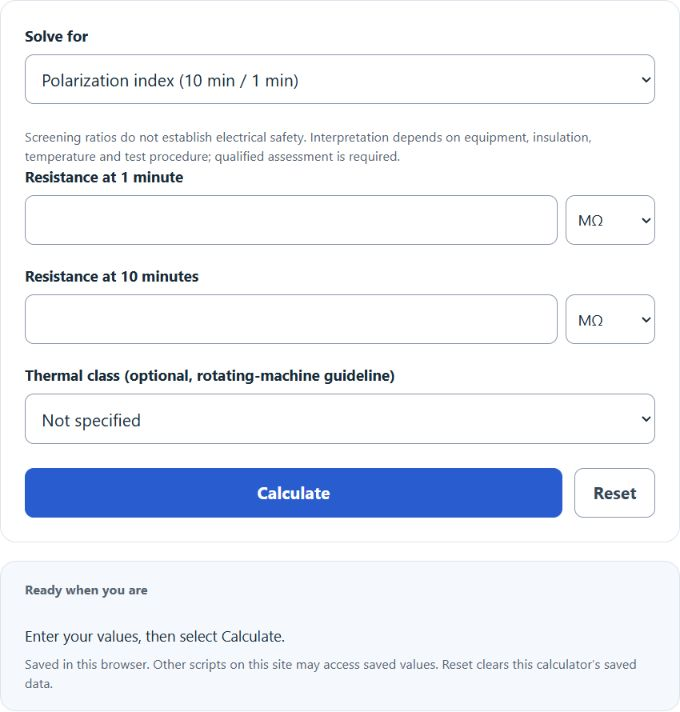
Calculate polarization index and dielectric absorption ratio from insulation resistance readings at 1 and 10 minutes or 30 and 60 seconds.
Related Calculators
- Ground Resistance Calculator
- Wire Resistance Calculator
- Conductivity to Resistance Calculator
- Impedance to Resistance Calculator
- Resistance per Meter Calculator
- All Chemistry Calculators
Polarization Index (PI) Formula
Variables:
- PI is the Polarization Index (dimensionless)
- R10 is the insulation resistance after 10 minutes
- R1 is the insulation resistance after 1 minute
To calculate the Polarization Index, divide the insulation resistance after 10 minutes by the resistance after 1 minute.
How to Calculate Polarization Index?
The following steps outline how to calculate the Polarization Index.
- First, determine the insulation resistance after 10 minutes.
- Next, determine the insulation resistance after 1 minute.
- Next, gather the formula from above = PI = R10 / R1.
- Finally, calculate the Polarization Index.
- After inserting the variables and calculating the result, check your answer with the calculator above.
Example Problem :
Use the following variables as an example problem to test your knowledge.
insulation resistance after 10 minutes = 2.5
insulation resistance after 1 minute = 3
PI = R10 / R1 = 2.5 / 3 = 0.8333
Frequently Asked Questions
What is insulation resistance and why is it important?
Insulation resistance is a measure of the resistance offered by an insulating material to the flow of electric current. It is crucial because it helps determine the integrity and safety of electrical insulation in wiring, equipment, and installations, preventing electrical shocks and fires.
How does the Polarization Index relate to insulation condition?
The Polarization Index (PI) is a ratio of the insulation resistance measured after 10 minutes to that measured after 1 minute. A higher PI typically indicates better insulation condition, as it shows that the insulation resistance increases over time when a voltage is applied, which is characteristic of good insulation.
Can the Polarization Index be used for all types of insulation?
While the Polarization Index is a useful indicator for the condition of many types of electrical insulation, it may not be applicable or reliable for all materials or conditions. Factors such as temperature, moisture, and the specific electrical properties of the insulation material can affect the PI.
What are some common values for a healthy Polarization Index?
A PI of 2 is a common screening reference for some insulation systems, not a universal acceptance limit or proof of electrical safety. Thermal class, equipment guidance, absolute resistance, temperature and trends must also be considered. At 1-minute resistance above 5,000 MΩ, PI may be uninformative; some materials have little dielectric absorption. A falling resistance (PI below 1) warrants qualified investigation without identifying a specific cause by itself.