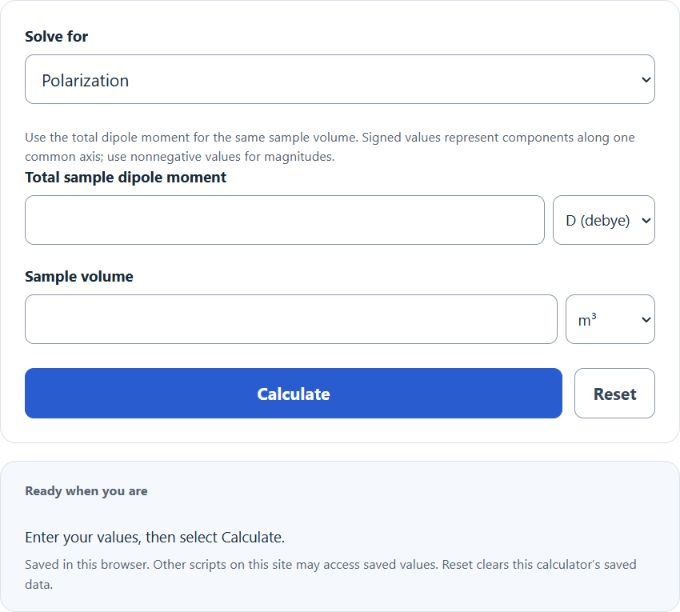
Calculate polarization, dipole moment, or total volume from any 2 inputs with unit conversions for C·m, C/m², m³, liters, ft³, and gallons.
Related Calculators
- Capacitor Dissipation Factor Calculator
- Frequency to Voltage Calculator
- Peak Voltage Calculator
- Wave Speed Calculator
- All Physics Calculators
Polarization Formula
This calculator determines electric polarization, which is the total electric dipole moment distributed over a given volume. In materials science and electromagnetics, polarization describes how strongly charges are displaced or aligned inside a substance.
| Quantity | Symbol | Description | SI Unit |
|---|---|---|---|
| Polarization | P | Dipole moment per unit volume | C/m² |
| Dipole Moment | p | Total electric dipole moment of the sample | C·m |
| Volume | V | Total volume occupied by the material or region | m³ |
If you know any two of these values, the third can be found directly. The relationship is linear, so doubling the dipole moment doubles the polarization, while doubling the volume cuts the polarization in half.
Rearranged Forms
These equivalent forms are useful when solving for a different variable:
How to Calculate Polarization
- Determine the total dipole moment of the material or region.
- Measure or estimate the total volume occupied by that same region.
- Divide the dipole moment by the volume.
- Express the result in consistent units, typically C/m².
This calculation gives the average polarization over the selected volume. If the material is nonuniform, the value should be interpreted as a bulk or volume-averaged result.
Why the Units Are C/m²
Polarization is often surprising because it is reported in coulombs per square meter rather than per cubic meter. That comes directly from the unit cancellation in the formula:
So even though volume appears in the denominator, the dipole moment already contains a distance term.
Unit Conversion Notes
Accurate unit handling is important, especially when dipole moment is entered in molecular-scale units such as debye or when volume is entered in practical engineering units.
When comparing results, make sure the dipole moment and volume refer to the same physical sample. Mixing molecular dipole values with macroscopic volume data without proper scaling will produce meaningless results.
Example
Suppose a material has a total dipole moment of 50 C·m and occupies a volume of 3 m³. The polarization is:
This means the sample has an average dipole moment density of 16.67 coulombs per square meter.
What the Result Means
- Larger polarization indicates stronger net dipole alignment or greater charge separation per unit volume.
- Smaller polarization indicates weaker alignment, less charge separation, or partial cancellation of dipoles.
- A value near zero can occur even in materials with polar molecules if the dipoles are randomly oriented.
Polarization is a vector quantity. This calculator accepts signed components along one common axis, or nonnegative magnitudes. The total sample dipole moment and its volume must refer to the same region.
Common Applications
- Analyzing dielectric materials placed in electric fields
- Estimating charge displacement in capacitors and insulators
- Comparing material response in electrostatics problems
- Studying polar substances, ferroelectric materials, and molecular alignment
- Relating microscopic dipole behavior to macroscopic material properties
Electric Polarization vs. Wave Polarization
This calculator is for electric polarization of matter, not the polarization of light or other transverse waves. Wave polarization refers to the orientation of oscillations, while electric polarization here refers to dipole moment density inside a material.
Common Mistakes
- Using dipole moment and volume values from different samples or regions
- Forgetting to convert debye to C·m before interpreting SI results
- Confusing electric polarization with optical polarization
- Using local or molecular values when the equation requires a total sample dipole moment
- Ignoring that the formula gives an average value over the specified volume
Frequently Asked Questions
- Can polarization be negative?
- Yes. If a sign convention or axis direction is used, the sign indicates orientation relative to that reference direction.
- Is this formula valid for nonuniform materials?
- Yes, but it gives an average polarization over the volume entered. Spatially varying materials may require point-by-point or field-based analysis.
- What if I only know the molecular dipole moment?
- You must convert that molecular value into a total dipole moment for the amount of material being analyzed before applying the formula.
- Why does a larger volume reduce polarization?
- Because the same total dipole moment is spread over more space, lowering the dipole moment density.