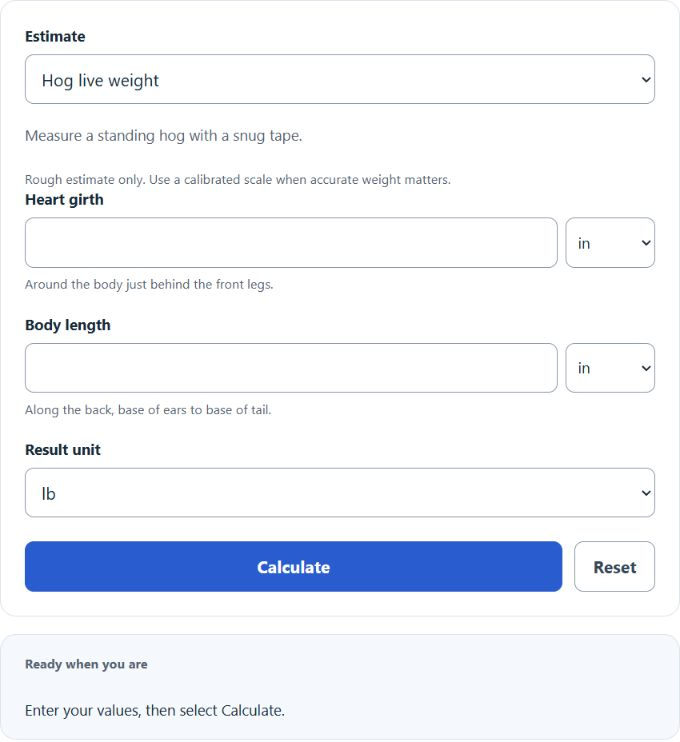
Choose an estimate for hog live weight, heart girth or body length, then enter the two required measurements in lb or kg and in or cm.
Related Calculators
- Cow Live Weight Vs Meat Weight Calculator
- Beef Yield Calculator
- Raw to Cooked Weight Conversion Calculator
- Meat Shrinkage Calculator
- All Food and Cooking Calculators
Hog Weight Formula
The calculator estimates hog weight from heart girth and body length. It also rearranges the same formula to solve for a missing measurement.
- HW = estimated hog weight, in pounds
- HG = heart girth, in inches
- BL = body length, in inches
- 400 = empirical divisor for this hog tape-measure estimate using inches and pounds
The base formula uses pounds and inches. If you enter kilograms or centimeters, the values are converted before the formula is applied, then converted back to your selected unit.
Useful Hog Weight Tables
These are illustrative size categories, not universal biological ranges. Actual weight varies by breed, condition, age and measurement technique.
| Hog Type | Typical Weight Range | Common Use |
|---|---|---|
| Feeder pig | 40 to 100 lb | Growing phase |
| Grower pig | 100 to 180 lb | Finishing preparation |
| Market hog | 220 to 300 lb | Market or processing weight |
| Mature sow or boar | 300 lb and up | Breeding stock |
Measurement Guide
| Measurement | Where to Measure | Tip |
|---|---|---|
| Heart girth | Around the body just behind the front legs | Keep the tape snug, not tight. |
| Body length | From the base of the ears to the base of the tail | Measure along the top line of the hog. |
How to Get a Better Estimate
Measure the hog while it is standing squarely on level ground. Take each measurement twice and use the average if the numbers differ. Do not pull the tape so tight that it compresses the body. This method gives a rough live-weight estimate. Reverse solves are model-implied dimensions, not measured dimensions. Use a calibrated scale when accurate weight matters.