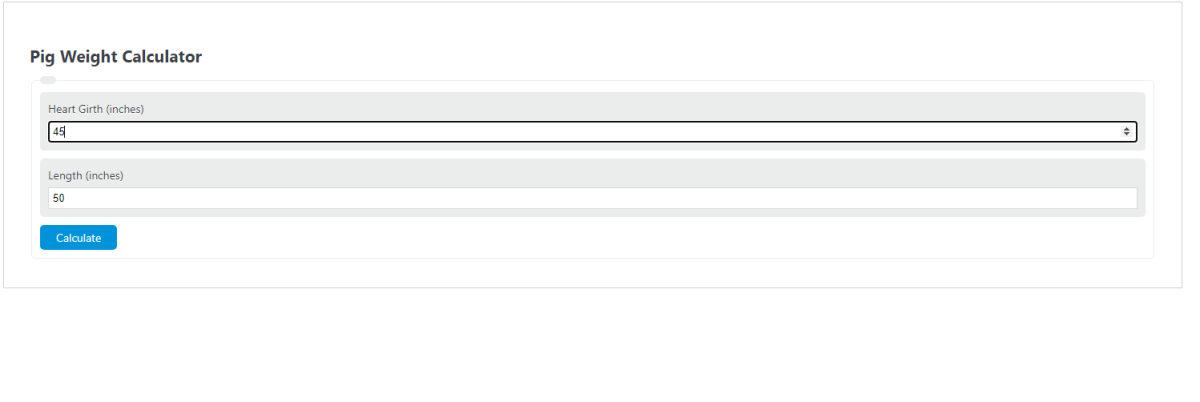
Estimate a pig’s live weight from heart girth and body length, or solve for a missing measurement, with inches, centimeters, pounds, kilograms, and an optional girth-only method.
- All Biology Calculators
- Pig Profit Calculator
- Hog Weight Calculator
- Pork Yield Calculator
- Butcher Yield Calculator
- FCR Calculator
Pig Weight Formula
The standard formula for estimating pig weight without a scale uses heart girth and body length measurements:
- Where PW is the pig weight (lbs)
- HG is the heart girth (inches), measured as the circumference of the pig directly behind the front legs
- L is the body length (inches), measured from the base of the ears to the base of the tail along the topline
This formula was developed by agricultural extension services and is widely used by small-scale farmers, 4-H participants, and homesteaders who lack livestock scales. It works because the cross-sectional area of a pig (approximated by girth squared) multiplied by its length closely models the animal’s total volume, and swine carry relatively uniform body density compared to other livestock.
Formula Accuracy and Limitations
Research from Kansas State University found that heart girth alone was strongly correlated with body weight (r squared = 0.98), with 95% of projected weights falling within plus or minus 10 pounds of the actual scale weight. A separate study found that heart girth measurement accurately predicted 50% of pigs within 9 pounds and 80% of pigs within 16 pounds of their true live weight. The combined girth-and-length formula is generally reported to be accurate within 3% for pigs in the 150- to 300-pound finishing range.
There are important limitations to keep in mind. A 1-inch misreading of heart girth translates to roughly a 10-pound error in the estimated weight. Pigs that have been recently transported or held off feed and water will show compressed girth measurements that underestimate their actual weight. The formula also loses accuracy at the extremes, performing best on finishing-weight pigs between 100 and 300 pounds and less reliably on very young pigs under 50 pounds or mature breeding stock over 400 pounds. Weight estimation models developed in one region may not transfer perfectly to pigs raised under different management systems, genetics, or climates.
Measurement Tips for Accurate Results
For the most reliable estimate, measure the pig while it is standing squarely on all four legs on level ground. Use a flexible fabric tape measure rather than a rigid one. Wrap the tape snugly around the body immediately behind the front legs at the narrowest point of the chest, which sits roughly over the heart. Avoid pulling the tape tight enough to compress the flesh, but do not leave slack. For body length, run the tape along the topline from the point between the ears to the base of the tail, keeping the tape in contact with the pig’s back. Ideally, take measurements in the morning before feeding, and take two or three readings of each measurement and average them to reduce error.
Average Pig Weight by Breed
Mature pig weights vary dramatically across breeds. The following table shows typical adult weight ranges for common breeds raised in the United States. These figures represent fully grown breeding stock, not market-weight animals.
| Breed | Mature Sow Weight (lbs) | Mature Boar Weight (lbs) | Primary Use |
|---|---|---|---|
| Yorkshire | 500 – 700 | 600 – 800 | Commercial (maternal line) |
| Duroc | 600 – 850 | 750 – 1,000 | Commercial (terminal sire) |
| Hampshire | 500 – 750 | 650 – 850 | Commercial (lean carcass) |
| Berkshire | 400 – 600 | 500 – 700 | Heritage/premium pork |
| Landrace | 500 – 700 | 600 – 800 | Commercial (maternal line) |
| Chester White | 500 – 650 | 600 – 750 | Commercial (maternal line) |
| Spotted | 500 – 700 | 600 – 800 | Commercial (dual purpose) |
| Poland China | 500 – 700 | 650 – 900 | Commercial (terminal sire) |
| KuneKune | 100 – 200 | 200 – 300 | Smallholder/pet |
| Pot-bellied | 70 – 150 | 70 – 175 | Pet/companion |
| Large Black | 500 – 700 | 600 – 800 | Heritage/pasture |
| Mangalitsa | 250 – 400 | 300 – 500 | Heritage/lard type |
Most commercial operations in the United States use crossbred pigs, typically a Yorkshire-Landrace sow crossed with a Duroc or Hampshire terminal sire. These crosses are genetically selected for lean meat production, fast growth, and large litter sizes.
Pig Weight by Age
Commercial pigs gain weight rapidly from birth to market. The following table shows approximate weight benchmarks for commercially raised pigs under standard management and nutrition. Heritage breeds and pasture-raised pigs typically grow 15 to 30% slower than these figures.
| Age | Approximate Weight (lbs) | Growth Phase |
|---|---|---|
| Birth | 2 – 4 | Neonatal |
| 1 week | 5 – 7 | Neonatal |
| 3 weeks (weaning) | 12 – 15 | Nursery |
| 6 weeks | 25 – 30 | Nursery |
| 8 weeks | 40 – 55 | Nursery/Grower |
| 10 weeks | 50 – 70 | Grower |
| 14 weeks | 100 – 130 | Grower |
| 18 weeks | 170 – 200 | Finisher |
| 22 weeks | 230 – 260 | Finisher |
| 24 – 26 weeks | 270 – 290 | Market weight |
Average daily gain (ADG) for commercial pigs in the grower-finisher phase ranges from 1.75 to 2.2 pounds per day. Genetics, diet composition, stocking density, and environmental temperature all influence daily gain. Pigs grow most efficiently at ambient temperatures between 60 and 70 degrees Fahrenheit. Heat stress above 85 degrees Fahrenheit can reduce daily gain by 10 to 20%.
Feed Conversion and Cost to Reach Market Weight
Feed conversion ratio (FCR) measures the pounds of feed required to produce one pound of live weight gain. Younger pigs convert feed more efficiently than older, heavier pigs. Early growing pigs convert feed at less than 2:1 (under 2 pounds of feed per pound gained), while finishing pigs approaching market weight convert at 3.5:1 to 4:1. The overall lifetime FCR for a pig raised from weaning to a 280-pound market weight is typically between 3:1 and 3.5:1.
This means a pig reaching a 280-pound market weight from a 15-pound weaning weight will consume roughly 800 to 930 pounds of feed over its growing period. At feed costs of $0.15 to $0.25 per pound, feed expense alone runs $120 to $230 per pig. Efficiency drops sharply above 280 pounds, which is the primary economic reason commercial operations target this as their market weight.
From Live Weight to Retail Meat
Understanding the relationship between a pig’s live weight and the amount of retail meat it yields is essential for anyone raising pigs for meat. The conversion happens in stages, and significant weight is lost at each step.
The dressing percentage for commercially bred hogs is 70 to 74% of live weight. This is the hanging carcass weight after removal of blood, hair, head, feet, and internal organs. A 280-pound live pig produces a hanging carcass of approximately 196 to 207 pounds. After cooling and further processing into retail cuts, another 20 to 25% of the carcass weight is removed as bone dust, fat trim, and moisture loss. The final retail yield is roughly 55 to 60% of live weight, meaning that same 280-pound pig yields 154 to 168 pounds of take-home meat.
The primal cuts break down approximately as follows from live weight: ham accounts for about 18%, loin 16%, Boston butt 8%, picnic shoulder 8%, belly/bacon 10%, and spare ribs 3%. Leaner, more muscular pigs produce a higher percentage of retail meat, while fatter pigs yield proportionally less. Heritage and lard-type breeds like the Mangalitsa may dress at only 60 to 65% with considerably lower lean meat yield.
Heart Girth to Weight Reference Table
The following reference table provides estimated pig weights based on heart girth measurements alone, useful for quick field estimates when measuring body length is impractical. These values are derived from the Kansas State University heart girth regression model.
| Heart Girth (inches) | Estimated Weight (lbs) |
|---|---|
| 25 | 49 |
| 28 | 64 |
| 30 | 78 |
| 33 | 100 |
| 35 | 120 |
| 38 | 150 |
| 40 | 175 |
| 42 | 200 |
| 44 | 230 |
| 46 | 260 |
| 48 | 290 |
| 50 | 325 |
These values assume a pig of typical commercial conformation. Breeds with unusually long or short bodies relative to their girth may fall outside these estimates. For pigs outside the 25- to 50-inch girth range, the full two-measurement formula (girth squared times length divided by 400) provides more reliable results.