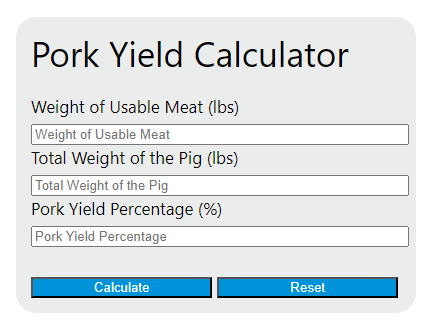
Calculate pork carcass and retail-cut yield from live weight, reverse required live weight, or derive dressing percentage with lb/kg and value breakdowns.
- All Food and Cooking Calculators
- Pork Loin Cooking Time Calculator
- Meat Shrinkage Calculator
- Butcher Yield Calculator
Pork Yield Formula
The pork yield percentage measures how much of a pig’s starting weight becomes usable meat. It is a practical metric for estimating take-home product, comparing butcher results, planning freezer space, and evaluating how trimming or processing choices affect final output.
| Variable | Meaning |
|---|---|
| PYP | Pork yield percentage |
| WUM | Weight of usable meat |
| TW | Total weight of the pig used as the starting reference weight |
If you know any two values, you can rearrange the formula to solve for the third:
How to Use the Pork Yield Calculator
- Enter the weight of usable meat you actually keep, package, or sell.
- Enter the total pig weight that you want to compare against.
- Make sure both weights use the same unit.
- Calculate the result to find the pork yield percentage.
Because yield is a ratio, the calculator works with pounds, kilograms, grams, or ounces as long as both inputs match. A pound-to-pound calculation gives the same percentage as the equivalent kilogram-to-kilogram calculation.
What Counts as Usable Meat
“Usable meat” should mean the finished product you count as retained value. That may include fresh cuts, roasts, chops, ground pork, and trim saved for sausage. The key is consistency. If you change what is counted from one animal to the next, the percentages are no longer directly comparable.
| Usually Counted | Sometimes Counted | Usually Excluded |
|---|---|---|
| Packaged cuts, roasts, chops, ground pork, trim kept for further use | Bone-in portions, fat kept for rendering, organs, skin, cured product after processing | Discarded trim, blood, waste, removed bone not retained, moisture loss that never reaches the final package |
Use the Right Starting Weight
The most important yield decision is the denominator. The same pig can show very different percentages depending on whether you start from live weight, carcass weight, or another intermediate weight.
| Starting Weight | What the Result Means | Best Use |
|---|---|---|
| Live weight | Live-to-usable-meat yield | Farm planning, take-home estimates, animal-to-animal comparison |
| Carcass or hanging weight | Carcass-to-usable-meat yield | Evaluating cutting, trimming, and deboning efficiency |
| Primal or boxed weight | Further-processed yield | Retail, inventory, and production management |
If you use total pig weight as the input, the most direct interpretation is live weight. If you instead use hanging or carcass weight, label the result clearly so it is not mistaken for live yield.
Factors That Affect Pork Yield
| Factor | Typical Effect on Yield | Why It Changes the Result |
|---|---|---|
| Cut style | Bone-in cuts may raise recorded usable weight; boneless trimmed cuts may lower it | More or less of the original mass is retained in the final package |
| Trim level | Aggressive fat trimming lowers yield | More material is removed before packaging |
| Processing method | Smoking, curing, drying, and cooking can reduce finished weight | Moisture loss changes the packaged amount |
| Animal composition | Better muscling generally improves usable meat proportion | A larger share of total weight becomes saleable product |
| Retention policy | Keeping fat, skin, organs, or soup bones increases counted yield | More of the animal is classified as usable |
| Measurement point | Live-weight yield is lower than carcass-based yield for the same packaged meat | The starting weight is larger |
Example
If a pig provides 50 pounds of usable meat from a 200-pound starting weight, the calculation is:
This means 25 percent of the starting weight ended up as the usable pork counted in the calculation.
Planning Backward From a Target Yield
You can also estimate expected usable meat when you know the pig weight and an assumed yield percentage.
At a 55 percent yield, a 280-pound pig would be expected to produce about 154 pounds of usable meat.
Why a Pork Yield May Look Lower Than Expected
- The usable meat weight was entered after heavy trimming or deboning.
- The total weight was live weight, but the expected result was based on carcass weight.
- Fat, skin, organs, or bones were not counted as retained product.
- Processed items lost moisture before final packaging.
- The two inputs were measured at different stages of processing.
Practical Ways to Use Pork Yield
- Estimate freezer space needed for a harvest or bulk purchase.
- Compare butcher instructions such as bone-in versus boneless cutting.
- Project saleable inventory for farm, market, or retail operations.
- Check whether trimming standards are too aggressive or too loose.
- Evaluate consistency across animals, processors, or processing dates.
Important Interpretation Notes
A higher yield is not always better. Keeping more fat, bone, or skin can increase the recorded percentage without increasing the amount of lean edible meat. Likewise, a lower yield is not automatically a problem if the goal is cleaner trimming, boneless cuts, or a premium finished product. The most useful comparison is between pigs processed with the same definitions, the same weight basis, and the same cut instructions.