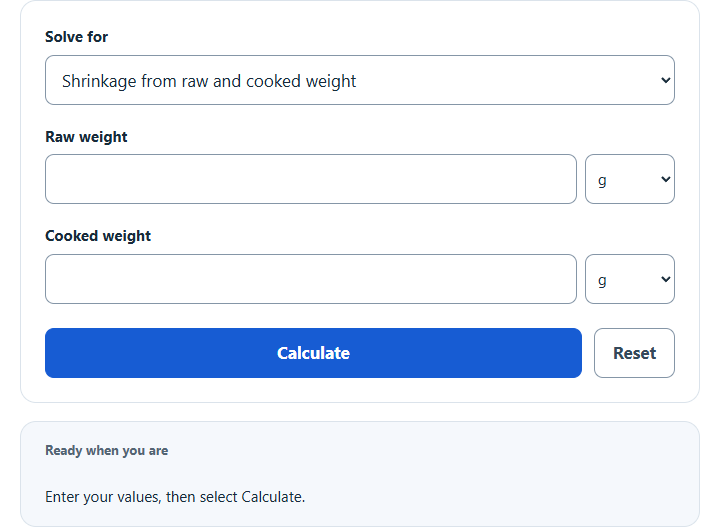
Calculate meat shrinkage from raw and cooked weight, or estimate cooked weight from raw using typical shrinkage by cooking method, plus yield and cost.
- All Food and Cooking Calculators
- Meat Ratio Calculator
- Meat Per Person Calculator
- Food Waste Percentage Calculator
- Deer Meat Yield Calculator
Calculator Functions
| Function | What it does | What it requires |
|---|---|---|
| Shrinkage from raw and cooked weight | Finds the percentage of weight meat lost in cooking and the cooked yield | Requires the raw weight and the cooked weight |
| Shrinkage from weight loss | Finds the shrinkage percentage when the loss is already known | Requires the raw weight and the weight lost |
| Weight loss from shrinkage | Estimates how much weight a raw cut will lose | Requires the raw weight and a cooking method or custom shrinkage percentage |
| Raw weight from loss | Finds the raw weight behind a known loss | Requires the weight lost and a cooking method or custom shrinkage percentage |
| Cooked weight from shrinkage | Estimates the weight left after cooking | Requires the raw weight and a cooking method or custom shrinkage percentage |
| Raw weight from cooked weight | Finds how much raw meat gives a wanted cooked weight | Requires the cooked weight and a cooking method or custom shrinkage percentage |
| Cooked cost from raw cost | Converts a raw price per unit of weight to the price of the cooked meat | Requires the raw cost, a cooking method or custom shrinkage percentage, the currency and the weight unit |
| Raw cost from cooked cost | Converts a cooked price per unit of weight back to the raw price | Requires the cooked cost, a cooking method or custom shrinkage percentage, the currency and the weight unit |
| Shrinkage from costs | Finds the shrinkage implied by a raw price and a cooked price | Requires the raw cost and the cooked cost in the same currency and weight unit |
| Complete portions available | Finds how many whole cooked portions a raw purchase yields after trim, bone and cooking losses | Requires the raw weight, the cooked portion size and a cut or custom loss percentages |
| Raw weight for portions | Finds the raw weight to buy for a number of cooked portions | Requires the portions needed, the cooked portion size and a cut or custom loss percentages |
| Trim and true cooked cost | Finds the cost of the cooked, edible meat after trim, bone and cooking losses, and the cost per portion | Requires the raw cost, the currency, the weight unit and a cut or custom loss percentages, with the portion size optional |
Weights can be entered in g, kg, lb or oz. The Cooking method list sets a typical shrinkage from 12% for sous vide to 32% for BBQ and starts at 25%, and Custom shrinkage % takes a measured figure. Costs are shown in dollars, euros or pounds with no currency conversion.
Meat Shrinkage Formulas
| S | Meat shrinkage (%) |
| Wr | Raw weight |
| Wc | Cooked weight, in the same unit |
The U.S. Department of Agriculture defines cooking yield as 100 times the hot cooked weight divided by the raw weight, and attributes the change to moisture and fat lost during cooking [1]. Shrinkage is what is left: 100 minus the yield.
Shrinkage from raw and cooked weight
A 1,000 g roast that weighs 750 g out of the oven lost (1,000 − 750) ÷ 1,000 × 100 = 25% and has a cooked yield of 75%. The cooked weight cannot be more than the raw weight here, so brined or sauced meat that gains weight is outside this function.
Shrinkage from weight loss
L is the weight lost. A loss of 250 g from 1,000 g raw is 25%.
Weight loss from shrinkage
At the 25% the calculator starts with, 1,000 g of raw meat is expected to lose 250 g.
Raw weight from loss
A 250 g loss at 25% shrinkage came from 250 ÷ 0.25 = 1,000 g of raw meat. Zero shrinkage has no answer.
Cooked weight from shrinkage
1,000 g raw becomes 750 g at 25% shrinkage and 680 g at the 32% listed for BBQ.
Raw weight from cooked weight
Serving 750 g of cooked meat at 25% shrinkage takes 750 ÷ 0.75 = 1,000 g raw.
Cooked cost from raw cost
Cr and Cc are the raw and cooked costs per unit of weight. The same money buys less cooked meat, so the price per kilogram rises: $12 per kg raw at 25% shrinkage is 12 ÷ 0.75 = $16 per kg cooked, a multiplier of 1.33.
Raw cost from cooked cost
A cooked cost of $16 per kg at 25% shrinkage corresponds to 16 × 0.75 = $12 per kg raw.
Shrinkage from costs
Raw meat at $12 per kg that works out to $16 per kg cooked implies (1 − 12 ÷ 16) × 100 = 25% shrinkage. This holds only when both prices describe the same purchase.
Complete portions available
(1 − B ÷ 100) ×
(1 − K ÷ 100)
Portions = Wr × Y ÷ p,
rounded down
Y is the edible yield, T is the trim loss, B is the bone loss after trimming, K is the cook loss after trim and bone, and p is the cooked portion size. Each loss is taken from what the previous step left, not from the purchase weight. The Brisket packer cut uses 20% trim, no bone and 35% cook loss, so Y = 0.80 × 0.65 = 52%. A 5,000 g brisket leaves 2,600 g of cooked meat, which is 15.3 portions of 6 oz (170.1 g), or 15 complete portions.
| Cut | Trim loss | Bone loss | Cook loss | Edible yield |
|---|---|---|---|---|
| Typical cooked meat | 0% | 0% | 25% | 75% |
| Brisket packer | 20% | 0% | 35% | 52% |
| Bone-in pork shoulder | 5% | 15% | 35% | 52.5% |
| Whole roasted chicken | 0% | 28% | 25% | 54% |
| Boneless ribeye | 10% | 0% | 25% | 67.5% |
| Baby back ribs | 0% | 45% | 30% | 38.5% |
| Ground beef 80/20 | 0% | 0% | 27% | 73% |
These are the losses each cut choice fills in. Any of the three can be overridden, and Custom loss percentages starts all three at zero.
Raw weight for portions
N is the number of complete portions needed. Twenty 6 oz portions of brisket are 3,402 g cooked, and at a 52% edible yield that takes 3,402 ÷ 0.52 = 6,542 g of raw brisket.
Trim and true cooked cost
Bone-in pork shoulder at $10 per kg has an edible yield of 0.95 × 0.85 × 0.65 = 52.5%, so the cooked meat on the plate costs 10 ÷ 0.525 = $19.05 per kg. With a portion size entered, the result adds the cost of one portion.
Limits of This Estimate
- The cooking method and cut percentages are round planning figures, not measurements. These estimates are based on the best available data and estimations. Measured USDA yields show the spread: braised brisket flat 69%, roasted rib eye roast 76% to 77%, roasted pork back ribs 82%, and ground beef patties from 63% to 77% depending on fat content and method [1].
- USDA weighs the cooked meat while it is still hot [1]. Meat weighed after resting or chilling will show a different loss.
- Only losses are modeled. Meat that absorbs a brine, marinade or sauce can finish heavier than the shrinkage predicts.
- Trim, bone and cook losses should each be counted once. A bone-in cut whose cook loss was measured with the bone still in already includes part of the bone weight.
Sources
- U.S. Department of Agriculture, Agricultural Research Service, USDA Table of Cooking Yields for Meat and Poultry (December 2012): cooking yield formula, what the weight change consists of, and measured yields by cut and method