Meat Per Person Calculator

Published By: Calculator Academy

Last Updated: January 5, 2026

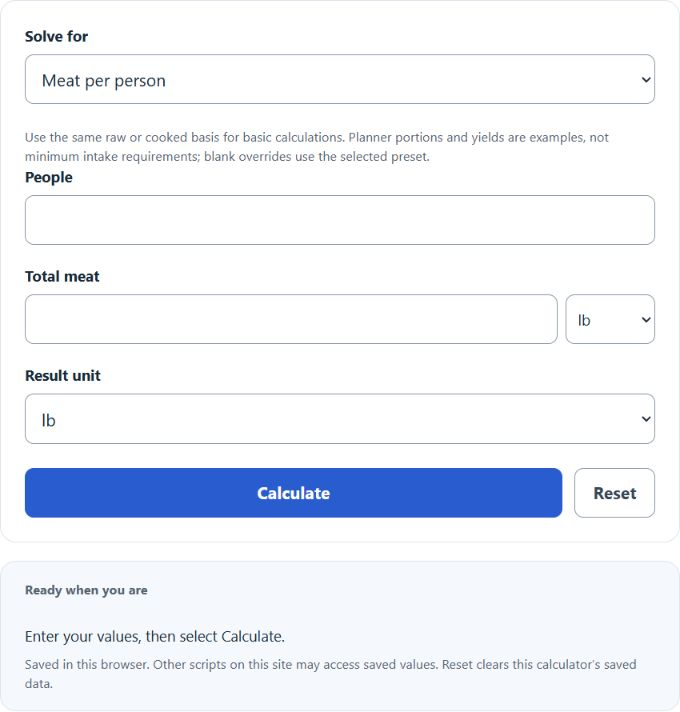
Enter the total number of guests you are going to serve into the calculator to determine the total amount of meat needed.

Meat Per Person Calculator

Basic
Event Planner

Enter any 2 values to calculate the missing variable

Meat Per Person Formula

The following formula is used to calculate the total amount of meat needed to host an event given a certain amount of people.

TM = P * 8 
  • Where TM is the total meat (ounces)
  • P is the total number of guests hosted

To calculate the meat per person, divide the total meat used by the total amount of people. For example, if there are 5 lbs of meat, and 10 people, the meat per person is .5 lbs.

How much meat per person?

When hosting events, the general rule of thumb is that you should provide at minimum 8 ounces (1/2 pound) of meat per person.

How to calculate meat per person?

Example Problem:

The following example outlines how to calculate how much meat to use for a given event.

First, determine how many guests will be served meat. For this example, 10 people intend to eat meat.

Next, multiply the number of people 8 ounces to get the total ounces of meat. 10 * 8 = 80 ounces.

Finally, divide by 16 to get the amount of meat in pounds.

80 / 16 = 5 lbs of meat
meat per person calculator
").textContent; const purchaseLabel = document.querySelector("#plannerPurchase option

Enter the total number of guests you are going to serve into the calculator to determine the total amount of meat needed.

Meat Per Person Calculator

Basic
Event Planner

Enter any 2 values to calculate the missing variable

Meat Per Person Formula

The following formula is used to calculate the total amount of meat needed to host an event given a certain amount of people.

TM = P * 8 
  • Where TM is the total meat (ounces)
  • P is the total number of guests hosted

To calculate the meat per person, divide the total meat used by the total amount of people. For example, if there are 5 lbs of meat, and 10 people, the meat per person is .5 lbs.

How much meat per person?

When hosting events, the general rule of thumb is that you should provide at minimum 8 ounces (1/2 pound) of meat per person.

How to calculate meat per person?

Example Problem:

The following example outlines how to calculate how much meat to use for a given event.

First, determine how many guests will be served meat. For this example, 10 people intend to eat meat.

Next, multiply the number of people 8 ounces to get the total ounces of meat. 10 * 8 = 80 ounces.

Finally, divide by 16 to get the amount of meat in pounds.

80 / 16 = 5 lbs of meat

meat per person calculator
").textContent; const summary = "Adults: "+a+", Kids: "+k+". Meat: "+meatLabel+" ("+styleLabel+", "+purchaseLabel+"). Buy "+formatNumber(buyInUnit)+" "+outUnit+" total. This yields about "+formatNumber(cookedInUnit)+" "+outUnit+" cooked. Approx. "+formatNumber(perAdultInUnit)+" "+outUnit+" cooked per adult."; document.getElementById("plannerResult").textContent = summary; try { localStorage.setItem("meatCalc_planner_result", summary); } catch(e){} } function calculateRouter(){ const active = localStorage.getItem("meatCalc_activeTab") ? localStorage.getItem("meatCalc_activeTab") : "basic"; if (active === "basic") { const pStr = document.getElementById("fieldname2").value.trim(); const mStr = document.getElementById("fieldname6").value.trim(); const ppStr = document.getElementById("fieldname8").value.trim(); const totalPeople = parseFloat(pStr); const totalMeat = parseFloat(mStr); const perPerson = parseFloat(ppStr); let missing = []; if (isNaN(totalPeople)) missing.push("people"); if (isNaN(totalMeat)) missing.push("totalMeat"); if (isNaN(perPerson)) missing.push("perPerson"); calculate(); if (missing.length === 1) { const tp = parseFloat(document.getElementById("fieldname2").value); const tm = parseFloat(document.getElementById("fieldname6").value); const pp = parseFloat(document.getElementById("fieldname8").value); const tmU = document.getElementById("fieldname6Unit").value; const ppU = document.getElementById("fieldname8Unit").value; let summary = ""; if (missing[0] === "perPerson") { summary = "Result: "+formatNumber(pp)+" "+ppU+" per person for "+formatNumber(tp)+" people."; } else { if (missing[0] === "totalMeat") { summary = "Result: Total meat needed is "+formatNumber(tm)+" "+tmU+"."; } else { summary = "Result: Number of people served is "+formatNumber(tp)+"."; } } document.getElementById("basicResult").textContent = summary; try { localStorage.setItem("meatCalc_basic_result", summary); } catch(e){} } } else { calculatePlanner(); } } function resetPlannerFields(){ document.getElementById("plannerAdults").value = ""; document.getElementById("plannerKids").value = ""; document.getElementById("plannerMeatType").value = "brisket"; document.getElementById("plannerBone").value = "boneless"; document.getElementById("plannerStyle").value = "regular"; document.getElementById("plannerPurchase").value = "raw"; document.getElementById("plannerUnit").value = "lb"; document.getElementById("plannerResult").textContent = ""; try { localStorage.removeItem("meatCalc_planner_result"); } catch(e){} } function resetRouter(){ const active = localStorage.getItem("meatCalc_activeTab") ? localStorage.getItem("meatCalc_activeTab") : "basic"; if (active === "basic") { resetFields(); document.getElementById("basicResult").textContent = ""; try { localStorage.removeItem("meatCalc_basic_result"); } catch(e){} } else { resetPlannerFields(); } } function setActiveTab(tab){ const basic = document.getElementById("basicCalculator"); const planner = document.getElementById("plannerCalculator"); const tBasic = document.getElementById("tab-basic"); const tPlanner = document.getElementById("tab-planner"); if (tab === "basic") { basic.style.display = "block"; planner.style.display = "none"; tBasic.style.backgroundColor = "#ffffff"; tPlanner.style.backgroundColor = "#f4f4f4"; } else { basic.style.display = "none"; planner.style.display = "block"; tBasic.style.backgroundColor = "#f4f4f4"; tPlanner.style.backgroundColor = "#ffffff"; } try { localStorage.setItem("meatCalc_activeTab", tab); } catch(e){} } document.addEventListener("DOMContentLoaded", function(){ try { const savedTab = localStorage.getItem("meatCalc_activeTab"); if (savedTab) { setActiveTab(savedTab); } else { setActiveTab("basic"); } const b = localStorage.getItem("meatCalc_basic_result"); if (b) { document.getElementById("basicResult").textContent = b; } const p = localStorage.getItem("meatCalc_planner_result"); if (p) { document.getElementById("plannerResult").textContent = p; } } catch(e){ setActiveTab("basic"); } const u6 = document.getElementById("fieldname6Unit"); const u8 = document.getElementById("fieldname8Unit"); if (u6.value !== "lb") { u6.value = "lb"; } if (u8.value !== "lb") { u8.value = "lb"; } const pu = document.getElementById("plannerUnit"); if (pu.value !== "lb") { pu.value = "lb"; } });

Meat Per Person Formula

The following formula is used to calculate the total amount of meat needed to host an event given a certain amount of people.

TM = P * 8 
  • Where TM is the total meat (ounces)
  • P is the total number of guests hosted

To calculate the meat per person, divide the total meat used by the total amount of people. For example, if there are 5 lbs of meat, and 10 people, the meat per person is .5 lbs.

How much meat per person?

When hosting events, the general rule of thumb is that you should provide at minimum 8 ounces (1/2 pound) of meat per person.

How to calculate meat per person?

Example Problem:

The following example outlines how to calculate how much meat to use for a given event.

First, determine how many guests will be served meat. For this example, 10 people intend to eat meat.

Next, multiply the number of people 8 ounces to get the total ounces of meat. 10 * 8 = 80 ounces.

Finally, divide by 16 to get the amount of meat in pounds.

80 / 16 = 5 lbs of meat

meat per person calculator