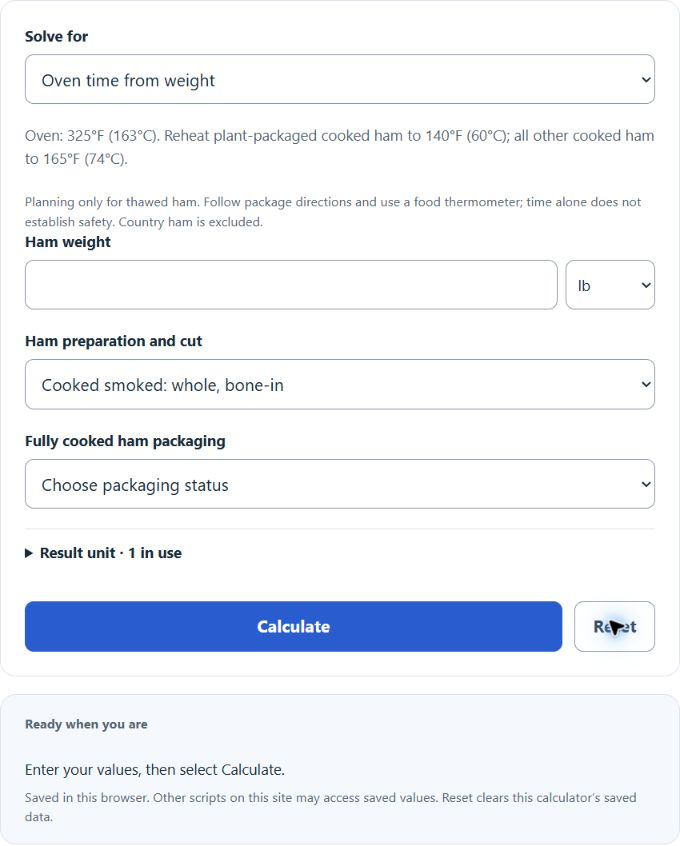
Estimate a ham oven-time range or planning weight at 325 °F (163 °C), using the matching preparation and cut. Results support minutes, hours, lb, kg and g; use a thermometer to verify the required internal temperature.
- All Food and Cooking Calculators
- Turkey Calculator (Cook Time/Defrost Time/+ More)
- Meat Per Person Calculator
How to Estimate Ham Cook Time
The Ham Cook Time Calculator estimates how long a ham should stay in the oven based on its weight and the cut you are cooking. It assumes an oven temperature of 325 °F and is most useful for meal planning, oven scheduling, glazing timing, and deciding when to begin checking for doneness.
Core Cook Time Formula
- T = total cook time in minutes
- W = weight of the ham in pounds
- R = minutes per pound for the selected ham portion
Cook Time by Preparation and Cut
The FoodSafety.gov ham chart gives planning ranges at 325 °F (163 °C). Choose the matching product; a generic boneless rate cannot distinguish canned, vacuum-packed and picnic ham. The listed weight ranges indicate where each estimate applies.
Smoked ham, already cooked
| Cut or product | Reference weight (lb) | Minutes per lb |
|---|---|---|
| Whole, bone-in | 10–14 | 15–18 |
| Half, bone-in | 5–7 | 18–24 |
| Boneless picnic shoulder | 5–8 | 25–30 |
| Canned, boneless | 3–10 | 15–20 |
| Vacuum-packed, boneless | 6–12 | 10–15 |
| Spiral-cut whole or half | 7–9 | 10–18 |
Smoked ham, cook before eating
| Cut or product | Reference weight (lb) | Minutes per lb |
|---|---|---|
| Whole, bone-in | 10–14 | 18–20 |
| Half, bone-in | 5–7 | 22–25 |
| Bone-in butt or shank section | 3–4 | 35–40 |
| Boneless picnic shoulder | 5–8 | 30–35 |
| Boneless shoulder roll | 2–4 | 35–40 |
Fresh ham, uncooked
| Cut or product | Reference weight (lb) | Minutes per lb |
|---|---|---|
| Whole leg, bone-in | 12–16 | 22–26 |
| Whole leg, boneless | 10–14 | 24–28 |
| Half, bone-in | 5–8 | 35–40 |
Use both ends of the selected rate range:
Quick Planning Examples
| Product | Weight | Estimated oven time |
|---|---|---|
| Cooked smoked whole, bone-in | 10 lb | 150–180 minutes (2.5–3 hours) |
| Cooked smoked half, bone-in | 6 lb | 108–144 minutes (1.8–2.4 hours) |
| Cook-before-eating butt/shank section | 4 lb | 140–160 minutes (2.333–2.667 hours) |
Time alone does not establish food safety. Fresh and cook-before-eating ham must reach 145 °F (63 °C), followed by at least 3 minutes resting. Reheat fully cooked ham still packaged by a USDA-inspected plant to 140 °F (60 °C). Repackaged ham, leftovers and all other cooked ham must reach 165 °F (74 °C). Use a food thermometer and follow product instructions.
Sources: FoodSafety.gov ham cooking chart and safe internal temperatures. Country ham uses a different preparation method and is excluded from this oven-time calculator.
How to Use the Calculator
- Enter the ham weight.
- Select the preparation and cut. For fully cooked ham, choose its packaging status; this determines the reheating temperature.
- Select oven time from weight or planning weight from time, enter the known value and select Calculate. Read the range in your chosen result unit.
- Use the range to plan the oven window. A thermometer and product instructions determine when cooking or reheating is complete.
- Leave extra time for resting, carving, and serving.
The source rates apply to the listed weight ranges. Values outside those ranges are extrapolations and display a warning. Estimates assume thawed ham; do not use them as a frozen-ham procedure.
Manual Weight Conversions
If you are calculating by hand and your ham weight is not in pounds, convert it first:
Why Actual Cook Time Can Differ
- Bone-in vs. boneless: shape and density can change how evenly heat moves through the meat.
- Starting temperature: starting temperature affects heating time; keep ham refrigerated until preparation and follow food-handling instructions.
- Oven calibration: many ovens run hotter or cooler than the dial indicates.
- Covered vs. uncovered: foil can reduce surface drying and slightly affect heating behavior.
- Glaze timing: adding sugar-heavy glaze too early can darken the exterior before the center is ready.
- Spiral slicing: pre-sliced hams often heat differently than solid cuts.
Helpful Cooking Notes
The calculator supplies a planning range, not a doneness or safety test. Follow package-specific directions and verify the applicable internal temperature with a food thermometer. A higher 165°F reheating target for repackaged or leftover cooked ham has no validated time adjustment in this chart.
If you are glazing the ham, a simple approach is to apply the glaze near the end of cooking so the exterior develops color without spending too long in the oven. For serving, it also helps to leave a short rest period before carving so juices can redistribute more evenly.
Common Questions
Is the result exact?
No. Ham cook time is an estimate based on weight and cut. Real oven performance, ham shape, and starting temperature can shift the final time.
Why does a butt or shank portion take longer per pound?
These cuts are often smaller and shaped differently than a large whole ham, so the planning rate is usually higher on a per-pound basis.
Can I use this calculator for reheating and full cooking?
Yes, select the matching cooked, cook-before-eating or fresh category. Cooking and reheating require different internal temperatures. Country ham and frozen ham are excluded. Fully cooked ready-to-eat ham may also be served cold according to its label.
What if I only know the time and want to estimate weight?
Rearrange the formula and solve for weight:
This inverse range is for planning a ham size from an available oven window. It does not guarantee that the food will reach its required internal temperature.