Calculate baker’s percentage, flour weight, or ingredient weight for baking recipes using grams, kilograms, pounds, or ounces in any unit.
- All Food and Cooking Calculators
- Flour Weight Calculator
- Bread Hydration Calculator
- Dough Hydration Calculator
- Baking Ratio Calculator
- Cooking Ratio Calculator
- Half Recipe Calculator
Baker’s Percentage Formula
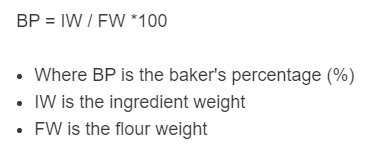
Baker’s percentage expresses each ingredient as a percentage of the total flour weight. Flour is always treated as 100%; the sum of all ingredient percentages normally exceeds 100%.
- Ingredient Weight: the weight of the ingredient you are calculating, such as water, salt, yeast, sugar, or oil.
- Flour Weight: the total weight of all flour in the recipe. This is the 100% base.
- Baker’s Percentage: the ingredient weight compared with flour weight, shown as a percent.
If the ingredient and flour use different units, the calculator first converts both weights to the same base unit, performs the calculation, then returns the result in the unit you selected.
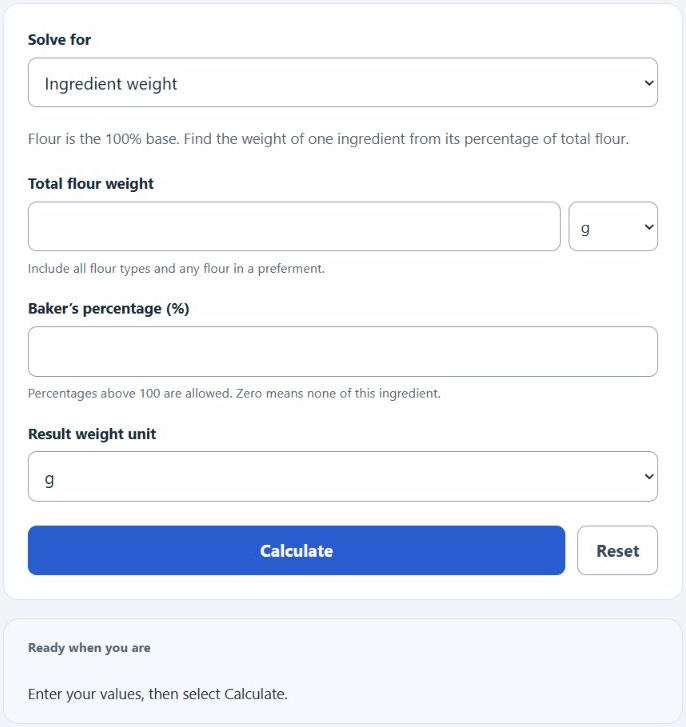
- Ingredient weight mode: use this when you know the flour weight and the baker’s percentage. For example, calculate how much water you need for 70% hydration.
- Flour weight mode: use this when you know an ingredient weight and its baker’s percentage. For example, calculate the flour weight from a known water weight.
- Baker’s percentage mode: use this when you know the ingredient weight and flour weight. For example, calculate the hydration percentage of a dough.
Illustrative Baker’s Percentage Ranges
These ranges illustrate how ingredients can be expressed relative to flour; they are not universal recipe limits. Choose amounts for your specific recipe, flour, fermentation and handling needs.
| Ingredient | Illustrative baker’s percentage | Notes |
|---|---|---|
| Water | 55% to 85% | Also called hydration. Higher values make wetter dough. |
| Salt | 1.8% to 2.5% | Most lean breads are close to 2%. |
| Instant yeast | 0.1% to 2% | Lower amounts are common for long fermentation. |
| Sugar | 0% to 15% | Lean bread may have none. Enriched dough often has more. |
| Oil or butter | 0% to 20% | Adds tenderness and richness. |
Weight Unit Conversions Used
| Unit | Equivalent in grams |
|---|---|
| 1 g | 1 g |
| 1 kg | 1000 g |
| 1 lb | 453.59237 g |
| 1 oz | 28.349523125 g |
Example Calculations
Example 1: Calculate ingredient weight
You have 500 g of flour and want 70% water hydration.
The water weight is 350 g.
Example 2: Calculate baker’s percentage
You have 360 g of water and 600 g of flour.
The water is 60% of the flour weight, so the dough has 60% hydration.
FAQ
Why is flour always 100% in baker’s percentage?
Flour is the base of the formula. Every other ingredient is measured against the total flour weight. If a dough has 1000 g of flour and 700 g of water, the water is 70% because 700 is 70% of 1000.
Can the total baker’s percentage be more than 100%?
Yes. The total usually goes over 100% because flour alone is 100%, and every other ingredient adds to that. For example, a dough with 100% flour, 70% water, 2% salt, and 1% yeast has a total formula percentage of 173%.
Do I include all types of flour in the flour weight?
Yes. Add together all flour in the recipe, including bread flour, whole wheat flour, rye flour, and any other flour. That combined flour weight is the 100% base. Include flour in any preferment; for overall hydration also include its water. The calculator requires positive flour weight and permits ingredient percentages above 100%.