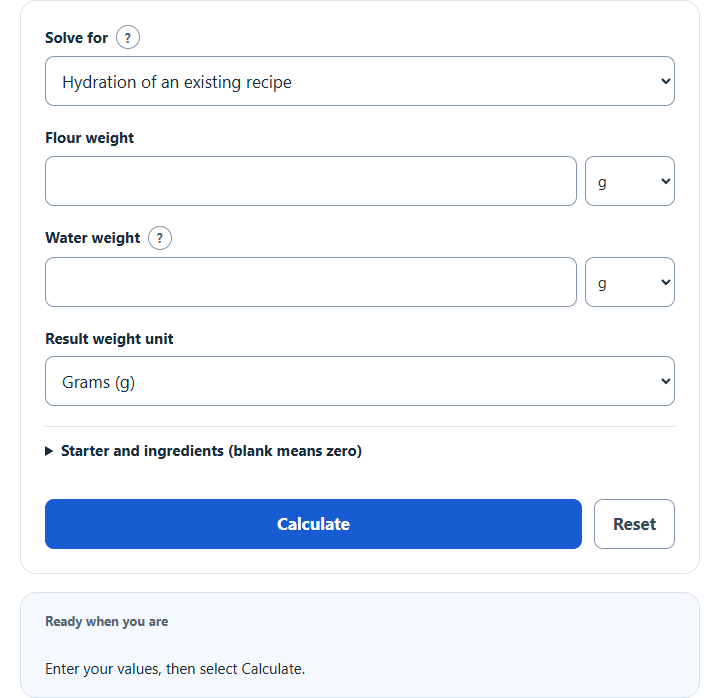
Calculate dough hydration by dividing water weight by flour weight, or find the water, flour and starter you need for a target hydration percentage.
Calculator Functions
| Function | What it does | What it requires |
|---|---|---|
| Hydration of an existing recipe | Finds the hydration percentage of a recipe | Requires the flour weight and the water weight |
| Water for a target hydration | Finds the water to add to a known amount of flour | Requires the target hydration and the flour weight |
| Recipe from total flour weight | Builds the ingredient weights for a batch from its flour | Requires the target hydration and the total flour weight, including flour in any starter |
| Recipe from total dough weight | Builds the ingredient weights for a batch of a set size | Requires the target hydration and the total dough weight |
| Recipe from number and mass of pieces | Builds the ingredient weights for a number of loaves, pizzas or rolls | Requires the target hydration, the number of pieces and the weight per piece |
| Adjust mixed dough from flour and water | Finds the water or flour to add to dough that is too dry or too wet | Requires the target hydration and the flour and water already mixed, including any starter |
| Adjust mixed dough from total weight | Finds the water or flour to add when only the dough weight is known | Requires the target hydration, the current hydration and the total dough weight |
Weights can be entered in grams, ounces or pounds, and results can be shown in any of the three. The optional settings add a sourdough starter or preferment with its own hydration, plus salt, oil or fat, sugar or malt and instant yeast as percentages of total flour. A blank optional field counts as zero, and a blank starter hydration counts as 100%. The recipe functions also offer example presets from 55% for bagels to 80% for ciabatta and focaccia, which fill in the hydration, salt and oil.
Dough Hydration Formulas
| H | Hydration (%) |
| W | Total water weight, including water in any starter |
| F | Total flour weight, including flour in any starter |
Hydration is a baker’s percentage: flour is always 100%, and every other ingredient is its weight divided by the flour weight [1]. The salt, oil, sugar and yeast percentages work the same way. Flour and water inside a preferment count toward the totals [1], so the calculator splits a starter into its two parts:
Ws = S − Fs
S is the starter weight, hs is the starter hydration as a decimal, and Fs and Ws are the flour and water inside the starter. A 100 g starter at 100% hydration holds 50 g of flour and 50 g of water.
Hydration of an existing recipe
The main formula applies directly. A recipe with 500 g of flour and 350 g of water is 350 ÷ 500 × 100 = 70% hydration. Adding 100 g of starter at 100% hydration makes it (350 + 50) ÷ (500 + 50) × 100 = 72.7273%.
Water for a target hydration
h is the target hydration as a decimal, so 75% is 0.75. Ws is the water already in the starter, or zero with no starter. For 500 g of flour at 75%, the water is 375 g. With 100 g of 100% starter as well, total flour is 550 g, total water is 412.5 g, and the water to add is 362.5 g.
Recipe from total flour weight
D = F × (1 + h + e)
D is the total dough weight and e is the sum of the salt, oil, sugar and yeast percentages as a decimal. Total flour of 1,000 g at 70% with 2% salt needs 700 g of water and 20 g of salt, for 1,720 g of dough. A starter is entered as a percentage of total flour, and its flour and water are subtracted from the amounts to weigh.
Recipe from total dough weight
Dividing the dough weight by the sum of all the percentages gives the flour [1]. For 1,000 g of dough at 70% hydration and 2% salt, flour is 1,000 ÷ 1.72 = 581.395 g, water is 406.977 g and salt is 11.628 g.
Recipe from number and mass of pieces
The dough weight is the number of pieces times the weight per piece, and the dough-weight formula then applies. Four 250 g dough balls at 62% hydration and 2.8% salt need 1,000 ÷ 1.648 = 606.796 g of flour, 376.214 g of water and 16.99 g of salt.
Adjust mixed dough from flour and water
Add flour = W ÷ h − F
The first line is used when the dough is drier than the target and the second when it is wetter. Dough with 500 g of flour and 300 g of water is at 60%, and reaching 70% takes 50 g more water. Dough with 500 g of flour and 400 g of water is at 80%, and bringing it down to 70% takes 400 ÷ 0.70 − 500 = 71.429 g more flour. When flour is added, the calculator also lists the extra salt that keeps the salt percentage the same.
Adjust mixed dough from total weight
The flour in the mixed dough is worked out from its weight D and its current hydration hnow, then the adjustment formulas above apply. A 900 g dough at 80% hydration with no other ingredients holds 500 g of flour and 400 g of water, so reaching 70% takes 71.429 g of flour.
Limits of This Estimate
- Only water counts as water. Oil, milk, eggs and other wet ingredients are not counted, so an enriched dough handles wetter than its hydration figure suggests.
- The same hydration feels different from one flour to the next. Whole grain and rye flours absorb water differently from white flour, and the calculator does not adjust for that.
- A starter is treated as flour and water only, at the hydration entered.
- The presets are example recipes, not rules for a bread style. These estimates are based on the best available data and estimations.
Sources
- King Arthur Baking, Baker’s Percentage: hydration as a percentage of flour weight, sizing a recipe from total dough weight, and counting flour and water in a preferment