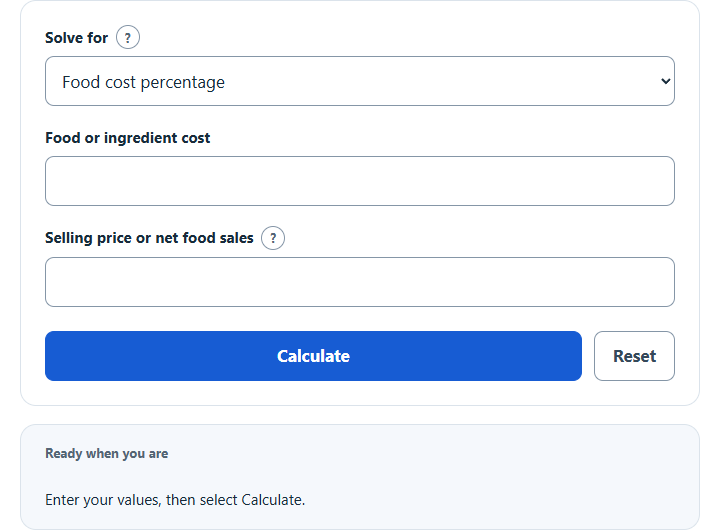
Calculate food cost percentage from ingredient cost and menu price, or find the menu price for a target food cost or your food cost % for a period.
Assumptions Read first
- The calculator uses a simple ratio: Food Cost % = (Total Cost of Food ÷ Total Sales) × 100. The other variables are solved algebraically from this identity.
- Choose a solve mode and complete its visible required fields. The period-inventory mode uses four matching inventory and sales inputs.
- Denominators cannot be zero. Specifically, Total Sales must not be 0 when computing Food Cost %, and Food Cost % must not be 0 when solving for Total Sales.
- Use the same currency for Cost and Sales and ensure both refer to the same period, menu scope, and location.
- Total Cost of Food is intended to represent food cost of goods sold (COGS) for the period (e.g., beginning inventory + purchases − ending inventory), optionally adjusted for transfers/waste/employee meals per your policy. It excludes labor, overhead, paper, and typically beverages.
- Total Sales should reflect net food sales for the same period (commonly excluding sales tax and tips, and net of comps/discounts/voids). Using gross vs. net sales will change the resulting percentage.
- Currency amounts are rounded to two decimals; percentages display up to two decimals. Calculations use full precision before display.
- The tool performs arithmetic only and does not enforce accounting policies or provide financial advice. Enter realistic, non‑negative values.
When to Use This Calculator
- Calculate your Food Cost % from known cost and sales for a period.
- Find required sales to hit a target Food Cost % given a known cost (e.g., to set menu price for an item).
- Compute the allowable food cost given projected sales and a target Food Cost %.
- Run quick what‑if scenarios when ingredient prices or sales change.
- Track cost control weekly/monthly and compare to targets or industry benchmarks.
Input Definitions
- Total Cost of Food ($) — Food COGS for the selected period. Typically: beginning inventory + purchases − ending inventory; may be adjusted for transfers, waste, or employee meals. Excludes labor/overhead/non‑food items.
- Total Sales ($) — Net food sales for the same period (commonly excluding taxes and tips; net of comps/discounts/voids), for the same scope as the cost.
- Food Cost Percentage (%) — The share of food sales consumed by food cost.
- Formulas:
- Food Cost % = (Total Cost of Food ÷ Total Sales) × 100
- Total Sales = Total Cost of Food ÷ (Food Cost % ÷ 100)
- Total Cost of Food = (Food Cost % ÷ 100) × Total Sales
- Data entry tips — Choose a solve mode; use matching currencies and periods and avoid zero denominators. Currency amounts display two decimals; percentages display up to two decimals.
- Food Budget Calculator
- Net Profit Calculator
- All Business Calculators
- Cupcake Cost Calculator
- Average Groceries Cost Per Month Calculator
- Food Waste Percentage Calculator
Food Cost Percentage Formula
The following formula is used to calculate the food cost percentage.
- Where FCP is the food cost percentage
- COF is the total cost of food
- S is the total sales of food
To calculate a food cost percentage, divide the cost of the food by the total sales of food, then multiply by 100.
Food Cost Percentage Definition
A food cost percentage is the ratio of the cost of food to the sales value of food.
Food Cost Percentage Example
How to calculate food cost percentage?
- First, determine the total cost of food.
Determine food used for the matching period: beginning food inventory plus purchases minus ending inventory, with adjustments under a consistent accounting policy.
- Next, determine the total sales.
Calculate how many sales were generated during the same time period.
- Finally, calculate the food cost percentage.
Using the formula, calculate the percentage of food costs.
FAQ
Food cost percentage is a ratio of the cost of food to the total sales generated by a restaurant.
There is no universal success threshold. A suitable target depends on the menu, pricing and operating costs; a food cost percentage alone does not establish profitability.