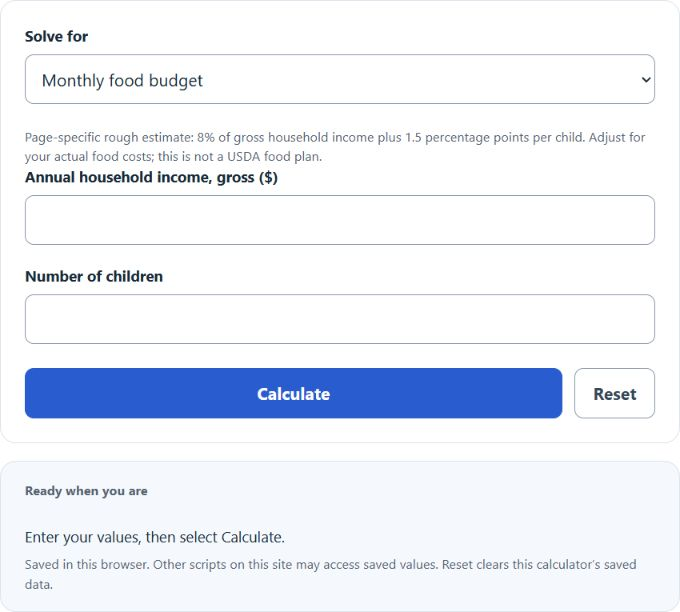
Calculate monthly and annual food budget from household income and number of children, or solve for income with an 8% base plus 1.5% per child.
How much money should I spend on food?
Food can be a major monthly expense in many households, especially for those with large families. As a result, many families or individuals can save significant amounts of money through planning and reducing food waste.
So how much should you spend?
There is no single universally “correct” percentage of income to spend on food. Costs vary widely by household size, location, dietary needs, and whether you include dining out versus groceries only. This page’s calculator uses a simple rule-of-thumb formula based on gross income: Monthly Food Budget = (Annual Income ÷ 12) × (0.08 + 0.015 × Number of Children) (8% baseline plus 1.5 percentage points per child). This is this page’s assumption, not a USDA food plan or a validated universal spending rule. The inverse child calculation is an algebraic equivalent, which can be fractional; a budget below the baseline has no nonnegative equivalent. Treat the result as a rough estimate and adjust it based on your real prices and priorities. Because taxes and deductions vary, many people also prefer to build a budget from take-home (net) pay instead of pre-tax income.
If food is taking a large share of your income, that does not automatically mean you are in financial trouble—it can reflect a lower income, higher local prices, medical or dietary needs, or temporary circumstances. It can, however, be a useful signal to review food waste, meal planning, and other parts of your budget.
How can I reduce my food budget?
You might be thinking that the numbers from a percentage-based estimate feel low, and they can be depending on your location and caloric needs. If you want to reduce your food budget, here are some practical ways that can help.
- Compare unit prices before buying in bulk. Larger packages of foods that store well can cost less per unit, but savings vary; buy only what you can use or store safely.
- Cut back on high-cost items you do not value much. Restaurant meals, convenience foods, and heavily processed snacks are often the most expensive per calorie/serving, but the right cuts depend on your preferences and nutrition needs.
- Meal prep weekly. Preparing meals ahead of time can help reduce impulse purchases and food waste.
- Try more than one grocery store. Prices and promotions can vary a lot by store and by week.
- Use coupons and loyalty programs if they apply to items you already planned to buy.