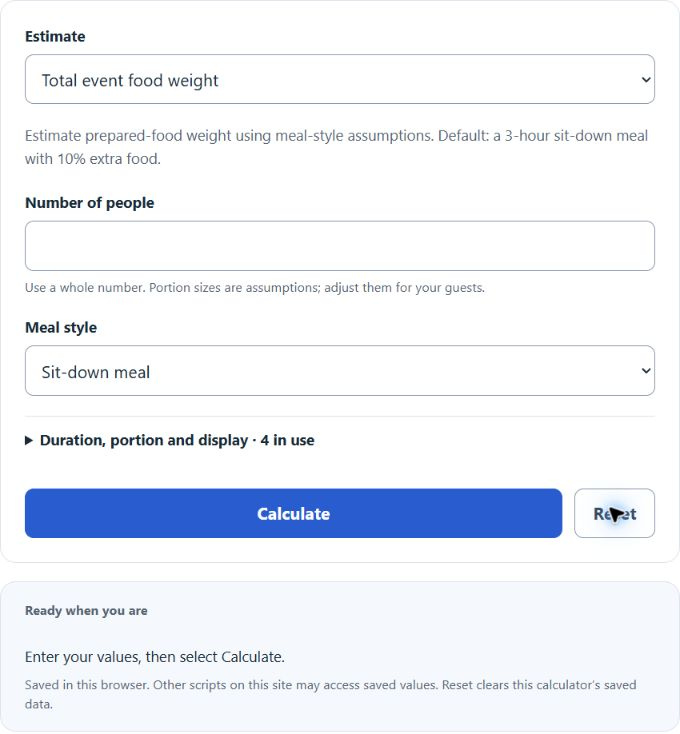
Estimate event food by people and meal style, or calculate purchased weight from edible serving size, meals and preparation yield. Use pounds, kilograms, ounces or grams; event portion presets are adjustable planning assumptions.
Related Calculators
- Cost Per Serving Calculator
- Moisture Loss Calculator
- Beef Yield Calculator
- Pork Yield Calculator
- All Food and Cooking Calculators
Food Quantity Formula
The following formula applies to the Serving size and yield mode. It calculates purchased weight from the edible serving weight. The two event modes use separate disclosed portion assumptions.
Variables:
- FQ is purchased food weight before the preparation loss represented by E (for example, kg)
- N is the number of people
- S is edible serving weight per person per meal (same weight unit as FQ; for example, kg)
- M is the number of meals
- E is preparation yield: edible output weight divided by purchased input weight, times 100; use a value above 0 and at most 100%
To calculate purchased weight, multiply whole-number people by edible serving weight per person per meal and whole-number meals. Divide by yield as a decimal (E/100). An 80% yield is 0.80 and represents 20% preparation loss, so divide by 0.80 rather than add 20%. Yield and a leftover buffer are different assumptions.
What is a Food Quantity?
Food quantity is the weight needed for the chosen plan. Serving size and yield estimates purchased weight; Total event food weight estimates edible prepared weight using meal-style presets or a custom portion. Event menu breakdown uses separate menu assumptions and rounds pieces and servings upward. It is not a sum to add to the separate total-weight estimate. None of these models determines an individual’s dietary needs.
How to Calculate Food Quantity?
Select Serving size and yield to use the formula below. For an event estimate instead, choose either event mode and review its duration, buffer and portion assumptions. The following steps apply to purchased weight:
- First, determine the number of people (N).
- Next, determine the edible serving weight per person per meal (S) in kg, g, lb or oz. Ounces here are avoirdupois weight, not fluid volume.
- Next, determine the number of meals (M).
- Next, determine preparation yield (E), above 0 and at most 100%. A 20% loss from purchased weight means 80% yield.
- Finally, calculate the Food Quantity (FQ) using the formula FQ = (N * S * M) / (E/100).
- Check the purchased weight with the Serving size and yield mode above. Its result uses the serving’s weight unit and also shows kg and lb equivalents. Event-mode duration and buffer settings do not apply to this calculation.
Example Problem:
Use the following variables as an example problem to test your knowledge:
Number of people (N) = 10
Standard serving size per person (S) = 0.5 kg
Number of meals (M) = 3
Efficiency of food preparation (E) = 80%. Edible weight = 10 × 0.5 × 3 = 15 kg. Purchased weight = 15 ÷ 0.80 = 18.75 kg; expected preparation loss = 3.75 kg.