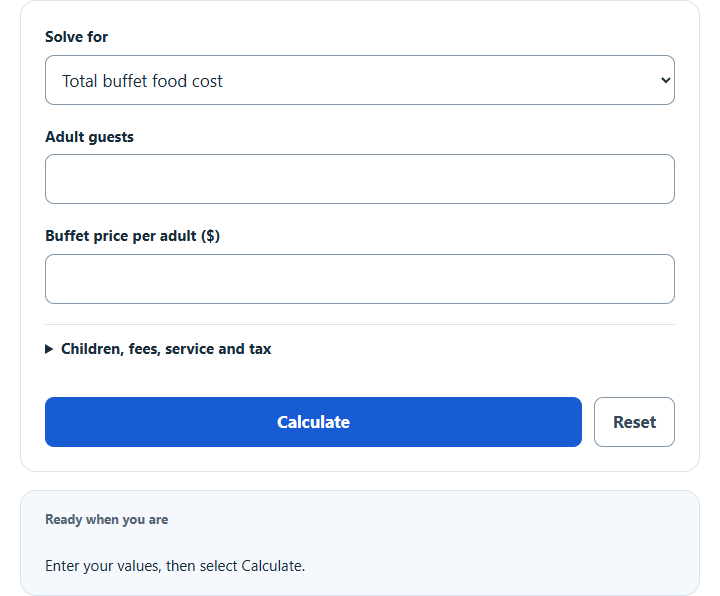
Calculate buffet food cost from your number of guests and price per person, with optional child pricing, fees, service, tax and a food quantity estimate.
Calculator Functions
| Function | What it does | What it requires |
|---|---|---|
| Total buffet food cost | Finds the all-in cost of a buffet from per-guest prices, with extra food, fees, service charge, gratuity and sales tax added | Requires the number of adult guests and the buffet price per adult |
| Price per adult from a budget | Finds the highest buffet price per adult that keeps the all-in total within a budget | Requires the all-in budget and the number of adult guests |
Both functions accept optional child guests and a price per child, an extra food allowance (%), fixed delivery and setup fees, a service charge (%), a gratuity (%) and sales tax (%). A blank optional field counts as 0. Every result also shows the all-in cost per guest, each cost component, and a weight of food to plan at about 1.5 lb per adult and 0.75 lb per child. Total buffet food cost adds the totals for 10 more and 10 fewer adults.
Buffet Food Cost Formula
x × (P × (1 + s) + F)
| T | All-in buffet cost ($) |
| P | Planned food cost ($): base food cost × (1 + extra food allowance) |
| s | Service charge as a decimal (20% = 0.20) |
| g | Gratuity as a decimal |
| F | Fixed delivery and setup fees ($) |
| x | Sales tax rate as a decimal |
Service charge and gratuity are both percentages of the planned food cost. Sales tax is charged on the food, the service charge and the fixed fees, and not on the gratuity. That split follows the usual state treatment, in which a mandatory service charge is taxable and a voluntary gratuity is not [1] [2].
Total buffet food cost
B is the base food cost, A and C are the numbers of adult and child guests, and a and c are the buffet prices per adult and per child. With no optional entries the total is simply guests × price: 100 adults at $60 is $6,000. Adding a 10% extra food allowance, a 20% service charge and 8% sales tax gives P = $6,600, a service charge of $1,320, tax of 0.08 × $7,920 = $633.60 and a total of $8,553.60.
Price per adult from a budget
((1 + s) × (1 + x) + g)
K is the all-in budget. This is the main formula solved for the planned food cost. The price per adult then follows from removing the extra food allowance and the child guests:
e is the extra food allowance as a decimal. A $10,000 budget for 100 adults with $500 of fixed fees, a 20% service charge and 8% tax gives P = (10,000 − 540) ÷ 1.296 = $7,299.38, or $72.99 per adult. A budget that does not cover the fixed fees and their tax, or child prices that use up all of the food money, is rejected.
Limits of This Estimate
- Sales tax rules for service charges and gratuities differ by state. California taxes mandatory tips and service charges and does not tax optional ones (publication revised September 2018) [1]. New York taxes a caterer’s service charge and leaves a mandatory gratuity untaxed only when it is shown separately, labeled as a gratuity and paid in full to employees (bulletin dated April 8, 2019) [2]. The caterer’s quote shows which charges are taxed.
- The food weight of 1.5 lb per adult and 0.75 lb per child is a planning rule of thumb, not a published standard. The right amount depends on the menu, the time of day and the length of the event. These estimates are based on the best available data and estimations.
- The total covers only what is entered. Drinks, rentals, staffing and venue costs are left out unless they are part of the price per guest or the fixed fees.
Sources
- California Department of Tax and Fee Administration, Publication 115, Tips, Gratuities, and Service Charges: mandatory charges are taxable and optional tips are not
- New York State Department of Taxation and Finance, Tax Bulletin ST-110, Caterers and Catering Services: tax on a caterer’s service charge and the conditions for an untaxed gratuity