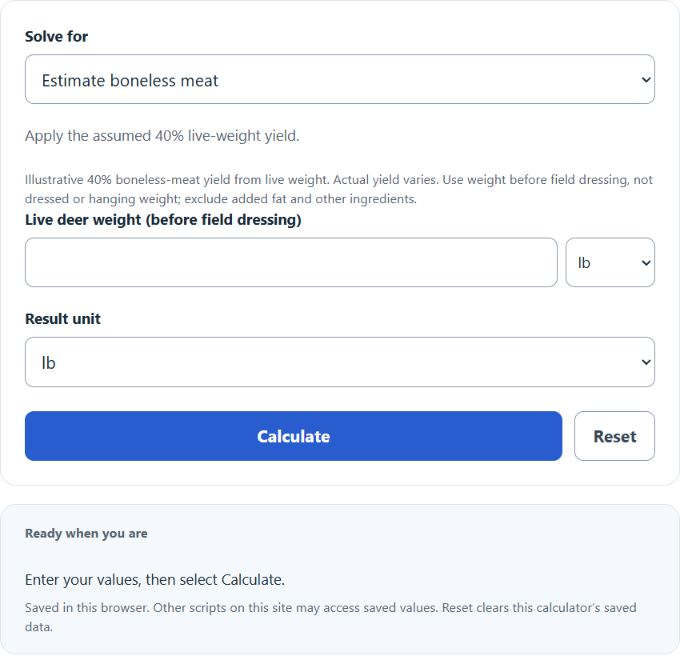
Calculate deer meat yield or total deer weight from one known value using a 40% yield ratio, with pounds and kilograms unit conversion.
- All Food and Cooking Calculators
- Price Per kg Calculator
- Meat Shrinkage Calculator
- Meat Ratio Calculator
Deer Meat Yield Formula
The calculator uses an illustrative assumption that boneless venison is 40% of live deer weight before field dressing. This is not a standard or guaranteed recovery rate. Boneless meat excludes added fat or other ingredients.
- Meat Yield is the estimated usable deer meat, in pounds or kilograms.
- Total Deer Weight is live deer weight before field dressing, in pounds or kilograms. Do not enter dressed or hanging weight.
- 0.40 is the assumed yield rate, meaning 40% of the total deer weight becomes usable meat.
If you enter the total deer weight, the calculator multiplies that weight by 0.40 to estimate the deer meat yield. If you enter the deer meat yield, the calculator divides that yield by 0.40 to estimate the original total deer weight.
The calculator converts kilograms to pounds before applying the formula, then converts the result back to the unit you selected.
Estimated Deer Meat Yield by Total Weight
The table below shows common estimates using the same 40% yield rate used by the calculator.
| Total Deer Weight | Estimated Meat Yield | Calculation |
|---|---|---|
| 100 lb | 40 lb | 100 × 0.40 |
| 125 lb | 50 lb | 125 × 0.40 |
| 150 lb | 60 lb | 150 × 0.40 |
| 175 lb | 70 lb | 175 × 0.40 |
| 200 lb | 80 lb | 200 × 0.40 |
Common Yield Factors That Affect Venison Amount
| Factor | Effect on Meat Yield |
|---|---|
| Shot placement | Damaged shoulders, ribs, or hindquarters can reduce usable meat. |
| Trimming preference | Removing more fat, silver skin, and connective tissue lowers final yield. |
| Bone-in vs. boneless cuts | Boneless processing produces less final weight than bone-in cuts. |
| Field dressing and handling | Poor cooling or contamination can require extra trimming and reduce yield. |
Example Calculations
Example 1: Estimate meat yield from total deer weight
If the total deer weight is 150 lb, use the meat yield formula:
The estimated deer meat yield is 60 lb.
Example 2: Estimate total deer weight from meat yield
If the meat yield is 48 lb, use the reverse formula:
The estimated total deer weight is 120 lb.
FAQ
What percentage of a deer becomes usable meat?
This calculator assumes 40% of live deer weight for illustration. The actual amount can be higher or lower depending on the size of the deer, the amount of trimming, shot damage, and whether the meat is processed bone-in or boneless.
Is this calculator using live weight or field-dressed weight?
Use live weight before field dressing. Live, field-dressed and hanging weights are different bases, so the assumed 40% factor must not be applied interchangeably to them. The reverse calculation estimates live weight only at that assumed yield.
Why is my actual venison yield different from the estimate?
The estimate uses an illustrative fixed yield assumption. Your actual packaged meat can differ because processors trim differently, some cuts may be discarded due to damage, and boneless processing removes bone weight. Extra grinding, sausage making, or mixing with added fat can also change the final packaged weight.