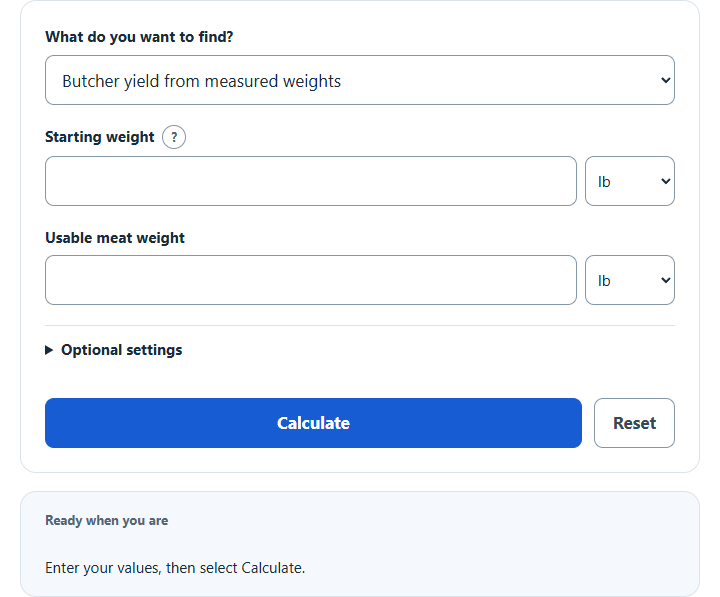
Calculate butcher yield as the percent of usable meat from a starting weight, or estimate packaged meat and hanging weight from live weight.
- All Food and Cooking Calculators
- Meat Shrinkage Calculator
- Deer Meat Yield Calculator
- Dressing Percentage Calculator
Calculator Functions
| Function | What it does | What it requires |
|---|---|---|
| Butcher yield from measured weights | Finds the percentage of a starting weight that is left as usable meat | Requires the starting weight and the usable meat weight |
| Packaged meat from live weight | Estimates the packaged meat that comes back from a live animal | Requires the animal and its live weight |
| Live weight for a packaged target | Estimates the live weight needed to bring home a set amount of packaged meat | Requires the animal and the target packaged weight |
Weights can be in pounds or kilograms. The animal can be beef, hog or lamb with typical percentages, or custom dressing and cutting percentages. An optional total cost adds the cost per usable pound or kilogram.
Butcher Yield Formulas
| Y | Butcher yield (%) |
| U | Usable meat weight after butchering or trimming |
| S | Starting weight: live, hanging (carcass) or as-purchased weight |
Butcher yield from measured weights
This is the formula of a kitchen yield test, where the starting weight is the as-purchased weight and the usable weight is the edible portion. A 2,500 g tenderloin that trims down to 1,750 g has a yield of 1,750 ÷ 2,500 × 100 = 70% [1]. The calculator also lists the trim, bone and waste, which is the starting weight minus the usable weight.
Packaged meat from live weight
L is the live weight. D is the dressing percentage, the hanging (carcass) weight as a percent of live weight [2]. C is the cutting yield, the packaged meat as a percent of hanging weight. The hanging weight on its own is L × D ÷ 100.
| Animal | Dressing % | Cutting yield % | Packaged % of live weight |
|---|---|---|---|
| Beef | 62 | 67 | 41.5 |
| Hog | 72 | 74 | 53.3 |
| Lamb | 54 | 70 | 37.8 |
A 1,300 lb steer gives 1,300 × 0.62 = 806 lb hanging and 806 × 0.67 = 540 lb packaged. These presets are typical figures, not measurements of one animal. Kansas State University gives dressing ranges of 60–64% for beef, 70–75% for pork and 54–59% for lamb, and cutting yields of 65–70% for bone-in beef, 55–60% for boneless beef, 75–80% for bone-in pork, 65–70% for boneless pork and 70–75% for bone-in lamb [2]. The hog preset of 74% sits between the boneless and bone-in pork ranges.
Live weight for a packaged target
To bring home 300 lb of packaged beef at the preset percentages, the live weight is 300 ÷ (0.62 × 0.67) = 722 lb.
Cost per usable pound
With a total cost entered, the calculator divides it by the usable or packaged weight. A $2,600 animal and processing bill for 540 lb of packaged beef is $4.81 per usable pound.
Limits of This Estimate
- Dressing percentage changes with gut fill, mud or manure on the hide, hide or wool weight, muscling and fatness [2].
- Cutting yield drops with boneless cuts, leaner ground meat, longer or dry aging, and cooked or cured products such as hams, bacon and sausage [2].
- The beef, hog and lamb presets are single values chosen from within published ranges. These estimates are based on the best available data and estimations. Custom percentages from the processor give a closer answer.
Sources
- BCcampus, Basic Kitchen and Food Service Management, Yield Testing: yield percentage as edible weight divided by as-purchased weight, and the 2,500 g tenderloin example
- Kansas State University Research and Extension, How Much Meat to Expect from Your Animal (MF3394): dressing percentage, typical ranges for beef, pork and lamb, and what changes the weight returned