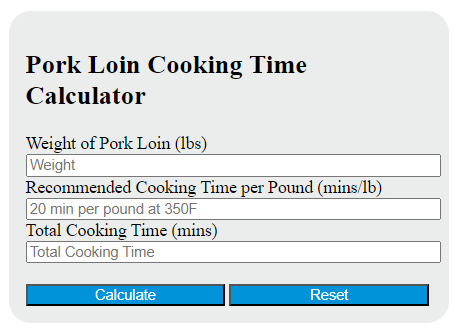
Calculate pork loin cooking time from roast weight, oven temperature, and cut, plus minutes per pound, pull temperature, and the exact time to start cooking.
- All Food and Cooking Calculators
- Cooking Calculator
- Cooking Measurement Converter Calculator
- Cooking Time Conversion Calculator
- Ham Cook Time Calculator
- Turkey Calculator (Cook Time/Defrost Time/+ More)
- Grams To Teaspoons
Pork Loin Cooking Time Formula
The following formula is used to calculate the cooking time for a pork loin.
Variables:
- T is the total cooking time (minutes)
- W is the weight of the pork loin (pounds)
- R is the recommended cooking time per pound (minutes per pound — use values from the reference table below based on oven temperature and roast size)
Pork Loin Cooking Time Reference Table
Use these values as the R input in the calculator above. All times target a pull temperature of 140°F; carryover cooking raises the internal temperature to the USDA-required 145°F during the mandatory 3-minute rest. Add 5 to 7 min/lb for bone-in roasts.
| Oven Temp | Small Roast 2-3 lb (min/lb) |
Medium Roast 4-6 lb (min/lb) |
Large Roast 7-10 lb (min/lb) |
|---|---|---|---|
| 325°F / 163°C | 25-30 | 22-26 | 18-22 |
| 350°F / 177°C | 22-26 | 20-24 | 15-18 |
| 375°F / 191°C | 18-22 | 16-20 | 13-16 |
| 400°F / 204°C | 15-18 | 13-16 | 11-13 |
Cooking Method Comparison
| Method | Time | Pull Temp | Notes |
|---|---|---|---|
| Oven 350°F | 20-25 min/lb | 140°F internal | Browned crust; rests to 145°F |
| Slow Cooker (Low) | 4-5 hours total | 145°F internal | No carryover; check with thermometer |
| Slow Cooker (High) | 2.5-3 hours total | 145°F internal | Slightly firmer texture than low |
| From Frozen (Oven) | +50% over normal | 145°F internal | Time unreliable; thermometer required |
| Stuffed Loin (Oven) | Normal + 30-45 min | 145°F in stuffing | Verify stuffing temp separately |
What is a Pork Loin Cooking Time?
Pork loin cooking time is the duration required to raise the internal temperature of the roast to a safe and palatable level. In 2011, the USDA revised its pork cooking guidelines, lowering the safe whole-muscle minimum from 160°F to 145°F with a 3-minute rest. Cooking to the older 160°F target reliably produces dry, tough meat; at 145°F the proteins retain significantly more moisture and the texture stays tender. The practical pull temperature is 140°F, since residual heat (carryover cooking) raises the interior an additional 5 to 10°F during rest. Larger roasts carry over more heat than smaller ones — a 10 lb loin may rise 10°F during rest while a 2 lb loin may rise only 5°F.
Why Minutes Per Pound Decreases as Roast Size Increases
Pork loin is a cylindrical cut. As a roast gets heavier, it grows primarily in length rather than in diameter. Heat must travel radially inward to reach the center — along the radius, not along the length. A 10 lb loin and a 5 lb loin are roughly the same diameter; the larger one is simply longer. Because the heat-penetration distance to the center does not scale with total weight, minutes per pound falls as the roast gets heavier. A 2 lb roast may need 25 min/lb at 350°F while a 10 lb roast at the same temperature needs only about 15 min/lb. Always use the size-appropriate column in the reference table above rather than applying a single flat rate.
How to Calculate Pork Loin Cooking Time
- Determine the weight (W) of the pork loin in pounds.
- Choose your oven temperature and find the corresponding minutes per pound (R) from the reference table, using the correct size column for your roast.
- Multiply W by R to get total estimated cook time in minutes: T = W x R.
- Begin checking internal temperature about 20 minutes before the estimated end time. Remove the roast at 140°F, tent loosely with foil, and rest 3 minutes minimum before slicing.
Example: A 5 lb boneless pork loin roasted at 350°F falls in the medium roast column, so R = 20-24 min/lb. Estimated total time: 100-120 minutes. Pull the roast at 140°F internal regardless of where the clock falls; carryover brings it to 145°F during the rest.