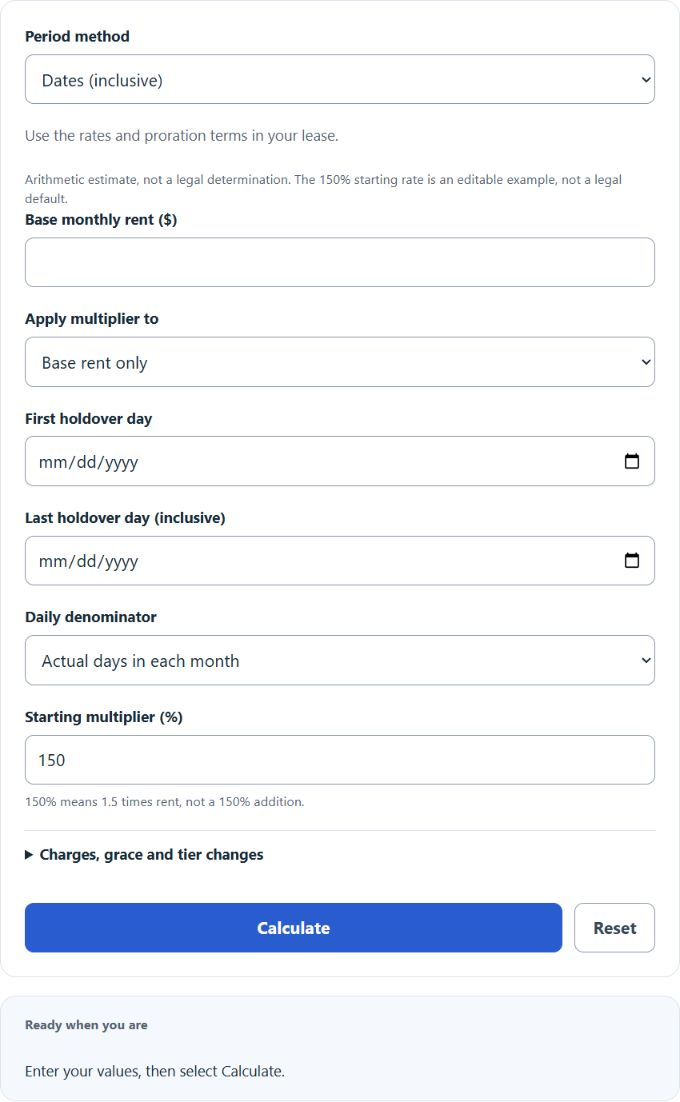
Choose dates or whole/partial months, enter base rent and your lease multiplier, and optionally add charges, an initial grace period and tier changes. Displayed multiplier examples do not establish the legally applicable rate.
- All Rent Calculators
- All Personal Finance Calculators
- Late Rent Calculator
- Occupational Rent Calculator
- Rent Late Fee Calculator
- Late Rent Interest Calculator
- Rent Increase Calculator
Holdover Rent Formula
A common lease-based approach is to calculate holdover rent as the normal rent for the charged holdover period, multiplied by any holdover premium (multiplier) specified in the lease or applicable law.
Variables:
- H is the total holdover rent (in dollars) for the charged holdover period
- M is the monthly rent subject to the multiplier. For gross premiums, it includes additional monthly charges. For base-only premiums, the formula gives the base-rent portion; add ordinary additional charges for the charged period.
- P is the charged holdover period in months (after subtracting any grace period, if applicable)
- k is the holdover multiplier as a percentage (for example, 150 means 1.5× the normal rent rate)
To calculate holdover rent for a single rate, multiply the monthly rent basis by the charged holdover period and the holdover multiplier. If your lease uses step-ups (tiers) over time (for example 150% for the first month and 200% thereafter), calculate each tier separately for its portion of the holdover period and add the results. The date method supports actual days in each calendar month, a fixed 30-day daily divisor, or 365/12. It counts actual calendar days inclusively; the fixed-30 option is not a formal financial 30/360 date-count algorithm. Base-only premiums leave additional charges at their ordinary rate; gross premiums multiply both.
What is Holdover Rent?
Holdover rent refers to rent charged when a tenant remains in a rental property after the lease term ends. Depending on the facts and local law, staying over can become a landlord-consented periodic tenancy (such as month-to-month) or, if the landlord does not consent, a tenancy at sufferance. The amount charged during the holdover period depends on the lease and applicable law: it may be the same as the prior rent or it may include a premium (often stated as a percentage such as 150%–200% of base rent) and may be prorated by month or by day.
How to Calculate Holdover Rent?
The following steps outline how to calculate the Holdover Rent.
- First, determine the monthly rent basis (M) (for example, base rent only, or base rent plus additional charges if your lease defines holdover on a “gross” basis).
- Next, determine the charged holdover period (P) in months (or determine the holdover dates and convert/prorate to a monthly amount), excluding any grace period if applicable.
- Next, determine the holdover multiplier (k) from the lease or applicable law (for example, 150% for the first month, 200% thereafter).
- Next, calculate the holdover rent. For a single rate, use H = M × P × (k/100). For tiered step-ups, calculate each tier’s amount and add them together.
- After inserting the values and calculating the result, check your answer with the calculator above.
Example Problem :
Use the following variables as an example problem to test your knowledge.
Monthly Rent Amount (M) = $1000
Holdover Period (P) = 3 months
If the lease specifies a 150% holdover rate (k = 150), then H = 1000 × 3 × (150/100) = $4,500. If there is no holdover premium (k = 100), then H = 1000 × 3 × (100/100) = $3,000. These examples assume no additional charges or grace period. The calculator rounds each displayed amount once to cents and estimates only the entered rent terms; lease interpretation, damages and other fees are outside its scope.