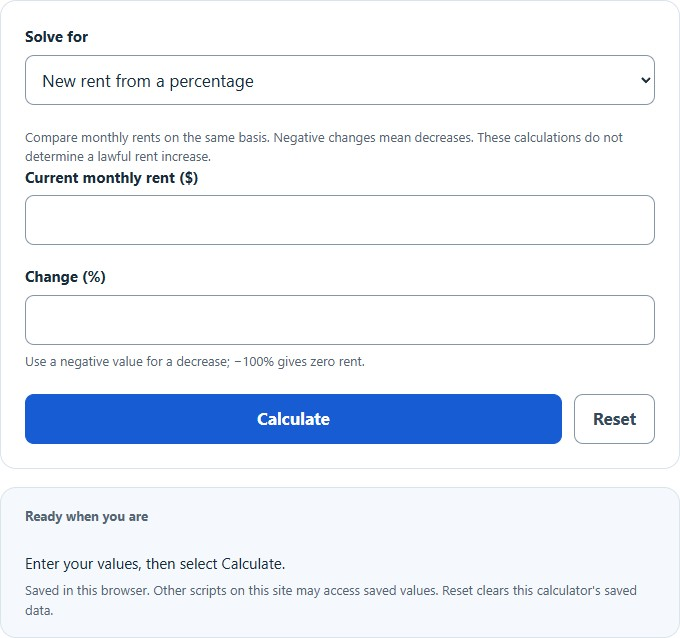
Calculate a rent increase percentage from old and new rent, find the new rent from a percent or dollar increase, and project rent with yearly increases.
Rent Increase Formula
The following formula compares two monthly rents on the same cost basis. A positive result is an increase, zero is unchanged, and a negative result is a decrease. The initial rent must be greater than zero.
%R = (RF-RI)/RI *100
- Where %R is the rent increase percent
- RF is the new monthly rent
- RI is the initial monthly rent
Rent Increase Definition
A rent increase is defined as a percentage increase in rent over a certain time period, most often a year.
How to calculate a rent increase?
The following example follows the steps required to calculate the percentage by which rent has increased from one year to the next.
First, determine the initial monthly rent. Use the same included charges for both amounts. If you add utilities or other bills to both figures, the result describes the change in that combined cost rather than base rent alone.
For this example, the initial rent from the previous year was found to be $1000/month.
Next, determine the current cost of rent using the same factors.
In this case, the rent for the current year is found to be $2000/month.
Finally, calculate the percentage rent increase using the formula above:
%R = (RF-RI)/RI *100
%R = ($2000-$1000)/$1000*100
%R = 100% increase
This example doubles the monthly rent. It demonstrates the arithmetic and does not imply that the increase is typical or legally permitted.
What is the most a landlord can raise your rent?
There is no single percentage limit that applies to every rental. The applicable country, state and local rules, property coverage or exemptions, tenancy type and lease determine the permitted amount. A calculator result does not establish legal permission. Check the current rules with the responsible housing authority.
How much should rent increase per year?
There is no general annual increase rule based on 1/60 of a property’s value. A mathematical increase may be expressed as a percentage of the existing rent or a fixed monthly amount; the lease and applicable law determine what may actually be charged.
Some jurisdictions have separate rules or approval processes for improvement-related increases. Improvements alone do not establish permission for an arbitrary increase.
Can rent be increased during a lease?
Whether rent may change during a fixed lease term depends on the lease and applicable law. Required notice, permitted timing and any cap are separate requirements; giving notice alone does not make an otherwise prohibited increase lawful.
There is no general PSA or Department of Revenue approval rule for rent increases. Consult the jurisdiction’s current notice and tenancy requirements. For examples of how rules differ, see the California tenants guide and the New York Attorney General’s tenants guide; neither is a rule for other locations.
What is an excessive rent increase?
Whether an increase is unlawful or subject to challenge depends on the governing law and the tenancy’s coverage. Market comparisons can inform a discussion, but do not replace a legal cap or required procedure.
A 10% increase is not a universal legal test for an excessive increase. Some rules use other limits, formulas or notice thresholds, and some properties are exempt.
Rent-stabilized tenancies may follow jurisdiction-specific rent orders and approval procedures. There is no general 7% housing-board rule that applies to all rent-stabilized tenants.
FAQ
There is no universal recommended or legal annual percentage. Check the applicable lease, property coverage and current state or local rules. This calculator compares amounts and projects a supplied rate; it does not set a lawful increase.