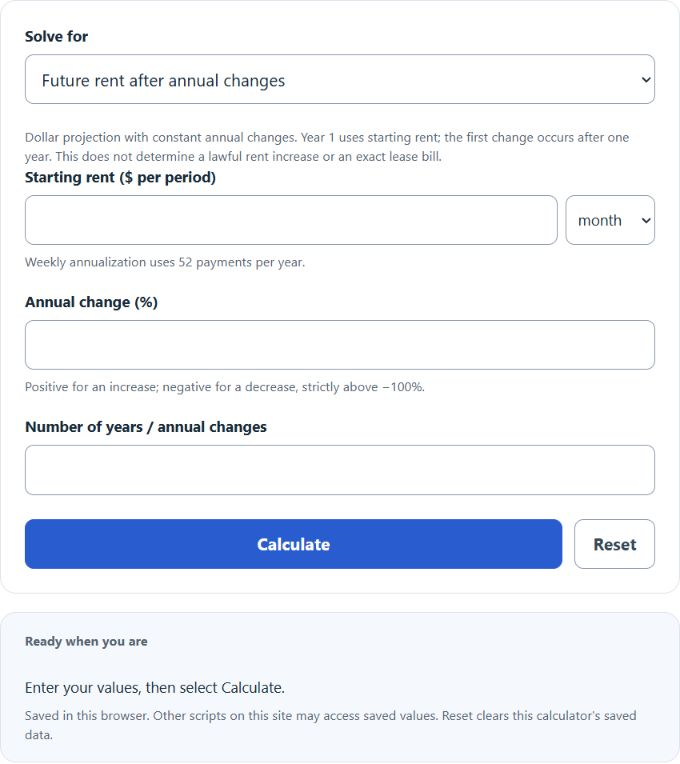
Calculate compounded rent increases, future or starting rent, annual growth rate, lease term, and year-by-year costs for monthly, weekly, or annual rent.
- All Rent Calculators
- All Personal Finance Calculators
- Rent Increase Calculator
- CPI Rent Calculator
- Rent Escalation Calculator
- Total Rent Calculator
- Rent Price Difference Calculator
Compound Rent Formula
The following formula is used to calculate Compound Rent:
- Where CR is the Compound Rent ($)
- MR is the starting rent ($)
- r is the annual increase rate (%/year)
- t is the total number of years
This formula follows the same mathematical structure as compound interest. Each year, the increase is applied not just to the original rent, but to the already-increased rent from the prior year, producing an exponential growth curve rather than a straight line.
What is Compound Rent?
Compound rent refers to applying each percentage change to the already changed rent. With a $1,500/month starting rent and 3% annual changes, the first change adds $45. After ten changes, rent is $2,015.87/month; the tenth change itself adds about $58.71 to the $1,957.16 rent after nine changes.
The concept appears in both residential and commercial leasing. In residential markets, landlords commonly raise rent by a fixed percentage annually, which compounds whether or not the lease explicitly uses that term. In commercial real estate, compound rent escalation clauses are written directly into multi-year leases, often tied to a fixed rate (typically 2% to 3%) or to the Consumer Price Index (CPI).
Compound vs. Simple Rent Increases
A simple (or linear) rent increase adds the same fixed dollar amount each year. A compound rent increase applies a percentage to the current rent, so the dollar amount of the increase grows over time. The difference is small in the first few years, but it accelerates significantly over longer lease terms.
Consider a $1,500/month starting rent with a 3% annual rate. After ten changes, simple escalation adding $45 each year reaches $1,950/month; compound escalation reaches $2,015.87. With starting rent paid during Year 1 and the first change after one year, ten years of payments total $206,349.83 with compounding and $204,300 with simple escalation: a $2,049.83 difference. Over twenty years, that difference is $21,066.74.
How Rent Compounds Over Time: Reference Data
The table below shows how a $1,500/month rent compounds over 5, 10, 15, and 20 years at several common annual increase rates. All values represent the monthly rent at the end of the given period.
| Annual Rate | Year 5 | Year 10 | Year 15 | Year 20 |
|---|---|---|---|---|
| 2% | $1,656 | $1,828 | $2,019 | $2,229 |
| 3% | $1,739 | $2,016 | $2,337 | $2,709 |
| 4% | $1,825 | $2,220 | $2,701 | $3,287 |
| 5% | $1,914 | $2,443 | $3,118 | $3,980 |
| 7% | $2,104 | $2,951 | $4,139 | $5,805 |
At a hypothetical 5% annual compound rate, rent becomes about 2.65 times the starting rent after twenty changes. At 7%, it becomes about 3.87 times the starting rent. These constant rates are scenarios, not forecasts of market rents.
Total Cumulative Rent Paid Over Time
Understanding the monthly rent at a future date is useful, but the total cumulative rent paid across the entire period often matters more for financial planning. The table below shows total rent paid during the first 10 and 20 years, starting from $1,500/month, with the first change after one year. Totals are rounded to the nearest dollar.
| Annual Rate | Total Paid (10 Yrs) | Total Paid (20 Yrs) |
|---|---|---|
| 0% (flat) | $180,000 | $360,000 |
| 2% | $197,095 | $437,353 |
| 3% | $206,350 | $483,667 |
| 5% | $226,402 | $595,187 |
| 7% | $248,696 | $737,919 |
A tenant starting at $1,500/month with 5% annual changes pays $595,187.17 during the first twenty years, compared with $360,000 at flat rent: $235,187.17 more. Starting rent applies during the first year. At 7%, twenty-year payments total $737,918.86, just over twice the flat-rent amount.
Rent Escalation Clauses in Commercial Leases
In commercial real estate, rent escalation clauses are standard in multi-year lease agreements. These clauses define how and when rent increases during the lease term. The three most common structures are fixed-percentage escalations, CPI-linked escalations, and operating expense pass-throughs.
For an illustrative ten-year lease starting at $10,000/month with a 3% change after each completed year, rent during Year 10 is $13,047.73/month. After the tenth change it is $13,439.16/month, which lies beyond that payment period. Payments during the ten years total $1,375,665.52 before fees or contractual rounding.
CPI-linked clauses use the index, reference dates, floor and ceiling specified in the lease. For example, a clause might use a 2% floor and 5% ceiling, but these are contract assumptions, not universal rules. This calculator uses one fixed annual percentage and does not model a changing CPI series.
U.S. Rent Increase Trends (2020 to 2025)
Rent measures differ. The Bureau of Labor Statistics rent index measures changes in shelter costs across sampled rental housing; new-tenant asking-rent series measure a different market segment. Values from those series should not be combined into one historical growth sequence without matching their definitions and dates.
National averages do not predict an individual lease. Administrative rent benchmarks, asking rents and actual contract rents are different measures. Use the local market, applicable law and your actual lease terms to choose a scenario rather than treating an administrative benchmark as a forecast.
For compound-rent modeling, test more than one annual-rate assumption. A constant 3% path is a scenario; actual annual changes may be higher, lower or negative and can be constrained by the lease and applicable law.
Rent Control and Compound Increase Limits by State
As checked October 16, 2026, legal limits depend on coverage, exemptions, timing and local rules. California AB 1482 generally caps covered increases at 5% plus applicable CPI or 10%, whichever is lower. Washington’s covered residential cap is 7% plus CPI or 10%, whichever is lower; its published 2026 percentage is 9.683%, with a separate manufactured-home-space rule. D.C.’s standard rent-control-year 2026 limits are 2.1% for protected elderly/disability tenants and 4.1% for other covered tenants. The earlier two-year 12% D.C. measure was time-limited, not a permanent nationwide-style rule. This calculator does not establish which rule applies.
Do not confuse Los Angeles city and county rules. City of Los Angeles RSO guidance states a 90%-of-CPI formula bounded between 1% and 4%, with a published 3% annual percentage through June 30, 2027. The 60%-of-CPI, maximum-3% formula applies to the county ordinance’s fully covered units in unincorporated areas. Coverage and other tenancy protections must be checked; absence of a general rent cap does not remove lease, notice, anti-retaliation or other legal requirements.
The Wealth Gap: Renters vs. Homeowners
Housing tenure and household wealth are associated, but that does not establish that compound rent causes a particular wealth gap. The Federal Reserve Survey of Consumer Finances measures household assets and liabilities; survey year and inflation-dollar basis must accompany any numerical comparison. This rent calculator does not estimate household net worth or home equity.
Rent pays for housing services and does not itself create ownership equity. Mortgage payments also include costs such as interest, and ownership involves taxes, maintenance, insurance and transaction costs. At $1,500/month with 3% annual changes, the first twenty years of rent total $483,666.74 under this model. A rent-versus-buy comparison needs the full costs, risks and investment alternatives; this projection alone cannot decide it.
Practical Applications of Compound Rent
Tenants use compound rent calculations to budget for future housing costs, evaluate whether to sign a long-term lease, or compare the total cost of renting versus buying over a specific time horizon. Knowing that a $2,000/month apartment at 4% compound growth becomes a $2,960/month expense in 10 years changes how a household plans savings and retirement timelines.
Landlords and property managers use compound rent to project future income streams, set escalation clauses in leases, and evaluate the long-term yield of rental properties. Commercial real estate investors model compound rent growth into discounted cash flow analyses to determine property valuations and cap rates.
Financial planners can use several rent-growth scenarios for a retirement budget. At a constant 3% rate, rent after twenty-five changes is about 2.09 times its initial value; at 4%, about 2.67 times. These are mathematical scenarios rather than guaranteed future costs.