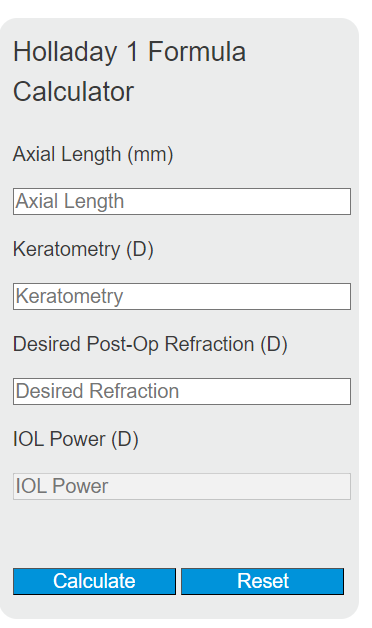
Use this Holladay 1 Formula Calculator to estimate IOL power from axial length, keratometry, target refraction, and a surgeon factor or A-constant, with lens-step comparison.
Important: This calculator is for educational use by ophthalmology professionals and students only. It is not medical advice and does not replace validated surgical planning software (IOL Master, LENSTAR, etc.). IOL selection must be verified by a licensed ophthalmologist using optimized lens constants from the manufacturer, ULIB, or IOLCon. If you experience eye pain, sudden vision loss, flashes, or floaters, seek emergency ophthalmic care immediately.
Related Calculators
- Prentice's Rule Calculator
- Spherical Equivalent Calculator
- Plus to Minus Cyl Calculator
- Minus Cyl to Plus Calculator
- Diopter Distance Calculator
- Lens Thickness Calculator
- All Health and Medical Calculators
Holladay 1 Formula
The Holladay 1 formula calculates IOL power in three steps: corneal radius derivation from keratometry, effective lens position (ELP) prediction via Fyodorov's corneal height geometry, and final power from thin-lens vergence optics.
Corneal radius and Fyodorov corneal height:
Effective lens position and vertex-corrected refraction:
IOL power (vergence formula):
Variables:
- AL = axial length (mm); measured by optical biometry (IOL Master, LENSTAR) or immersion A-scan ultrasound
- K = average corneal power (D); mean of flat (K1) and steep (K2) meridians from keratometry or topography
- R = target refraction at spectacle plane (D); 0.00 D for emmetropia, -0.25 D for slight myopic target
- SF = Surgeon Factor (mm); distance from the pseudophakic iris plane to the principal plane of the IOL. Convert from A-constant: SF = 0.5663 x A - 65.60. Typical ranges: 0.0 to 0.5 mm (plate-haptic IOLs), 1.0 to 1.5 mm (single-piece acrylic), 1.5 to 2.5 mm (three-piece silicone or PMMA)
- r = corneal radius (mm); d = corneal diameter constant (11.5 mm); t = corneal thickness constant (0.55 mm)
- H = Fyodorov corneal height (mm); geometric estimate of the anterior segment depth offset from corneal curvature
- ELP = predicted effective lens position (mm); R_c = target refraction corrected to corneal plane at 12 mm vertex distance; 1336 = refractive index of aqueous/vitreous x 1000
What is the Holladay 1 Formula?
The Holladay 1 formula (1988) is a third-generation IOL power formula and the first to use two biometric variables (AL and K) to predict the postoperative effective lens position (ELP). First- and second-generation regression formulas (SRK I, 1980; SRK II, 1988) used a single fixed-offset lens constant without accounting for the biological variability in anterior segment dimensions across eyes with different AL and corneal curvature combinations. Holladay 1 resolved this by incorporating Fyodorov's corneal height geometry to tailor the ELP estimate to each eye.
The Surgeon Factor (SF) is the Holladay 1 lens constant. It represents the physical distance from the pseudophakic iris plane to the principal plane of the IOL, making it anatomically meaningful rather than a pure regression offset. SF is not interchangeable with the SRK/T A-constant, Haigis a0, or Hoffer Q pACD; each constant is formula-specific and must be sourced from the manufacturer or an optimized database such as ULIB or IOLCon.
Holladay 1 is incorporated into all major optical biometers (IOL Master 500/700, LENSTAR LS 900) and is the reference algorithm in the Pediatric IOL Consultant software for children under 7 years. Performance by axial length: for AL below 21.5 mm, Hoffer Q or Holladay 2 typically achieves lower prediction error; for AL 21.5 to 24.5 mm, Hoffer Q, Holladay 1, and SRK/T are comparable (averaging all three is common practice); for AL 24.5 to 26 mm, Holladay 1 is generally preferred; for AL above 26 mm, a Wang-Koch axial length adjustment is recommended to correct the systematic myopic shift that occurs with unmodified optical biometry measurements in high myopes.
How to Calculate IOL Power Using the Holladay 1 Formula
The following steps outline how to calculate IOL power using the Holladay 1 formula:
- Measure axial length (AL) using optical biometry or immersion A-scan ultrasound.
- Measure average keratometry (K): mean of flat (K1) and steep (K2) meridians in diopters.
- Determine target refraction (R): typically 0.00 D for emmetropia or a slight myopic target such as -0.25 D.
- Obtain the Surgeon Factor (SF) from the lens manufacturer, ULIB, or IOLCon. If only the A-constant is available, apply: SF = 0.5663 x A - 65.60.
- Calculate corneal radius: r = 337.5 / K.
- Calculate Fyodorov corneal height: H = r - sqrt(r^2 - 5.75^2) + 0.55.
- Calculate predicted ELP: ELP = SF + H.
- Apply 12 mm vertex correction to target refraction: Rc = R / (1 - 0.012 x R). For R = 0.00, Rc = 0.00 D.
- Calculate IOL power: P = 1336 / (AL - ELP) - 1336 / (1336 / (K + Rc) - ELP).
- Round P to the nearest 0.50 D IOL power step. Verify against the calculator above.
Example Problem:
Axial Length (AL) = 23.50 mm
Keratometry (K) = 44.00 D
Target Refraction (R) = 0.00 D (emmetropia)
A-constant = 118.4; SF = 0.5663 x 118.4 - 65.60 = 1.45 mm
r = 337.5 / 44.00 = 7.6705 mm
H = 7.6705 - sqrt(7.6705^2 - 5.75^2) + 0.55 = 7.6705 - sqrt(58.84 - 33.06) + 0.55 = 7.6705 - 5.0768 + 0.55 = 3.144 mm
ELP = 1.45 + 3.144 = 4.594 mm
Rc = 0.00 / (1 - 0) = 0.00 D
P = 1336 / (23.50 - 4.594) - 1336 / (1336 / 44.00 - 4.594) = 1336 / 18.906 - 1336 / 25.770 = 70.66 - 51.85 = 18.81 D
Rounded IOL Power = 19.00 D