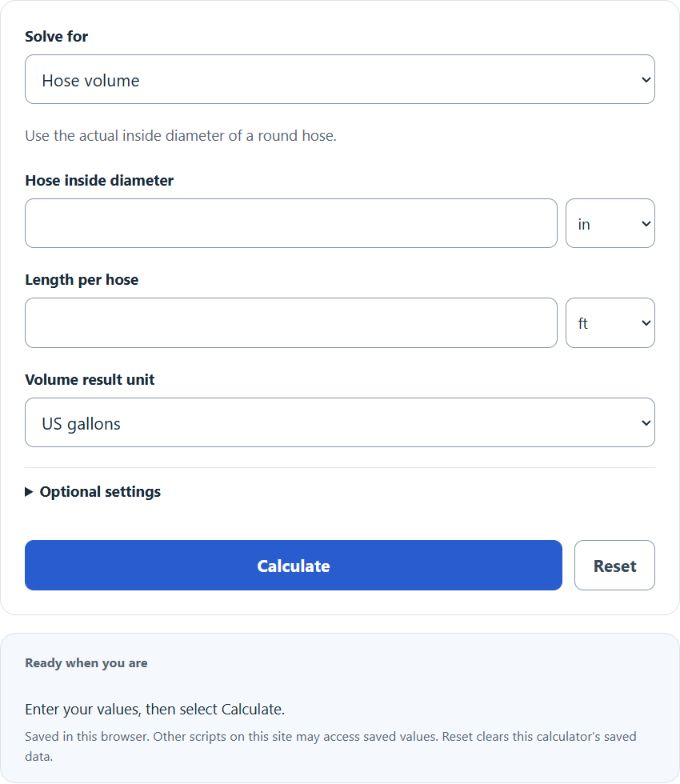
Choose hose volume, length per hose, inside diameter or fill time. Optional settings apply to identical hose count and percentage of full capacity; fill percentage is a volume fraction, not liquid depth. Fill-time flow is the total delivery rate across all hoses.
- All Construction Calculators
- All Volume Calculators
- Hose Flow Rate Calculator
- Pipe Volume Calculator
- Pipe Stretch Calculator
Hose Capacity Formula
Hose capacity is the internal volume of a hose. For a round hose, the inside space is modeled as a cylinder, so the calculation is simply cross-sectional area multiplied by length. Always use the internal diameter of the hose, not the outside diameter.
The same relationship can also be written with radius instead of diameter:
Variable Definitions
- HC = hose capacity or internal volume
- d = internal diameter of the hose
- r = internal radius of the hose
- L = hose length
If diameter and length are entered in compatible units, the result is the hose volume in cubic units. For example, inches produce cubic inches, and meters produce cubic meters.
Common Shortcut Forms
| Use Case | Formula |
|---|---|
| Diameter in inches, length in feet, result in cubic inches | HCin³ = 3π d² L |
| Diameter in inches, length in feet, result in US gallons | HCgal = (π) / (77) d² L |
| Diameter in centimeters, length in meters, result in liters | HCL = (π) / (40) d² L |
| Diameter in inches, length in feet, result in cubic feet | HCft³ = (π) / (576) d² L |
How to Calculate Hose Capacity
- Measure the hose inside diameter.
- Measure the full hose length.
- Convert units first if the diameter and length are not in a compatible system.
- Find the cross-sectional area of the hose opening.
- Multiply the area by the hose length to get total internal volume.
- Convert the result to gallons, liters, cubic feet, or cubic meters if needed.
Quick Capacity Reference
The values below are approximate capacities for a 100 ft hose with the listed internal diameter.
| Internal Diameter | Approx. Capacity | Approx. Liters |
|---|---|---|
| 1/2 in | 1.02 gal | 3.86 L |
| 5/8 in | 1.59 gal | 6.03 L |
| 3/4 in | 2.29 gal | 8.69 L |
| 1 in | 4.08 gal | 15.44 L |
| 1.25 in | 6.37 gal | 24.13 L |
| 1.5 in | 9.18 gal | 34.75 L |
| 2 in | 16.32 gal | 61.78 L |
Example Calculations
A hose with a 1-inch internal diameter and a length of 50 ft has a capacity of about 2.04 gallons.
A hose with a 2.5 cm internal diameter and a length of 20 m holds about 9.82 liters.
Why Hose Capacity Matters
- Filling and draining: helps estimate how much liquid remains in the line.
- Chemical dosing: useful when the hose volume becomes part of the total batch or transfer amount.
- Priming and purging: important for pumps, sprayers, coolant loops, and process lines.
- Winterizing and cleaning: helps estimate how much fluid must be removed, flushed, or replaced.
- System design: gives a better estimate of total line volume when multiple hoses and fittings are connected.
Important Notes
- Capacity is not flow rate. Capacity tells you how much the hose can hold, while flow rate depends on pressure, friction loss, fittings, elevation, and pump performance.
- Diameter has a squared effect. If hose length stays the same, doubling the internal diameter increases capacity by four times.
- Length has a linear effect. If diameter stays the same, doubling the hose length doubles the capacity.
- Use actual internal diameter when precision matters. Nominal hose sizes may not match the exact measured I.D.
- End fittings and accessories can change total system volume; their volume is not included here. If total system volume matters, include manifolds, valves, couplers, and filters separately.
- The base capacity calculation assumes a full, round hose; an optional fill percentage scales that capacity by volume. Flattened, kinked, corrugated, or partially collapsed hose can reduce real internal volume.
Common Mistakes
- Using outside diameter instead of inside diameter
- Mixing inches, feet, centimeters, and meters without converting first
- Confusing storage volume with delivery rate
- Ignoring extra volume from fittings or connected piping
- Rounding the diameter too aggressively on small hoses
Unit Conversions Often Used With Hose Volume