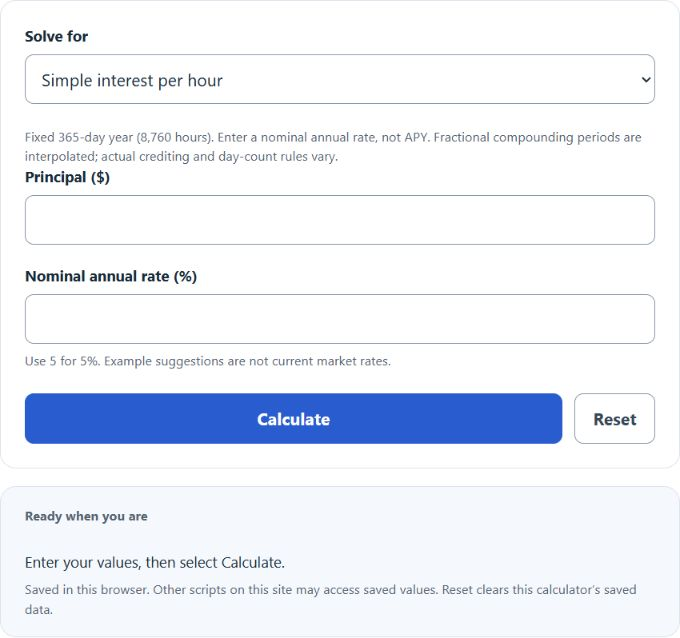
Calculate hourly interest from principal and annual rate, or find accrued interest and final amount over hours with compounding options.
Hourly Interest Formula
The following equations are commonly used to work with hourly interest.
- Where H is the estimated interest per hour (currency/hour) using a simple proration of the annual rate
- I is the total interest accrued over t hours (currency) assuming hourly compounding
- P is the principal (initial amount of money)
- r is the nominal annual interest rate (in decimal form, e.g., 10% = 0.10), excluding compounding; APY is a different measure
- t is the time in hours
If you want the interest per hour as a single constant estimate, use H = P·r/8760. If you want the total interest earned over a specific number of hours with hourly compounding, compute I by applying the hourly growth factor \((1 + r/8760)\) for t hours and subtracting the original principal.
What Is Hourly Interest?
Definition:
“Hourly interest” can refer to either (1) an estimated interest amount per hour based on an annual rate (often calculated as a simple pro‑rata amount), or (2) the total interest accrued over a number of hours when interest compounds on an hourly schedule. The calculator above supports both: choose Simple interest per hour or Accrued interest over time in the Solve for selector. Principal and annual-rate inverse modes are also available.
How to Calculate Hourly Interest?
Example Problem:
The following example outlines the steps and information needed to calculate the interest accrued over a given number of hours (with hourly compounding).
First, determine the principal. In this example, the principal is $5,000.
Next, determine the annual interest rate in decimal form. In this case, the annual interest rate is 10%, or 0.10.
Then, decide how many hours have passed. Let’s say 24 hours have elapsed.
Finally, calculate the total interest accrued over 24 hours using the formula above:
I = P × ((1 + r/8760) ^ t - 1)
I = $5,000 × ((1 + 0.10/8760) ^ 24 - 1)
Evaluating this gives I ≈ $1.37 of interest accrued over the 24-hour period (hourly compounding), so the balance would be approximately $5,001.37. (For comparison, the simple estimated interest per hour would be H = 5000×0.10/8760 ≈ $0.0571 per hour.)
FAQ
Does hourly interest make a big difference compared to daily interest?
Hourly compounding can slightly increase the total amount earned compared to daily compounding when both use the same nominal annual rate, because interest is credited more frequently. The difference is usually small over short periods, but it can grow over long time horizons or with higher balances and rates.
How do I handle different compounding methods?
For compounding n times per year over t hours (using a 365‑day year), you can use: A = P(1 + r/n)n·(t/8760), and then interest = A − P. Fractional periods use exponential interpolation: monthly periods are fixed at 730 hours rather than calendar months. This estimates growth, not actual crediting, and excludes fees, taxes, deposits and withdrawals. For continuous compounding, use A = P·er·(t/8760).
Why divide by 8760?
There are 8,760 hours in a 365-day year (24 hours per day × 365 days). Dividing by 8,760 converts an annual rate to an hourly rate on that basis. This calculator always uses 8,760 hours. Some applications use different day-count conventions (and leap years have 8,784 hours), so confirm which convention applies to your situation.