Calculate hourly rate from total pay and hours worked, convert salary to hourly pay, and estimate gross paycheck with overtime before taxes.
Hourly Rate Formula
The calculator preserves salary-to-hourly, hourly-to-salary and freelance calculations, and includes the pay-and-hours and overtime-paycheck tasks described below. All amounts are US dollars before tax.
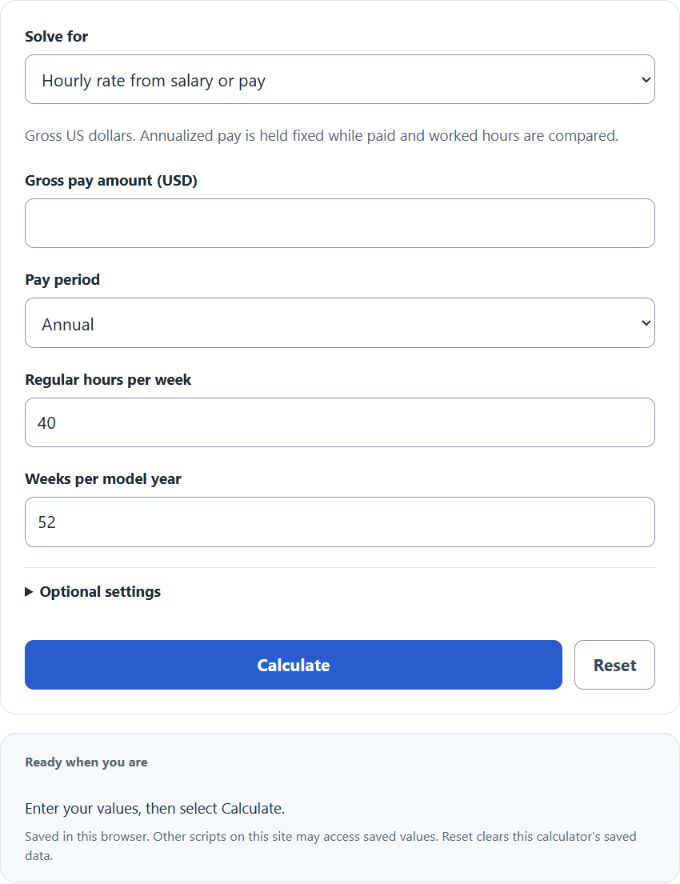
Hourly rate from salary or pay: annualized pay divided by paid hours. Paid hours = hours/week × model weeks − unpaid days × hours/day. Worked hours additionally subtract paid days not worked. The displayed worked-hour comparison holds annual pay fixed; enter actual annual pay after any unpaid-leave deduction.
Salary from hourly rate: weekly pay = rate × regular hours + rate × additional overtime hours × multiplier. Annual pay = weekly pay × model weeks. Do not count overtime hours twice.
Freelance rate: (income goal + business expenses) / (1 − surplus margin/100) / annual billable hours. The income goal is before personal income tax, not take-home pay. The surplus margin is the revenue share left after both the entered income goal and expenses; it is not a markup.
Average rate from pay and hours: total gross pay / (total hours − unpaid break hours). This average can include overtime or bonuses and need not be a contractual or statutory regular rate.
Gross paycheck with overtime: regular hours × rate + overtime hours × rate × multiplier. Regular hours are the smaller of total hours and your chosen threshold; overtime hours are any excess.
Salary annualization uses 12 monthly, 24 twice-monthly or 26 biweekly periods. Weekly/daily inputs use your model weeks/workdays. Average monthly output is annual pay/12; it is not a four-week paycheck. Workdays default to5, regular hours/week to40, model weeks to52; freelance defaults are25 billable hours/week and48 weeks. Actual pay calendars may differ.
Reference Tables
Use these conventional examples to check your inputs and results. The salary table assumes 40 hours/week and 52 weeks/year; the pay-frequency table is a convention, not a guarantee of every calendar year.
| Annual Salary | Hourly (40 hr/wk) | Weekly | Monthly |
|---|---|---|---|
| $30,000 | $14.42 | $576.92 | $2,500 |
| $45,000 | $21.63 | $865.38 | $3,750 |
| $60,000 | $28.85 | $1,153.85 | $5,000 |
| $75,000 | $36.06 | $1,442.31 | $6,250 |
| $100,000 | $48.08 | $1,923.08 | $8,333 |
| $150,000 | $72.12 | $2,884.62 | $12,500 |
| Pay Frequency | Periods per Year | Notes |
|---|---|---|
| Weekly | 52 | Common for hourly trades |
| Bi-weekly | 26 | Every other Friday |
| Semi-monthly | 24 | 1st and 15th |
| Monthly | 12 | Common for salaried staff |
Examples and FAQ
Example 1: Finding your real rate from a paycheck. You earned $640 over a week and clocked 45 hours with a 30-minute unpaid lunch each of the 5 days. Paid hours = 45 - 2.5 = 42.5. Hourly rate = 640 / 42.5 = $15.06 per hour.
Example 2: Salary to hourly with time off. A $65,000 salary at 40 hours per week works out to 65,000 / 2,080 = $31.25 per hour. With 10 paid holidays and 15 vacation days, you actually work 235 days x 8 hours = 1,880 hours. Adjusted hourly = 65,000 / 1,880 = $34.57 per worked hour.
Does the result include taxes? No. Every figure is gross pay, before federal, state, and payroll deductions.
How is overtime calculated? The gross-paycheck mode applies your chosen threshold (default40) and multiplier (default1.5) to total hours. The salary mode instead accepts separate regular and additional overtime hours. These are arithmetic models. Covered nonexempt US employees generally receive at least1.5 times their regular rate after40 workweek hours, but eligibility, regular-rate calculations and other rules matter. See US Department of Labor guidance.
Should I subtract unpaid breaks? In the average-rate mode, enter unpaid break hours separately; total hours must include those breaks. Keep paid breaks within paid hours. A 30-minute unpaid lunch is0.5 hours. Whether a break may legally be unpaid depends on the applicable rules.
Why are paid-hour and worked-hour rates different? Salary-to-hourly mode divides annualized pay by paid hours for the main rate, then by actually worked hours for a comparison. Paid holidays and vacation reduce worked hours only; unpaid days reduce both. The same entered annual pay is used in both ratios.