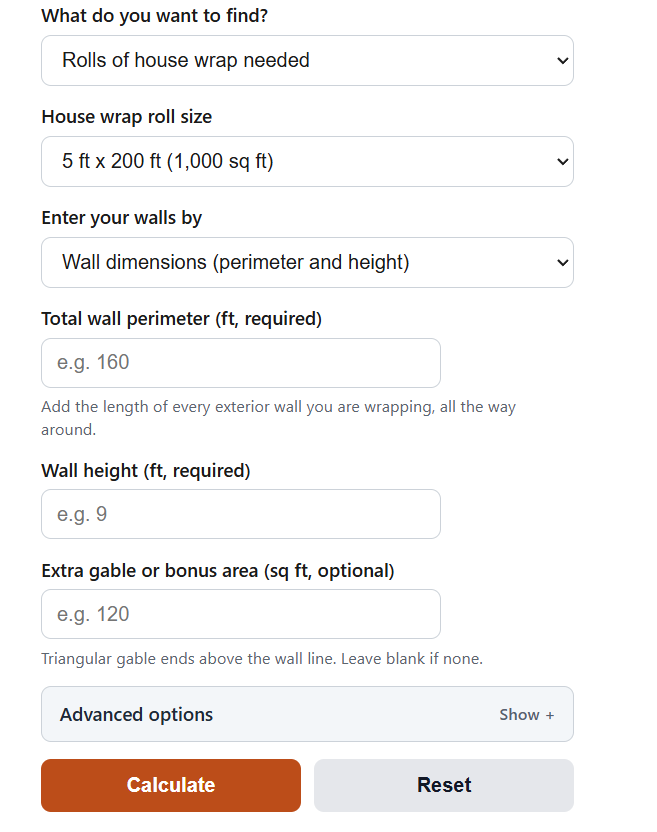
Calculate how many rolls of house wrap you need from your wall dimensions or area, with roll-size options, overlap by course, opening deductions, and cost.
House Wrap Formula
The calculator sizes a house wrap order two ways. The standard way finds the rolls from your wall area with a flat waste allowance for overlap, then rounds up because wrap is sold in whole rolls:
R = roundup(A * (1 + w) / C)
When you enter dimensions instead of a total, the wall area is the perimeter times the wall height, plus any gable or bonus area:
A = P * H + G
The second way accounts for roll width. A flat percentage assumes the roll is wide enough to cover the wall in one horizontal course, which is not true when the wall is taller than the roll. Course mode counts how many horizontal rows the roll width forces, since each row after the first loses the overlap height:
Courses = 1 + roundup((H - Wr) / (Wr - O))
R = roundup(Courses * Wr * P / C)
To read coverage the other direction, the calculator takes rolls you already own and removes the waste allowance to show the usable wall area they will cover:
Usable = n * C / (1 + w)
Variables:
- R is the number of rolls, always rounded up because rolls are sold whole
- A is the wall area to cover
- P is the total perimeter of the walls you are wrapping
- H is the wall height
- G is any extra gable or bonus area above the wall line
- w is the waste allowance written as a decimal, so 10 percent is 0.10
- C is the coverage of one roll, its width times its length
- Wr is the roll width
- O is the seam overlap in feet, so a 6 inch overlap is 0.5
- Courses is the number of horizontal rows the roll width forces on the wall
- n is the number of rolls you already have
Pick what you want to find at the top. In rolls mode you enter the walls by dimensions or by a total area and get the rolls to buy. The roll size selector sets the coverage figure, and Custom lets you type a width and length off the label. Under Advanced you switch between the flat waste allowance and course mode, change the overlap, subtract window and door openings, add a price per roll for a cost, and turn on a seam tape and cap nail estimate. Coverage mode runs it backward: enter the rolls you have and it reports the usable wall area they cover.
Roll Sizes and Course Coverage
This first table lists the standard house wrap rolls, the area each covers, and an approximate 2026 retail price so you can turn a roll count into a budget. Economy polyolefin wrap sits at the low end of each range and name brands like Tyvek and Typar at the high end. Prices swing with region and brand, so enter your own price per roll in the calculator when you have it.
| Roll size | Coverage | Typical price each | Best for |
|---|---|---|---|
| 3 ft x 100 ft | 300 sq ft | $50 to $75 | Sheds, additions, patch work |
| 5 ft x 200 ft | 1,000 sq ft | $130 to $190 | Most single story homes |
| 9 ft x 100 ft | 900 sq ft | $150 to $190 | 8 to 9 ft walls, no top seam |
| 9 ft x 150 ft | 1,350 sq ft | $250 to $310 | Larger or two story homes |
| 10 ft x 150 ft | 1,500 sq ft | $280 to $360 | Crews with tall walls |
This second table is the part most estimators skip. It shows how many horizontal courses, and how many horizontal seams, each roll width forces on a wall of a given height, using a 6 inch overlap. A 9 ft roll covers an 8 or 9 ft wall in one pass with no horizontal seam, while a 3 ft roll needs three or four rows for the same wall. More courses mean more overlap loss and more taping, so a wider roll on a tall wall is both faster and less wasteful. This is why a flat 10 percent allowance can fall short when the wall is taller than the roll.
| Wall height | 3 ft roll | 5 ft roll | 9 ft roll | 10 ft roll |
|---|---|---|---|---|
| 8 ft | 3 courses, 2 seams | 2 courses, 1 seam | 1 course, 0 seams | 1 course, 0 seams |
| 9 ft | 4 courses, 3 seams | 2 courses, 1 seam | 1 course, 0 seams | 1 course, 0 seams |
| 10 ft | 4 courses, 3 seams | 3 courses, 2 seams | 2 courses, 1 seam | 1 course, 0 seams |
| 16 ft | 7 courses, 6 seams | 4 courses, 3 seams | 2 courses, 1 seam | 2 courses, 1 seam |
| 20 ft | 8 courses, 7 seams | 5 courses, 4 seams | 3 courses, 2 seams | 3 courses, 2 seams |
Example Problems
Example 1: Rolls from a footprint.
Your house is 40 ft by 30 ft with 9 ft walls, and you are buying 9 ft by 100 ft rolls. The perimeter is 2 times (40 plus 30), which is 140 ft, so the gross wall area is 140 times 9, or 1,260 sq ft. Add a 10 percent waste allowance and divide by the 900 sq ft roll:
R = roundup(1,260 * 1.10 / 900) = roundup(1.54) = 2 rolls. Because the 9 ft roll covers the 9 ft wall in one course, there are no horizontal seams to tape.
Example 2: The same house with 10 ft walls.
Keep the 140 ft perimeter but raise the walls to 10 ft and stay with the 9 ft by 100 ft roll. A 9 ft roll cannot cover a 10 ft wall in one pass, so course mode counts 2 courses with 1 horizontal seam. The material used is 2 courses times 9 ft times about 140 ft, near 2,529 sq ft, so R = roundup(2,529 / 900) = 3 rolls. A flat 10 percent allowance would have said 2 rolls and left you short, which is the case where roll width matters.
Frequently Asked Questions
How much house wrap do I need for a 2,000 square foot house?
Floor area is not the number to use, since wrap covers the outside walls, not the floor. A single story 2,000 sq ft house is roughly 45 by 45 ft, so the perimeter is about 180 ft and 9 ft walls give close to 1,620 sq ft of wall. With a 10 percent overlap allowance that is about 1,782 sq ft, which is two 9 ft by 100 ft rolls at 1,800 sq ft, or one 9 ft by 150 ft roll plus a small 5 ft by 200 ft roll. A two story house of the same footprint roughly doubles the wall area, so plan on about four 900 sq ft rolls.
Do I subtract windows and doors?
Usually not by much. Many installers run the wrap right over window and door openings in a continuous sheet and cut the openings out afterward, which keeps the barrier tight and uses the cutouts as flashing. That practice turns the openings into part of your waste allowance rather than a deduction. The calculator leaves openings in by default and gives you optional window and door fields under Advanced if you want to subtract large ones, such as garage or sliding glass doors.
Does the roll width change how much I need?
Yes, and this is where a flat percentage misleads you. If your wall is taller than the roll is wide, you have to run a second horizontal course and overlap it, which adds material and a seam to tape. A 9 or 10 ft roll wraps a standard 8 to 9 ft wall in a single course with no horizontal seam, while a 3 or 5 ft roll needs several courses for the same wall. Turn on course mode under Advanced to see the courses and seams for your exact roll width and wall height instead of assuming a