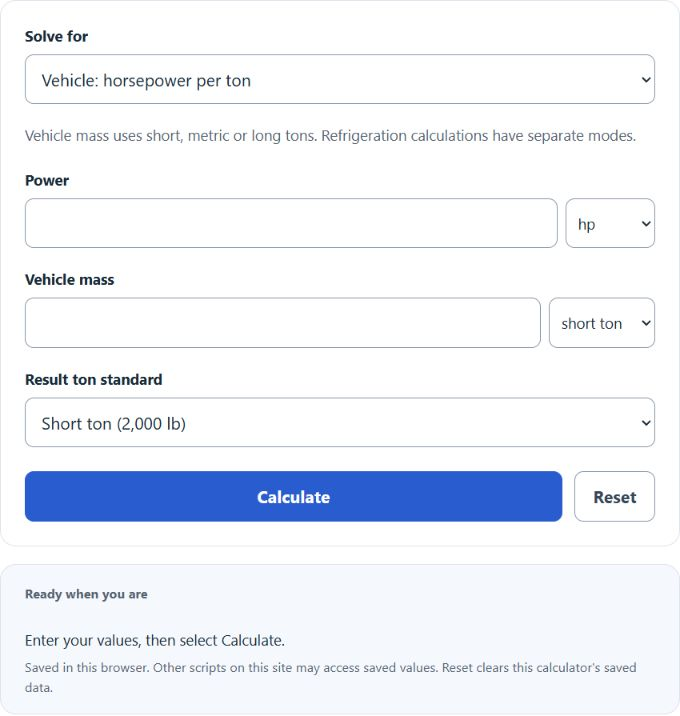
Calculate vehicle horsepower, mass, or HP per short, metric, or long ton. Separate HVAC modes calculate compressor input HP per refrigeration ton, input power, or cooling capacity.
HP per Ton Formula
Horsepower per ton is a simple power-to-weight ratio used to compare vehicle performance. It shows how much power is available for each ton of vehicle mass. In general, a higher value means the vehicle has more power relative to its weight and will usually feel stronger under acceleration.
In this formula:
- HP = engine or motor output in horsepower
- W = vehicle weight in tons
- HP/Ton = horsepower per ton
If your calculator is set to solve for a different variable, these equivalent forms are useful:
| Missing Value | Formula |
|---|---|
| Horsepower | HP = (HP / Ton) × W |
| Weight in tons | W = (HP) / (HP / Ton) |
How to Calculate HP per Ton
- Find the vehicle’s horsepower rating.
- Determine the vehicle weight in the same ton unit selected in the calculator.
- Divide horsepower by weight in tons.
- Interpret the result as the amount of power available for each ton of mass.
This ratio is most useful when comparing vehicles on a like-for-like basis. For example, if one car makes more horsepower but also weighs much more, its real-world performance advantage may be smaller than expected.
Ton Units Matter
The calculator supports multiple ton types, so unit selection is important:
- Short ton: 2,000 pounds. Most common for U.S. vehicle weight discussions.
- Metric ton: 1,000 kilograms. Common in international specifications.
- Long ton: 2,240 pounds. Less common in modern automotive use.
If you compare two vehicles, make sure both results use the same ton standard. A horsepower-per-metric-ton value is not identical to horsepower-per-short-ton.
Converting kW and Horsepower
If a vehicle’s output is listed in kilowatts instead of horsepower, convert it before using the formula:
This helps keep the power input consistent with the calculator’s output.
Example
If a vehicle produces 300 horsepower and weighs 2 short tons, then:
The vehicle has 150 horsepower per short ton. That means each ton of mass is supported by 150 horsepower.
How to Interpret the Result
- Higher HP per ton: usually better straight-line performance potential.
- Lower HP per ton: usually slower acceleration for the same drivetrain efficiency and traction level.
- Best use case: comparing cars, trucks, motorcycles, EVs, and performance builds with a single normalized metric.
HP per ton is helpful, but it is not the only performance factor. Tire grip, gearing, torque delivery, transmission tuning, drivetrain losses, aerodynamics, and road conditions also affect how fast a vehicle feels.
What Weight Should You Use?
- Curb weight: useful for comparing stock vehicles as sold.
- Race weight: better for motorsport setups that include driver and fuel.
- Loaded weight: more realistic for trucks, cargo vehicles, or vehicles carrying passengers and equipment.
Using the wrong weight figure is one of the most common reasons for misleading results. If the vehicle will normally be driven with people, tools, cargo, or towing equipment, that extra mass should be considered.
HVAC Refrigeration Modes
The HVAC modes use tons of refrigeration (12,000 BtuIT/h), not tons of vehicle mass. Divide actual compressor input power in mechanical-horsepower equivalent by cooling capacity to find HP/TR; multiply that ratio by capacity to recover input HP, or divide input HP by the ratio to recover capacity. The displayed kW/TR converts the same input-power basis. A motor shaft horsepower rating alone does not measure electrical consumption. Compare power and cooling at the same operating condition; this calculator does not assign equipment efficiency ratings.
Common Input Mistakes
- Entering pounds or kilograms without converting to tons first.
- Comparing short-ton results to metric-ton results.
- Mixing crank horsepower and wheel horsepower when comparing vehicles.
- Ignoring modifications that changed either power or weight.
HP per Ton vs. Pounds per Horsepower
Some people prefer to look at pounds per horsepower instead. That is the inverse way of measuring the same basic relationship. Using short tons, the conversion is:
A lower lb/HP number is better, while a higher HP/Ton number is better.
When This Calculator Is Most Useful
- Comparing two or more vehicles before purchase
- Estimating the effect of added power modifications
- Seeing how weight reduction changes performance potential
- Checking whether a build is improving in power-to-weight terms
Because it is fast to calculate and easy to understand, horsepower per ton is one of the most practical ways to compare performance across vehicles with different sizes and power levels.