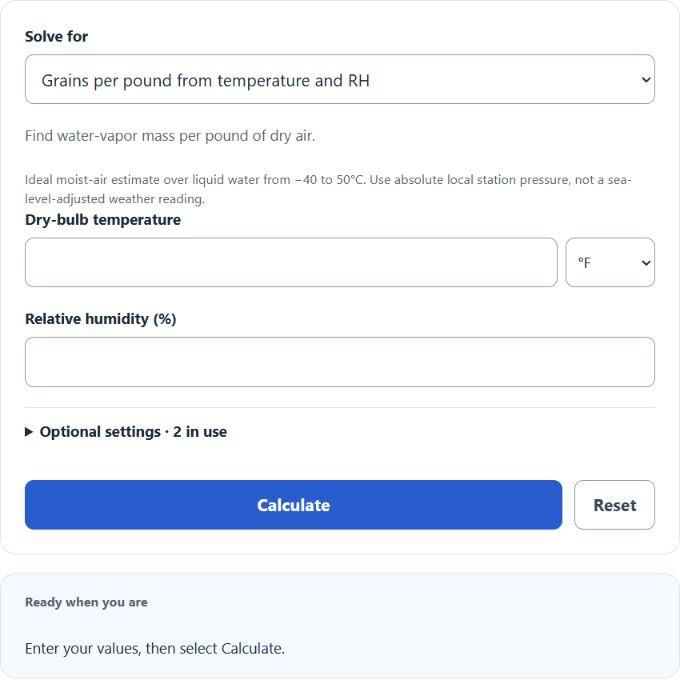
Calculate grains of water vapor per pound of dry air from temperature and relative humidity, or solve for relative humidity from GPP. Enter actual absolute local pressure when it differs from the standard sea-level default.
Related Calculators
- Cubic Feet ↔ Pounds Calculator
- Inches Of Water To psi Calculator
- Grams Per Second Calculator
- m3/h to lpm Converter
- All Unit Converters
Humidity Grains Per Pound Formula
Grains per pound (gr/lb) is the mass of water vapor in one pound of dry air. The calculator uses the psychrometric humidity ratio and converts to grains, where 1 lb = 7000 grains.
Saturation vapor pressure (Magnus form, kPa) at temperature T in °C:
Vapor pressure from relative humidity:
Relative humidity from a known GPP:
Variables:
- GPP = grains of water vapor per pound of dry air (gr/lb)
- W = humidity ratio (lb water / lb dry air)
- P = total atmospheric pressure (kPa)
- Pw = partial pressure of water vapor (kPa)
- Pws = saturation vapor pressure at the dry-bulb or dew point temperature (kPa)
- T = temperature (°C)
- RH = relative humidity (%)
Calculator modes:
- Temp + RH: Computes Pws from dry-bulb temperature, multiplies by RH/100 to get Pw, then solves for W and converts to GPP.
- GPP + Temp: Converts GPP to W, back-solves for Pw, and divides by Pws at the dry-bulb temperature to get RH.
Pressure defaults to 101.325 kPa. You can enter absolute station pressure directly in kPa, hPa, inHg or psi. The calculator does not derive pressure from altitude. The Magnus liquid-water fit is limited to −40 to 50°C; it is not an ice-saturation model.
Reference Tables
Use the table below to sanity-check a result. Values assume standard sea level pressure.
| Dry-bulb (°F) | 30% RH | 50% RH | 70% RH | 90% RH |
|---|---|---|---|---|
| 50 | 16 | 26 | 37 | 48 |
| 60 | 23 | 38 | 54 | 69 |
| 70 | 32 | 54 | 76 | 99 |
| 75 | 38 | 64 | 91 | 117 |
| 80 | 45 | 76 | 108 | 139 |
| 90 | 63 | 106 | 150 | 194 |
| 100 | 86 | 145 | 206 | 269 |
The following illustrative GPP bands describe moisture mass only. They are not standards for comfort, saturation, mold risk or restoration targets; temperature, materials and site conditions also matter:
| GPP Range | Illustrative band | Interpretation |
|---|---|---|
| Below 40 | Dry | Lower moisture mass per dry-air mass |
| 40 to 60 | Moderate | No comfort conclusion from GPP alone |
| 60 to 80 | Humid | No equipment recommendation from GPP alone |
| Above 80 | Higher moisture mass | Saturation depends on temperature and pressure |
Example Problems
Example 1: Find GPP from temperature and RH. Air is at 75°F and 50% RH at sea level.
- Convert temperature: 75°F = 23.89°C
- Pws ≈ 2.95825 kPa at 75°F (23.8889°C)
- Pw ≈ 2.95825 × 0.50 = 1.47913 kPa
- W ≈ 0.621945 × 1.47913 / (101.325 − 1.47913) = 0.00921355 lb/lb
- GPP ≈ 0.00921355 × 7000 = 64.49 gr/lb
Example 2: Find RH from GPP and temperature. Air is at 70°F with 55 gr/lb at sea level.
- W = 55 / 7000 = 0.007857 lb/lb
- Pw ≈ 1.26409 kPa using W = 55/7000 without intermediate rounding
- Pws at 70°F (21.1111°C) ≈ 2.49888 kPa
- RH ≈ 100 × Pw/Pws = 50.59%
FAQ
Why grains instead of grams? Grains per pound is the legacy unit on psychrometric charts in the United States. One pound of water equals 7000 grains, so the unit gives convenient whole-number values for indoor air.
Does GPP change with temperature? No. GPP measures the actual mass of water vapor in the air. If you heat or cool the air without adding or removing vapor (including condensation), GPP stays the same while RH changes.
Why does altitude matter? Total atmospheric pressure appears in the humidity ratio formula. At higher elevations, lower pressure raises the humidity ratio for the same vapor pressure, so GPP changes slightly even at identical temperature and RH.
What is the difference between dew point and GPP? Dew point is the temperature at which the current vapor would saturate the air. GPP is the mass of that vapor per pound of dry air. Their relationship also depends on total pressure. This calculator uses temperature with RH or GPP, rather than a separate dew-point mode.