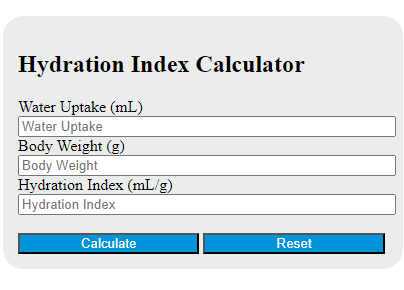
Calculate water uptake, body weight, or hydration index from the other two values with unit conversion in mL, L, oz, gal, g, kg, or lb units.
Related Calculators
- Weight Loss Percentage Calculator
- Protein to Energy Ratio Calculator
- REE/RDEE (Resting-Energy-Expenditure) Calculator
- 10 Percent Rule Running Calculator
- All Health and Medical Calculators
Hydration Index Formula
The hydration index used by this calculator expresses water uptake relative to body weight. Instead of looking at fluid volume alone, it shows how much fluid is consumed for each unit of body mass, which makes hydration plans easier to compare across different people, days, or activities.
This is best treated as a practical intake-per-weight metric. It helps with planning and comparison, but it is not the same thing as a direct measurement of whole-body hydration status.
Where:
| Variable | Meaning | Common Units |
|---|---|---|
| HI | Hydration index | mL/g, L/kg, oz/lb |
| WU | Water uptake or total fluid consumed | mL, L, oz, gal |
| BW | Body weight | g, kg, lb |
If you know any two values, you can solve for the third:
Unit-Specific Forms
To keep the result consistent, use matching units for both intake and body weight.
Important: mL/g and L/kg have the same numeric value because both the numerator and denominator scale by 1,000. oz/lb is a different numeric scale, so it should be converted rather than compared directly by eye.
How to Calculate the Hydration Index
- Choose the time period you want to evaluate, such as a workout, a work shift, or a full day.
- Measure total water uptake during that period.
- Record body weight in the corresponding unit system.
- Divide water uptake by body weight.
- Interpret the result as fluid consumed per unit of body mass.
Example
If a person drinks 2.7 liters of fluid and weighs 75 kilograms, the hydration index is:
The same calculation in base metric units is:
If you are solving for fluid intake from a target hydration index, multiply the target by body weight:
How to Interpret the Result
- Higher values mean more fluid has been consumed for each unit of body weight.
- Lower values mean less fluid has been consumed relative to body size.
- This is most useful as a comparison tool when reviewing hydration habits across different people or different days.
- A useful target depends on context, including climate, activity level, exercise duration, sweat losses, and diet.
When This Calculator Is Useful
- Estimating daily fluid intake relative to body size
- Comparing hydration plans for athletes, teams, or clients
- Reviewing water intake during hot-weather work or outdoor activity
- Setting a fluid-intake goal from a desired intake-per-weight ratio
- Standardizing hydration logs so they are easier to compare over time
Important Notes
- This calculator estimates fluid intake per unit of body weight; it does not directly diagnose dehydration, overhydration, or electrolyte imbalance.
- Heat, heavy sweating, illness, altitude, caffeine intake, sodium losses, and long training sessions can all change actual hydration needs.
- Keep the comparison period consistent. A single workout intake should not be compared directly to a full-day intake.
- If your inputs start in different unit systems, use the calculator’s conversions before interpreting the final value.
Common Input Mistakes
- Entering total fluid intake for one period and body weight from a different person or time frame
- Mixing units manually instead of using a consistent output basis
- Assuming a higher number always means “better” without considering sweat rate, temperature, and activity demands
- Using the result as a medical assessment instead of a planning metric