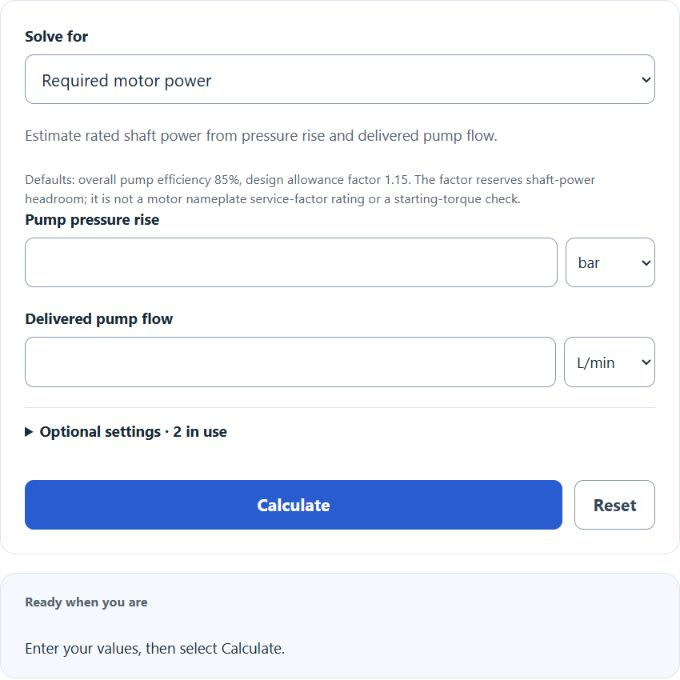
Calculate hydraulic pump motor power, available flow, or maximum pressure in US or metric units, with pump efficiency, an explicit design allowance, sensitivity, and an illustrative motor-size list.
Related Calculators
- Loss Coefficient Calculator
- Load Percentage Calculator
- Leak Rate Calculator
- Heat Rejection Calculator
- All Construction Calculators
Hydraulic Pump Motor Sizing Formula
The following formula is used to calculate the hydraulic pump motor size for a hydraulic system:
Variables:
- Motor Shaft Rating is the design shaft-power target in mechanical horsepower (HP), before electric-motor losses
- Flow Rate is the desired flow rate of the hydraulic system in (US) gallons per minute (GPM)
- Pressure is the desired pressure rise across the pump in pounds per square inch (PSI)
- Efficiency is the overall efficiency (as a decimal, e.g., 0.85, which is 85% efficiency)
Multiply delivered US GPM by pump pressure rise in psi and the design allowance factor, then divide by overall pump efficiency and the unit-derived divisor 12000/7 (approximately 1714.285714). The default factor 1.15 reserves 15% shaft-power headroom; it is not a motor nameplate service-factor rating or a guarantee of starting or thermal performance.
What is Hydraulic Pump Motor Sizing?
Hydraulic pump motor sizing refers to the process of determining the appropriate size and power of a hydraulic pump motor for a specific application. This process is crucial because the size and power of the motor directly affect the performance and efficiency of the hydraulic system. The sizing process involves several factors including the required pressure, flow rate, and load of the system. The pressure is determined by the force needed to perform the task, while the flow rate is determined by the speed at which the task needs to be performed. The load refers to the resistance that the hydraulic system needs to overcome to perform the task. By considering these factors, one can determine the appropriate size and power of the hydraulic pump motor, ensuring that the system operates efficiently and effectively.
How to Calculate Hydraulic Pump Motor Sizing?
The following steps outline how to calculate the Hydraulic Pump Motor Sizing.
- First, determine the flow rate required (Q) in gallons per minute (GPM).
- Next, determine the pressure required (P) in pounds per square inch (PSI).
- Next, use overall pump efficiency η as a fraction and an explicit design factor. Design Shaft Rating (HP) = Q × P × factor / ((12000/7) × η). Hydraulic horsepower excludes pump losses and the design allowance.
- Finally, calculate the Hydraulic Pump Motor Sizing.
- After inserting the variables and calculating the result, check your answer with the calculator above.
Example Problem :
Use the following variables as an example problem to test your knowledge.
Flow rate required (Q) = 50 GPM
Pressure required (P) = 2000 PSI
Overall efficiency (η) = 85% = 0.85
Required running shaft power = (50 × 2000) / ((12000/7) × 0.85) ≈ 68.6275 HP. With the default 1.15 design factor, the design shaft-rating target is approximately 78.9216 HP. Actual motor selection requires manufacturer checks.