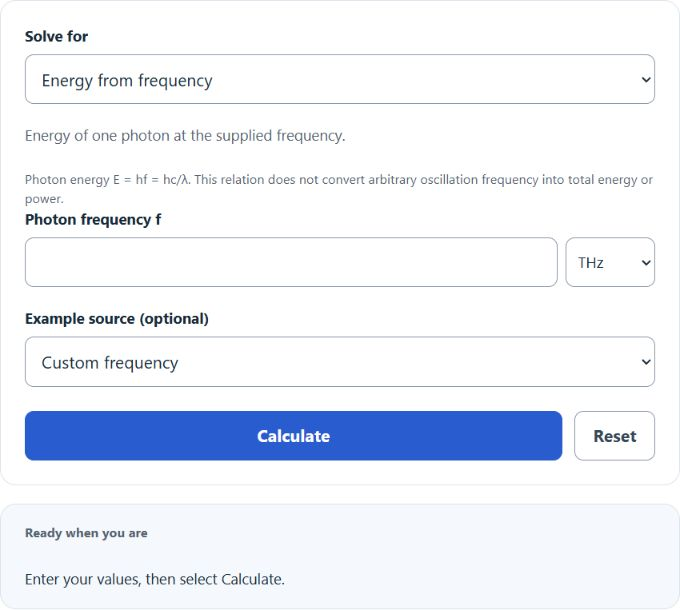
Calculate energy per photon from frequency or vacuum wavelength in J and eV, plus energy per mole of photons in kJ/mol.
- All Physics Calculators
- Waves, Optics, and Quantum Unit Converters
- Hz to RPM Calculator
- Volts To Hz Calculator
- mm To Hz Calculator
Hz To Joules Formula
The following formula is used to calculate the energy of a photon from its frequency.
Variables:
- E is the energy of the photon (joules)
- h is Planck’s constant (6.62607015 × 10^-34 m^2 kg / s)
- v is the frequency of the photon (Hz)
For one photon, E = hf. From vacuum wavelength, E = hc/λ, with c = 299792458 m/s. Wavelength inside a material must not be substituted directly into this vacuum relation. Use 1 eV = 1.602176634 × 10⁻¹⁹ J and Nₐ = 6.02214076 × 10²³ mol⁻¹ to obtain eV per photon and kJ per mole of photons. These constants are exact SI definitions; displayed results are rounded.
| Frequency | Energy (J) | Energy (eV) | Energy (kJ) | Energy (cal) |
|---|---|---|---|---|
| 1 Hz | 6.63e-34 | 4.14e-15 | 6.63e-37 | 1.58e-34 |
| 10 Hz | 6.63e-33 | 4.14e-14 | 6.63e-36 | 1.58e-33 |
| 50 Hz | 3.31e-32 | 2.07e-13 | 3.31e-35 | 7.92e-33 |
| 60 Hz | 3.98e-32 | 2.48e-13 | 3.98e-35 | 9.50e-33 |
| 100 Hz | 6.63e-32 | 4.14e-13 | 6.63e-35 | 1.58e-32 |
| 1 kHz | 6.63e-31 | 4.14e-12 | 6.63e-34 | 1.58e-31 |
| 10 kHz | 6.63e-30 | 4.14e-11 | 6.63e-33 | 1.58e-30 |
| 100 kHz | 6.63e-29 | 4.14e-10 | 6.63e-32 | 1.58e-29 |
| 1 MHz | 6.63e-28 | 4.14e-9 | 6.63e-31 | 1.58e-28 |
| 2.4 MHz | 1.59e-27 | 9.93e-9 | 1.59e-30 | 3.80e-28 |
| 10 MHz | 6.63e-27 | 4.14e-8 | 6.63e-30 | 1.58e-27 |
| 100 MHz | 6.63e-26 | 4.14e-7 | 6.63e-29 | 1.58e-26 |
| 144 MHz | 9.54e-26 | 5.96e-7 | 9.54e-29 | 2.28e-26 |
| 315 MHz | 2.09e-25 | 1.30e-6 | 2.09e-28 | 4.99e-26 |
| 433 MHz | 2.87e-25 | 1.79e-6 | 2.87e-28 | 6.86e-26 |
| 700 MHz | 4.64e-25 | 2.89e-6 | 4.64e-28 | 1.11e-25 |
| 900 MHz | 5.96e-25 | 3.72e-6 | 5.96e-28 | 1.43e-25 |
| 1 GHz | 6.63e-25 | 4.14e-6 | 6.63e-28 | 1.58e-25 |
| 2.4 GHz | 1.59e-24 | 9.93e-6 | 1.59e-27 | 3.80e-25 |
| 5 GHz | 3.31e-24 | 2.07e-5 | 3.31e-27 | 7.92e-25 |
| * Values shown in scientific notation; rounded to 3 significant figures. Uses h = 6.62607015×10⁻³⁴ J·s; 1 eV = 1.602176634×10⁻¹⁹ J; 1 thermochemical cal = 4.184 J. | ||||
What is Hz To Joules?
Hz (hertz) and joules are units of measurement in physics but they measure different things. Hz is a unit of frequency, measuring the number of cycles per second. On the other hand, the joule is a unit of energy, work, or amount of heat. There isn’t a direct conversion from Hz to joules because they measure different things. However, in the context of quantum mechanics, the energy of a photon can be calculated from its frequency (in Hz) using the Planck-Einstein relation, E=hv, where E is energy in joules, h is Planck’s constant, and v is frequency in Hz.
How to Calculate Hz To Joules?
The following steps outline how to calculate the energy of a photon (E) in joules using the formula E = h * v.
- First, determine the value of Planck’s constant (h). In this case, h = 6.62607015 × 10^-34 m^2 kg / s.
- Next, determine the frequency of the photon (v) in Hz.
- Next, use the formula E = h * v to calculate the energy of the photon (E) in joules.
- Finally, calculate the energy of the photon (E) using the values of h and v.
- After inserting the values and calculating the result, check your answer with the calculator above.
Example Problem:
Use the following variables as an example problem to test your knowledge.
Planck’s constant (h) = 6.62607015 × 10^-34 m^2 kg / s
Frequency of the photon (v) = 2.5 × 10^14 Hz. Its energy is E = hf ≈ 1.65652 × 10⁻¹⁹ J per photon.